THEBUSINESSBYTES
BUREAU
NEW
DELHI, FEBRUARY 5, 2026
Calling the proposed
agreement a “force multiplier for the global good,” Union Commerce and Industry
Minister Piyush Goyal on Thursday said the India–Gulf Cooperation Council Free
Trade Agreement would bring greater predictability, stability and momentum to
trade relations between the two sides, while boosting investments, jobs and
food and energy security across the region.
The Minister was
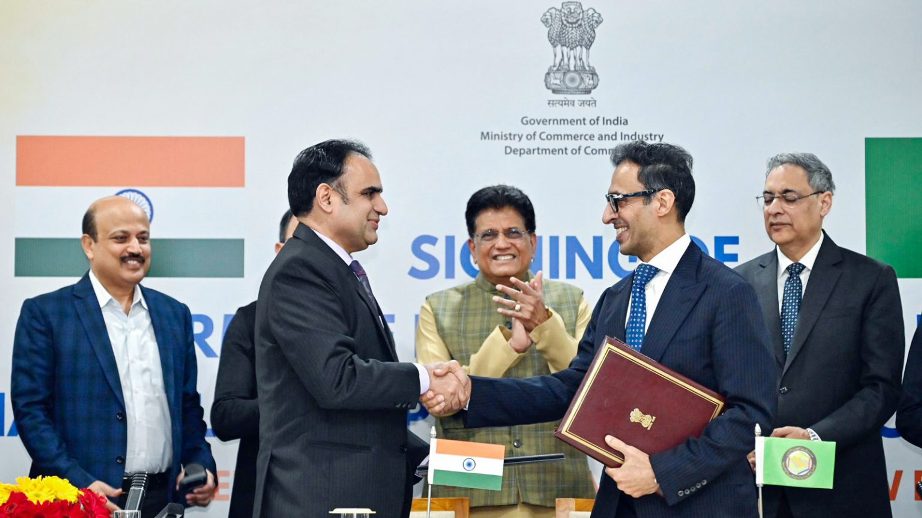
speaking at Vanijya Bhawan in New Delhi where India and the GCC formally signed
the Terms of Reference for negotiations on the proposed FTA, a key milestone
that officially launches discussions on a comprehensive trade pact. The ToR was
signed by Ajay Bhadoo, Additional Secretary and Chief Negotiator at the
Department of Commerce, and Dr. Raja Al Marzouqi, Chief Negotiator of the GCC
Secretariat General, in the presence of Minister of State for Commerce and
Industry Jitin Prasada and Commerce Secretary Rajesh Agrawal.
 The Terms of
Reference will define the scope, structure and modalities of the negotiations,
laying the foundation for an ambitious agreement aimed at facilitating the
seamless flow of goods and services between India and the six-nation GCC bloc.
Goyal expressed confidence that the pact would deepen economic integration,
attract fresh investments and create new employment opportunities while
reinforcing supply chains in an increasingly uncertain global economic
environment.
The Terms of
Reference will define the scope, structure and modalities of the negotiations,
laying the foundation for an ambitious agreement aimed at facilitating the
seamless flow of goods and services between India and the six-nation GCC bloc.
Goyal expressed confidence that the pact would deepen economic integration,
attract fresh investments and create new employment opportunities while
reinforcing supply chains in an increasingly uncertain global economic
environment.
Dr. Al Marzouqi
highlighted the centuries-old trade and cultural links between India and the
GCC, noting that the signing of the ToR marks the formal commencement of
negotiations towards a mutually beneficial agreement. He said the proposed FTA
would further strengthen economic cooperation at a time when global markets are
facing heightened volatility. During his visit, Al Marzouqi also held
discussions with the Commerce Secretary on advancing cooperation in areas of
shared interest.
According to the Ministry of Commerce and Industry, the proposed FTA is expected to unlock substantial trade potential with one of India’s most strategic economic partners. India’s trade with the GCC stood at USD 178.56 billion in FY 2024–25, accounting for 15.42 per cent of India’s total global trade, with bilateral trade growing at an average annual rate of 15.3 per cent over the past five years.
India exports engineering goods, rice, textiles, machinery and gems and jewellery to the GCC, while importing crude oil, LNG, petrochemicals and precious metals. With a combined GDP of USD 2.3 trillion and a population of 61.5 million, the GCC is also a major source of foreign direct investment, with cumulative inflows into India exceeding USD 31.14 billion. Nearly ten million Indians living in the region further cement the deep-rooted economic and people-to-people ties.