
THEBUSINESSBYTES BUREAU
NEW DELHI,
FEBRUARY 18, 2026
India and Germany have
reinforced their strategic partnership in telecommunications and digital
transformation, committing to a future-ready framework that prioritises secure
networks, emerging technologies and global standards. The renewed momentum
follows the signing of the Joint Declaration of Intent (JDI) last month, with
both countries now moving toward structured implementation through time-bound
collaboration and joint work plans.
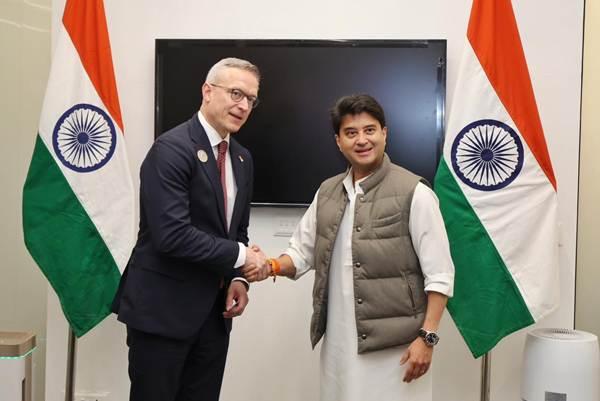
The bilateral meeting held at
Sanchar Bhawan in New Delhi between Union Communications Minister Jyotiraditya
M. Scindia and Germany’s Federal Minister for Digital Transformation and
Government Modernization Karsten Wildberger underscored the growing convergence
between the two economies on digital governance and advanced telecom systems.
The dialogue reflected mutual recognition of technological progress on both
sides and a shared view that the current phase offers significant scope for
deeper cooperation in next-generation connectivity.
 The JDI, signed during the
India–Germany Summit on 10 January 2026, provides a non-binding yet forward-looking
framework for policy dialogue, scientific exchange and technical collaboration.
Officials described it as a flexible platform designed to convert shared intent
into measurable outcomes through defined timelines, stakeholder mapping and periodic
review mechanisms.
The JDI, signed during the
India–Germany Summit on 10 January 2026, provides a non-binding yet forward-looking
framework for policy dialogue, scientific exchange and technical collaboration.
Officials described it as a flexible platform designed to convert shared intent
into measurable outcomes through defined timelines, stakeholder mapping and periodic
review mechanisms.
Scindia emphasised that the
partnership must move beyond broad statements and deliver tangible results. He
highlighted India’s scale in digital connectivity, noting that the country now
has more than 1.23 billion telecom subscribers and close to a billion internet
users, with 5G coverage reaching nearly all districts. Ultra-low data tariffs,
averaging about ten cents per gigabyte, have enabled mass adoption and created
what he termed a robust digital carriageway for global collaboration. He
pointed to India’s Digital Public Infrastructure as a key strength,
particularly the Unified Payments Interface, which processes roughly 250
billion transactions annually and is being adopted by multiple countries as an
interoperable digital payments model.
Germany, while acknowledging
India’s rapid digital expansion, brought to the table its strengths in secure
communications and quantum technologies. Wildberger shared Germany’s progress
in quantum encryption and demonstrated the feasibility of quantum communication
over a 35-kilometre link sustained for eleven consecutive days. He stressed
that early and active engagement with India would be crucial to unlocking the
full potential of 6G and building trusted, sovereign network architectures.
Both sides agreed to convene the
first high-level meeting under the JDI framework to finalise an initial
two-year work plan. The plan will identify priority domains, launch flagship
projects and ensure outcome-driven execution through regular virtual monitoring.
Key areas of cooperation will include 5G and 5G-Advanced deployment, early 6G
standardisation, network modernisation, AI at the edge, industry-grade network
slicing and resilient telecom supply chains.
Institutional collaboration
emerged as a central pillar of the partnership. Ongoing work between the Centre
for Development of Telematics (C-DOT) and Germany’s Fraunhofer Heinrich-Hertz
Institute was highlighted as a model for joint research in advanced telecom,
quantum communication, artificial intelligence and next-generation network
technologies. Both governments also see opportunities in Open RAN ecosystems,
indigenous technology development and open-source innovation networks linking
academia and industry.
The two countries underscored the importance of coordinated engagement in global forums such as the International Telecommunication Union to promote interoperable and secure telecom standards. India sought Germany’s support for its candidature for key ITU positions and for hosting the ITU Plenipotentiary Conference in 2030, signalling a broader diplomatic dimension to the technology partnership.
By aligning strengths in scale, affordability and digital public infrastructure with expertise in secure networks and quantum communication, India and Germany aim to build trusted telecom ecosystems and resilient digital supply chains. The renewed engagement under the JDI framework positions both nations to play a more influential role in shaping global standards for the 6G era and beyond.