THEBUSINESSBYTES BUREAU
NEW DELHI, FEBRUARY 9, 2026
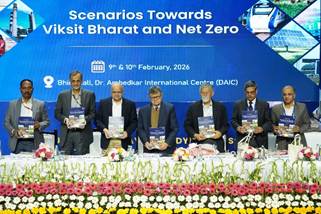
India will require a massive investment of USD 22.7 trillion to cut
greenhouse gas emissions and achieve its net zero target by 2070, according to
a new study released by NITI Aayog. The report, titled “Scenarios Towards
Viksit Bharat and Net Zero: An Overview”, outlines the scale of financial
mobilisation needed to support India’s low-carbon transition while sustaining
long-term economic growth.
On an annual basis, the cumulative requirement translates into average
investment flows of nearly USD 500 billion per year. This is significantly
higher than the actual annual investment of around USD 135 billion recorded in
2024, of which only USD 70–80 billion currently flows into clean energy sectors.
The study underlines the urgency of closing this gap to align India’s
development pathway with its climate commitments.
A substantial portion of the investment must be front-loaded. Of the
total requirement, nearly USD 8 trillion will be needed by 2050, including
close to USD 5 trillion in the power sector alone, reflecting the
capital-intensive nature of renewable energy and other low-carbon technologies.
The Net Zero Scenario mapped in the report represents an ambitious trajectory
consistent with India’s pledge to achieve net zero greenhouse gas emissions by
2070.
The study estimates that with coordinated domestic and external reforms,
India could realistically mobilise about USD 16.2 trillion by 2070.
Domestically, this would require deeper corporate bond markets, greater
financialisation of household savings, and expanded participation of
institutional investors in emerging green sectors, supported by high-quality
and diversified assets. Internationally, scaling up foreign direct investment
and foreign portfolio investment, backed by credible transition roadmaps and a
strong pipeline of bankable projects, will be crucial.
Despite these efforts, a financing gap of USD 6.53 trillion remains.
Given domestic constraints and the risk of crowding out private investment,
this gap is expected to be largely met through external sources, raising the
share of international capital to 42 per cent of total needs by 2070, up from
17 per cent in 2022–23. Concessional finance and grants will be especially
vital for supporting technologies that are not yet commercially viable.
Importantly, the report notes that while the net-zero transition demands
high investment, its impact on long-term GDP growth is limited. India’s GDP is
projected to remain resilient, reaching nearly USD 30 trillion by 2047, in line
with the vision of Viksit Bharat. The study emphasises that mobilising foreign
capital can ease pressure on domestic savings and help sustain growth during
the transition.
The analysis compares two pathways — the Current Policy Scenario, which
estimates total investments of USD 14.7 trillion based on existing policies,
and the Net Zero Scenario, which charts a more ambitious but achievable route
towards a developed, low-carbon India.