
THEBUSINESSBYTES
BUREAU
NEW DELHI, AUGUST 1, 2026
India and Rwanda have agreed to deepen
bilateral trade and investment ties by institutionalising a structured
mechanism for commercial engagement, identifying critical minerals, healthcare,
digital technologies and agriculture among the priority sectors for future
cooperation during the inaugural meeting of the India-Rwanda Joint Trade
Committee (JTC).
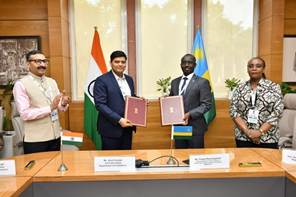
The first session of the India-Rwanda Joint
Trade Committee was held in New Delhi on July 30 and 31, marking the launch of
a permanent, structured and periodic apex mechanism to review bilateral
commerce, diversify the trade basket, expand two-way investments and address
logistical bottlenecks.
The Indian delegation was led by Joint
Secretary in the Department of Commerce Amit Kumar, while the Rwandan side was
headed by Director General for Asia, Pacific and Middle East Affairs in the
Ministry of Foreign Affairs and International Cooperation, Virgile Rwanyagatare.
In his inaugural address, Additional Secretary
in the Department of Commerce Yashvir Singh said the first JTC session
establishes an institutional framework to regularly review bilateral trade,
diversify commercial exchanges, encourage investments and resolve market access
and logistics-related issues.
Reviewing the current state of bilateral trade,
the two sides noted that India's major exports to Rwanda include drug
formulations and biologicals, two- and three-wheelers, industrial and
electrical machinery, oil meals, and iron and steel products. Rwanda's exports
to India comprise lead, spices, essential oils, copper, precious and
semi-precious stones, processed agricultural products and minerals.
Both countries committed to making concerted
efforts to diversify the bilateral trade basket, strengthen
business-to-business engagement and address market access concerns.
India highlighted significant export potential
in heavy engineering goods, pharmaceuticals and medical devices, refined
petroleum products, textiles, marine products, plastics, sports goods and toys,
gems and jewellery, and scientific instruments. During the discussions, it was
noted that India continues to be Rwanda's largest source of pharmaceutical
imports, accounting for around 24.5 per cent of the country's total
pharmaceutical imports.
Rwanda, on its part, identified chillies,
macadamia, French beans, avocados, essential oils, tea, coffee, horticultural
products, minerals and precious stones as priority exports to the Indian
market. The two sides also discussed harmonisation of standards and
capacity-building cooperation between the Bureau of Indian Standards and the
Rwanda Standards Board.
On the investment front, Rwanda said India was
its second-largest foreign investor as of 2025 and highlighted investment
opportunities across mining, agro-processing, affordable housing, information
and communication technology, manufacturing, healthcare, tourism and financial
services.
To facilitate greater investment flows, both
sides designated Invest India and the Rwanda Development Board as investment
focal points under the JTC framework and agreed to exchange calendars of trade
fairs, business forums and Buyer-Seller Meets.
Rwanda also underlined its strategic location
as a gateway to the East African Community (EAC), the Common Market for Eastern
and Southern Africa (COMESA) and the African Continental Free Trade Area
(AfCFTA), offering Indian companies access to a wider regional market.
The meeting identified critical minerals as a
major pillar of future cooperation, with India expressing interest in
strengthening collaboration in Rwanda's tin, tungsten and tantalum resources.
The two sides also discussed institutional cooperation between the Geological
Survey of India and the Rwanda Mines, Petroleum and Gas Board to support
collaboration in the sector.
In pharmaceuticals and healthcare, both
countries noted that the Memorandum of Understanding between their health
authorities is at an advanced stage of finalisation for signing. India also
proposed recognition of the Indian Pharmacopoeia and enhanced cooperation in
traditional medicine.
The discussions further covered cooperation in
agriculture and agro-processing, including market access for avocados, textiles
and leather, green mobility, digital public infrastructure, fintech,
cybersecurity and renewable energy.
India reiterated its commitment to supporting
Rwanda's capacity-building initiatives through the Indian Technical and
Economic Cooperation (ITEC) Programme, the Study in India initiative and the
Skill India Mission, including assistance for strengthening Rwanda's Technical
and Vocational Education and Training ecosystem.
The meeting concluded in a cordial and constructive atmosphere, with Commerce Secretary Rajesh Agrawal congratulating both delegations for advancing the bilateral commercial partnership and stressing the importance of close monitoring and time-bound implementation of the decisions recorded in the Agreed Minutes.
The Agreed Minutes were signed in New Delhi on July 31, and both sides agreed to convene the second session of the India-Rwanda Joint Trade Committee in Rwanda after one year on a mutually convenient date through diplomatic channels.