THEBUSINESSBYTES BUREAU
NEW DELHI, AUGUST 21, 2026
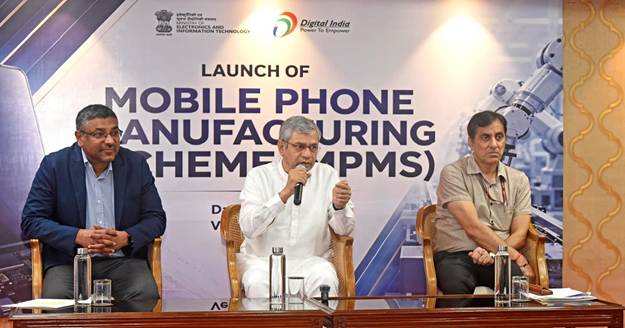
India on Friday unveiled a Rs 62,500-crore Mobile Phone
Manufacturing Scheme aimed at taking the country’s electronics manufacturing
ambitions to the next level by deepening domestic value addition, strengthening
supply chains and creating globally competitive Indian-owned mobile phone
brands, with Electronics and IT Minister Ashwini Vaishnaw saying the first
strong indigenous brand could emerge by mid-2027.
Notified by the Ministry of Electronics and Information
Technology (MeitY), the five-year Mobile Phone Manufacturing Scheme (MPMS) will
run from FY 2026-27 to FY 2030-31 and is expected to drive cumulative mobile
phone production of around Rs 39 lakh crore, significantly boost exports and
create nearly 60,000 direct jobs.
The scheme comes at a crucial juncture for India’s mobile
manufacturing industry, following the completion of the Production Linked
Incentive Scheme for Large Scale Electronics Manufacturing (PLI-LSEM) in March
2026. The government sees MPMS as the next major policy push to sustain the
sector’s rapid expansion while moving beyond assembly towards deeper
localisation, greater intellectual property ownership and higher economic value
capture within the country.
Vaishnaw said the scheme would provide a significant impetus
to Indian-owned mobile brands, intellectual property and product design,
stressing that a genuine Indian brand must have Indian ownership of its design,
IP and brand and possess the capability to compete with the best products in
its market segment.
The government, he said, would undertake a meticulous
evaluation to establish that the intellectual property is genuinely
Indian-owned, while non-fiscal and other support measures would be developed in
consultation with industry.
The MPMS has been structured around two target segments.
Target Segment 1 (TS1) will incentivise mobile phone manufacturing, while
Target Segment 2 (TS2) will specifically support Indian mobile phone brands.
For manufacturers under TS1, the scheme offers differentiated
incentives ranging from 2.25 per cent to 5 per cent. Under TS2, Indian brands
will receive a 5 per cent incentive, with an additional 3 per cent available
for Indian design and research and development. The scheme also provides
non-fiscal support for Indian brands.
An additional incentive of up to 1.5 per cent will be
available to applicants in both segments for domestic sourcing of key
components and sub-assemblies, provided such components are localised for at
least 25 per cent of the total mobile phone units manufactured in a financial
year.
The sourcing-linked incentive is designed to encourage deeper
domestic manufacturing rather than limiting localisation to final assembly,
reinforcing the government's push for greater self-reliance across the mobile
phone value chain.
Applicants under the scheme will include mobile phone
manufacturers and Electronics Manufacturing Services (EMS) providers registered
in India, with sales and incentives calculated on a brand-wise basis.
Applicants under TS2 may also be granted a one-year gestation period.
Eligibility for TS1 requires manufacturers, including EMS
companies, to have a minimum turnover of Rs 10,000 crore in FY 2025-26.
Existing brands will have to achieve an annual threshold of Rs 5,000 crore
every year over and above their FY 2025-26 sales.
A new brand will become eligible after achieving annual sales
of Rs 10,000 crore in India and will subsequently have to meet the year-on-year
threshold sales requirement of Rs 5,000 crore.
For TS2, applicants must have a minimum turnover of Rs 1,000
crore in FY 2025-26 and satisfy the government's definition of an Indian brand.
This includes registration or incorporation in India, ownership of intellectual
property and trademarks within India, management control with Indian citizens,
more than 51 per cent shareholding held by Indian citizens, and in-house design
and R&D capabilities in India.
The scheme marks a significant shift in India's electronics
manufacturing strategy, with policy support now increasingly focused not just
on making products in India but also on creating Indian-owned brands,
intellectual property and technology.
India's electronics manufacturing sector has expanded sharply
since FY 2014-15 under the government's Make in India initiative, with
electronics manufacturing growing seven-fold and exports rising eleven-fold.
Mobile phones have been the principal driver of this transformation, turning
India into a major manufacturing and export base while generating large-scale
employment opportunities.
Several manufacturing facilities now employ more than 5,000
people at a single location, while employment at some plants has reached
20,000, creating significant opportunities for young men and women, including
those from rural areas.
India is currently the world's second-largest mobile phone manufacturer
by volume, while 99.2 per cent of mobile phones used in the country are now
made in India. Smartphones also emerged as India's largest exported product
category in 2025, overtaking traditional leading export items such as diesel
fuel and cut diamonds.
The government expects the new scheme to build on the
foundation created by PLI-LSEM, which played a catalytic role in establishing
India as a global hub for mobile phone manufacturing and exports.
With a Rs 62,500-crore policy push now aimed at scale,
localisation and Indian ownership, the government is seeking to move India's
mobile phone industry into a new phase — from being a major manufacturing
destination to becoming a source of globally competitive brands, indigenous
technology and higher-value intellectual property.