
THEBUSINESSBYTES BUREAU
NEW DELHI, AUGUST 21, 2026
Prime Minister Narendra Modi on Friday said the world
increasingly sees India as a “bright spot for growth and hope”, asserting that
the country's political stability, policy continuity and next-generation
reforms are not only transforming the lives of its citizens but also
strengthening its ability to contribute to global stability.
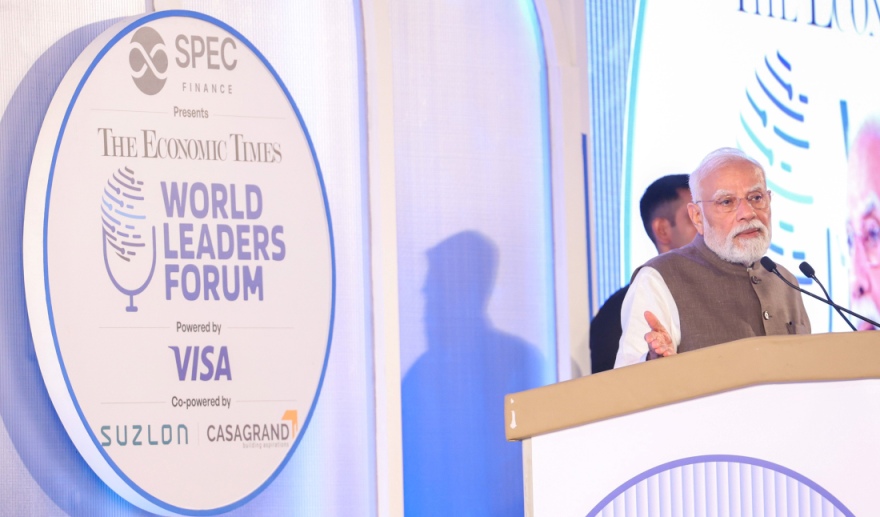
Addressing the Economic Times World Leaders Forum 2026 here,
Modi said the theme of the summit, “Shared Futures”, was particularly relevant
in an era marked by global economic fluctuations, resource weaponisation and
growing distrust, as the destinies of nations have become increasingly
interconnected.
“The sentiment of
Shared Future, alongside the responsibility associated with it, actively
provides a solution to many problems of this 21st-century world,” he said,
recalling that “One Earth, One Family, One Future” had been India's guiding
mantra during its G20 Presidency.
Modi said India's progress, including lifting 25 crore people
out of poverty while retaining its position as the world's fastest-growing
major economy, has reinforced global confidence in the country.
He said the government was pursuing reforms across seven key
sectors under the “Saptadhara” framework, including manufacturing, technology
and green economics, while simultaneously undertaking next-generation reforms
at the policy, governance and ease-of-living levels.
“Reforms are not a
compulsion for us; this is our ultimate commitment and our absolute
conviction,” Modi said.
Drawing a sharp contrast between the economic philosophy of
the past and the government's approach today, the prime minister referred to
what he described as “Production Linked Punishment” during the License Raj era,
when companies could be penalised or compelled to destroy goods if they
exceeded prescribed production limits.
He said such a mindset deliberately perpetuated scarcity and
deprivation, severely constraining employment generation and economic
opportunity.
In contrast, the Production Linked Incentive (PLI) scheme had
created a new economic ecosystem, he said, noting that it had attracted Rs 2.5
lakh crore in actual investments, generated Rs 22 lakh crore in production and
sales, driven Rs 15 lakh crore in exports and created more than 14 lakh jobs.
“Where the punishment
model of the previous License Raj increased unemployment, today our incentive
model is actively creating lakhs of new jobs,” Modi said.
Attributing India's rapid development to political stability
and policy continuity, Modi said the government was fundamentally changing the
relationship between the state and citizens by moving away from a “prohibited
unless permitted” approach towards “permitted unless prohibited”.
“The fundamental basis
of the relationship between the government and the citizens must be deep trust,
not suspicion,” he said.
He cited the Jan Vishwas Bill, which decriminalised numerous
minor procedural offences and replaced imprisonment with economic penalties in
several cases, as part of the effort to reduce the compliance burden.
The government, he said, had removed more than 40,000
compliances and repealed over 1,500 obsolete laws, substantially reducing the
regulatory burden on businesses.
Referring to the passage of the Bankers' Books Evidence Bill
during the Monsoon session, Modi said replacing a 19th-century British-era law
with modern legislation recognising digital banking records would reduce legal
complications, enhance transparency and improve the ease of doing business.
“This will actively
reduce legal complications, massive transparency in the system will increase,
and the Ease of Doing Business will significantly rise,” he said.
The prime minister also underlined the human-centric
dimension of governance, citing the transformation of the Indian Railways as an
example.
He said electronic interlocking had been installed at more
than 6,500 stations and 10,000 level crossings, while mission-mode efforts had
eliminated roughly 9,000 unmanned crossings, contributing to a reduction of
train accidents by up to 90 per cent compared to pre-2014 levels.
“Systems must be made
in such a way in which there is absolute sensitivity towards every single human
life and their precious time,” he said.
Railway hygiene, too, had undergone a major transformation,
Modi said, pointing out that more than 3.6 lakh bio-toilets had been installed
in trains since 2014, effectively eliminating the problem of human waste being
discharged on tracks.
“This massive change
is not just about cleaning; it is fundamentally about the dignity of the
passengers, hygiene, and modern governance,” he said.
Citing punctuality as another measure of governance quality,
Modi said the Delhi-Meerut Namo Bharat Rapid Rail and Delhi Metro had achieved
an on-time performance of 99.9 per cent, comparable with transport systems in
cities such as New York, Hong Kong and Paris.
“This is not just the
story of a Metro and Namo Rapid Rail running on time; this is the proud identity
of an India rapidly changing with time,” he said.
Turning to policy reforms, Modi said India was designing
proactive, pro-people and pro-growth policies based on the country's actual
requirements rather than forcing citizens and businesses to operate within
outdated restrictions.
He recalled that, at one point, even mapping India by Indians
had been restricted, and said the deregulation of geospatial data had
subsequently opened the door to rapid growth in startups and new businesses.
“Policies must be
designed strictly according to the actual needs of the country and the people
of the country,” he said.
The prime minister also pointed to the growth of India's
drone industry in agriculture, defence and content creation as an example of
the opportunities unlocked by deregulation.
“We fully freed
drone-flying from shackles, and today India's drone industry is taking an
unprecedented flight,” he said.
Modi said the government's approach to border infrastructure
had also undergone a fundamental change, with the country's frontiers
increasingly viewed as a source of strategic strength rather than
vulnerability.
The Border Roads Organisation, he said, dedicated 250
infrastructure projects to the nation in 2024 and 2025 alone.
“When the defensive
thinking fundamentally changed, the entire picture of border infrastructure
actively changed as well,” he said.
Highlighting reforms in strategically sensitive sectors, Modi
referred to the Shanti Bill, which opened the nuclear energy sector to private
participation, and the restructuring of more than 40 ordnance factories into
seven modern corporate entities.
He said such measures had strengthened India's self-reliance
and contributed to a 55-fold increase in defence exports compared with 2014.
“Today India is
actively becoming self-reliant for its defence needs too, and our defence
export has massively increased,” he said.
The prime minister said the impact of reforms was
increasingly visible in the everyday lives of ordinary citizens, with digital
services such as online grocery purchases, QR-code payments and instant
peer-to-peer money transfers becoming routine.
“These incredible
things are remarkable, but they are now just a highly efficient part of the
life of the common man of India,” he said.
He said India's digital transformation had been powered by
some of the world's cheapest data, rapid 5G deployment and the integration of
Aadhaar with mobile and banking services, enabling seamless e-KYC and digital
authentication.
“Today if you have to
open a bank account, the government has literally brought the bank itself
directly to you,” Modi said.
He also highlighted the e-Sanjeevani platform, which has
facilitated nearly 50 crore tele-consultations and brought medical advice to
people who previously had to travel long distances to access doctors.
“Today the doctor is
highly accessible and available right at their home, directly on their screen,”
he said.
The modernisation of India's travel infrastructure was
another example cited by the prime minister, with Digi Yatra at airports and
FASTag on highways helping passengers and motorists save time through seamless,
largely non-stop movement.
“Time is being
massively saved, life is becoming significantly easier, and crores of people
are able to securely focus on their progress,” he said.
Modi said genuine transformation required governments to take
decisions based on long-term national interests rather than short-term
electoral considerations.
“Decisions that
fundamentally change the country are those whose impact is clearly seen on the
ground, taken keeping both the present and the future firmly in mind,” he said.
As an illustration, he cited the PM-KUSUM and PM Surya Ghar
Muft Bijli Yojana, saying the government had chosen sustainable empowerment
through rooftop solar rather than merely announcing free electricity.
More than 50 lakh families, he said, had benefited from rooftop
solar installations, enabling households to reduce electricity bills and, in
several cases, earn income by selling surplus power to the grid.
“We are decisively
determined to have a sun on every roof of every house to provide massive,
sustainable energy,” Modi said.
He added that the benefits of the Surya Ghar scheme would
remain with families for years, irrespective of electoral cycles.
“Whether there are
elections or not, this Surya Ghar and its light will permanently remain to
benefit the families of the country for years,” he said.
Concluding his address, Modi said the government's “Reform
Express” would continue to accelerate reforms aimed at expanding the Ease of
Living and Ease of Doing Business for the youth, women, farmers and the middle
class, with the larger objective of building a Viksit Bharat.
He expressed confidence that India's domestic strength and stability would have a wider global impact, providing greater certainty and security to the international community.
“The more stable India is and the more secure its future, the more the power to give the world a sense of security will be generated from right here,” Modi said.