THEBUSINESSBYTES
BUREAU
NEW
DELHI, MAY 21, 2026
India’s growth
trajectory will remain unmatched globally for at least the next quarter
century, Union Minister of Commerce and Industry Piyush Goyal said on Thursday,
underscoring the country’s rising economic strength, expanding global
partnerships and deep structural reforms that are positioning it as a long-term
growth engine of the world economy.
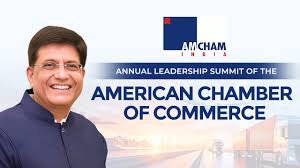
Addressing the Annual
Leadership Summit of the American Chamber of Commerce in New Delhi, the
Minister said India and the United States are evolving as natural partners with
strong complementarities across high-technology sectors including innovation,
precision defence manufacturing, digital data centres, quantum computing and
medical devices. He emphasised that the relationship is anchored in mutual
trust, shared economic interests and a growing convergence of strategic priorities
between the two largest democracies.
Highlighting the
scale of recent engagements, Goyal noted that American industry commitments in
India over the past six months are estimated to exceed 60 billion dollars, with
major investments in digital infrastructure, including large-scale data centre
projects by global technology giants such as Amazon and Google. He said India
today offers a unique combination of market scale, skilled talent and policy
stability, making it one of the most attractive destinations for global
capital.
The Minister observed
that the United States is actively seeking reliable and trusted partners, and
India has consistently demonstrated strong respect for intellectual property
rights while ensuring timely, high-quality execution. With a population of 1.4
billion aspirational citizens, rising incomes and a rapidly expanding middle
class, India provides unmatched demand aggregation that strengthens global
innovation cycles.
Describing the
India–US relationship as one of minimal competition and maximum
complementarity, Goyal said the partnership becomes especially powerful when
trust is combined with economic synergy, enabling the creation of resilient
global supply chains. He said this alignment will define global economic architecture
in the decades ahead.
Goyal also outlined
the Government’s push for structured industrial expansion through the Bhavya
scheme, under which 100 new industrial parks are being developed across the
country. These parks are designed as integrated ecosystems combining industrial
infrastructure with housing, recreation and social facilities to ensure
holistic development and improved quality of life for workers.
He added that
improved infrastructure, lower logistics costs and a series of free trade
agreements are creating a strong investment cycle that is driving manufacturing
growth and export competitiveness. “India will continue to remain the world’s
fastest growing economy for at least the next 25 years,” he reiterated.
Focusing on small and
medium enterprises, the Minister said coordinated government efforts through
the MSME Ministry and DPIIT are aimed at upgrading technology capabilities and
improving skill development. He said the proposed Export Promotion Mission will
help MSMEs obtain globally recognised certifications, enabling their
integration into international supply chains.
To strengthen quality
infrastructure, agencies such as the Export Inspection Council, Bureau of
Indian Standards and FSSAI are working together to build world-class testing
systems across the country. Shri Goyal also emphasised India’s growing
transformation from a manufacturing assembly hub to a centre of design,
innovation and intellectual property creation.
Referring to
macroeconomic resilience, he noted that India’s growth forecast has been
revised upward from 6.4 per cent to 6.5 per cent despite global disruptions
including geopolitical tensions and regional conflicts. He attributed this
performance to strong governance, policy consistency and global confidence in
India as a stable investment destination.
The Minister
highlighted that global companies are increasingly viewing India as a preferred
hub for Global Capability Centres, with over 2,117 GCCs employing around 2.35
million people and generating nearly 98 billion dollars in revenue. He said
this reflects India’s emergence as a core driver of global services and
innovation networks.
Goyal further pointed
to India’s rapid digital transformation, driven by initiatives under the
leadership of Narendra Modi such as Startup India, Make in India and Digital
India. He noted that digital adoption is expanding beyond major cities into
tier-two and tier-three regions, powered by strong connectivity and affordable
data access.
On infrastructure, he
underscored the transformative impact of PM Gati Shakti, which integrates
nearly 1,800 data layers to improve planning and execution of logistics
networks, highways, railways and ports. The initiative, he said, has
significantly reduced inefficiencies and improved coordination across
infrastructure projects.
Highlighting the
renewable energy sector, Goyal said India’s solar capacity has expanded from
less than 2 gigawatts to over 150 gigawatts in just over a decade, making the
country a global leader in clean energy expansion. He added that reliable
24-hour clean power at competitive rates is making India a preferred
destination for data centres and advanced manufacturing.
The Minister also
stressed that India is moving decisively toward its long-term vision of
becoming a developed nation by 2047 under the Viksit Bharat framework. He said
the country aims to achieve a per capita income of 20,000 dollars while
expanding infrastructure, improving ease of living and strengthening economic competitiveness.
Calling for deeper
industry collaboration, Goyal urged large companies to support MSMEs through
faster payment cycles, suggesting that payments could be cleared within seven
days after goods approval to strengthen liquidity and investment capacity
across smaller enterprises.
He concluded by
stating that India’s economic transformation is not only structural but also
deeply aspirational, driven by innovation, youth engagement and global
integration. Those who invest in India’s growth story today, he said, will
benefit from one of the most sustained and dynamic economic expansions in the
world over the coming decades.