
THEBUSINESSBYTES
BUREAU
NEW
DELHI, MAY 22, 2026
India’s expanding
trade partnership with Europe requires a significantly stronger standards and
compliance ecosystem to fully harness emerging opportunities under free trade
agreements, senior industry leaders and policymakers emphasized at a high-level
conference organised in the national capital.
The observation set
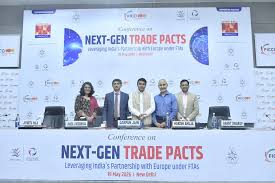
the tone for a conference on “Next-Gen Trade Pacts: Leveraging India’s
Partnership with Europe under FTAs,” jointly organised by the Centre for Trade
and Investment Law (CTIL) of the Indian Institute of Foreign Trade in
collaboration with the Federation of Indian Chambers of Commerce & Industry
at FICCI Federation House, bringing together policymakers, trade experts, legal
practitioners, industry leaders and academics to deliberate on India’s evolving
engagement with Europe under new-generation trade agreements.
In his inaugural
address, Secretary General of Federation of Indian Chambers of Commerce &
Industry, Anant Swarup, welcomed participants and underscored the growing
strategic importance of India’s trade ties with Europe. Chair of the FICCI
Foreign Trade and Trade Facilitation Committee and Managing Director of Shahi
Exports Pvt. Ltd., Harish Ahuja, stressed the urgent need to strengthen
standards infrastructure, testing and certification systems, digital compliance
mechanisms, and institutional frameworks to effectively overcome non-tariff
barriers in European markets.
Setting the broader
context, Professor and Head of the Centre for Trade and Investment Law (CTIL)
and India Chair of the WTO Chairs Programme, Dr. James J. Nedumpara,
highlighted that next-generation trade agreements go far beyond tariff reductions
and increasingly shape the architecture of global trade through deeper
regulatory and institutional commitments.
Delivering the
keynote address, Additional Secretary in the Department of Commerce and
Industry, Government of India, Darpan Jain, described the conclusion of
India–EU Free Trade Agreement negotiations as a landmark in India’s economic
diplomacy. He noted that the agreement would provide preferential tariff access
for 99.5 per cent of Indian exports, strengthen India’s integration into European
value chains, expand market access across goods and services, and significantly
reduce non-tariff barriers.
Concluding the
inaugural session, Director General of Federation of Indian Chambers of
Commerce & Industry, Jyoti Vij, emphasized that the success of trade
agreements ultimately depends on industry readiness, awareness building, and
institutional capacity development to ensure effective utilisation.
The conference
featured thematic sessions covering India’s trade opportunities with Europe,
regulatory compliance and standards frameworks, services trade and digital
economy engagement, and the implications of the Carbon Border Adjustment
Mechanism (CBAM) for Indian industry. Discussions focused on enhancing export
competitiveness, addressing sanitary and phytosanitary measures and technical
barriers to trade, expanding India’s services footprint in European markets,
and adapting to emerging carbon-linked trade regulations.
Experts from CTIL
also presented detailed analyses on leveraging India’s FTAs with the UK, EU and
EFTA, navigating SPS and TBT barriers, strengthening services and digital trade
engagement, and understanding EU carbon measures and trade remedies frameworks.
The conference
concluded with a vote of thanks delivered by Assistant Secretary General of
Federation of Indian Chambers of Commerce & Industry, Pragati Srivastava,
marking the end of a comprehensive dialogue on strengthening India–Europe trade
engagement under evolving global trade dynamics.