
THEBUSINESSBYTES
BUREAU
NEW
DELHI, JUNE 14,
2026
India’s space economy
is poised for a transformative leap, with its valuation expected to grow from
the current USD 8-9 billion to nearly USD 40-45 billion over the next decade,
powered by policy reforms, private sector participation and a thriving startup
ecosystem, Union Minister of State for Science & Technology, Earth Sciences
and Department of Space, Dr Jitendra Singh, said on Sunday. Highlighting the
rapid evolution of the country’s space sector, he noted that more than 400
space startups are now driving innovation and shaping the next phase of India’s
journey as a leading global space power.
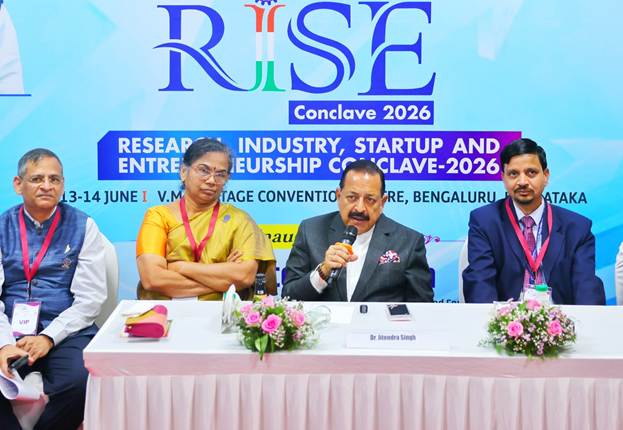
Addressing a press
conference during the RISE Conclave 2026, Dr Jitendra Singh said the remarkable
transformation of India’s space sector reflects a broader national shift in
which science and technology have moved beyond laboratories to become an
integral part of public consciousness. He said one of the greatest achievements
of recent years has been the growing connection between science and society,
with ordinary citizens increasingly viewing themselves as stakeholders in
India’s scientific progress.
“The biggest achievement is that the common
citizen today feels connected to India’s scientific progress and sees a stake
in it,” Dr Jitendra Singh said.
The Minister
attributed the growing prominence of science and technology in public discourse
to the vision of Prime Minister Narendra Modi, who has consistently brought
science-led initiatives into the national mainstream through his Independence
Day addresses. He said flagship programmes such as Swachh Bharat, Digital
India, Digital Health, Deep Ocean Mission and Gaganyaan have helped place
innovation and technology at the heart of India’s development agenda.
Dr Jitendra Singh
observed that the increasing presence of mainstream media at science and
technology events reflects the rising public interest in scientific
achievements. He noted that landmark missions such as Chandrayaan-3 have
transformed space science into a subject of national fascination, generating
unprecedented awareness and engagement among citizens across the country.
Highlighting India’s
growing strength in frontier sectors such as space, atomic energy and advanced
technologies, the Minister said these achievements have significantly enhanced
the country’s global standing. The confidence generated by such successes, he
added, has strengthened the credibility of indigenous technologies and
reinforced India’s reputation as a trusted technology partner on the world
stage.
He said recent breakthroughs
have demonstrated India’s ability to excel in emerging domains where advanced
technologies increasingly shape strategic and economic outcomes. The growing
acceptance of Indian technologies and products in international markets, he
added, reflects the strength and maturity of the country’s scientific and
technological capabilities.
Referring to reforms
in the space sector, Dr Jitendra Singh said India had only a handful of space
startups a few years ago, but today boasts a vibrant ecosystem of more than 400
startups actively contributing to innovation and growth. He said the rapid
expansion of this ecosystem highlights the immense potential of India’s space
economy and the opportunities being created for entrepreneurs and investors.
The Minister said
India’s achievements through missions such as Chandrayaan-3 and the upcoming
Gaganyaan programme have firmly established the country among the world’s
leading space-faring nations. He noted that India has consistently demonstrated
its ability to execute complex missions with innovation, efficiency and
cost-effectiveness.
Dr Jitendra Singh
also underscored India’s unique strength in leveraging space technology for
governance and development. He said space-based applications have been
integrated into infrastructure planning, project monitoring and public service
delivery on a scale rarely witnessed elsewhere. Initiatives such as PM Gati
Shakti, urban development programmes and drone-enabled monitoring systems are
helping improve planning, implementation and oversight of development projects
while enhancing transparency and efficiency.
Emphasising the
importance of continuous learning in scientific advancement, the Minister said
every major space programme evolves through experience and innovation. Challenges
encountered during missions contribute to stronger systems, better preparedness
and more robust future missions. He stressed that temporary setbacks should be
viewed in the broader context of technological progress and noted that India’s
overall track record compares favourably with leading space powers, citing the
successful first-attempt achievements of the Chandrayaan and Mars Orbiter
missions.
Dr Jitendra Singh
revealed that the analysis of the recent PSLV mission anomaly has been
completed and the underlying causes identified. Corrective measures have
already been initiated and future missions will benefit from the lessons
learned, further strengthening India’s space programme.
He said India’s scientific achievements are increasingly contributing to economic growth, technological self-reliance and global competitiveness. The expanding participation of startups, industry and research institutions is creating a robust innovation ecosystem capable of advancing the vision of Viksit Bharat 2047.
The Minister was speaking at the RISE Conclave 2026, organised under the theme “Innovation & Entrepreneurship Driven Growth for Viksit Bharat 2047.” The conclave brought together researchers, startups, industry leaders, investors and policymakers to deepen collaboration across the innovation ecosystem and accelerate the translation of scientific research into societal and economic outcomes. More than 125 startups and technology innovators showcased cutting-edge solutions in aerospace technologies, artificial intelligence, deep-tech and agri-food innovation, while discussions focused on strengthening research-industry partnerships and driving innovation-led growth across the country.