
THEBUSINESSBYTES
BUREAU
BHUBANESWAR, OCTOBER 10, 2026
Industry must take the lead in skill
development, research and innovation to accelerate economic growth and create
employment opportunities for young people, Odisha Skill Development and
Technical Education Department Commissioner-cum-Secretary Bhupendra Singh
Poonia said on Saturday.
Addressing the valedictory session of the
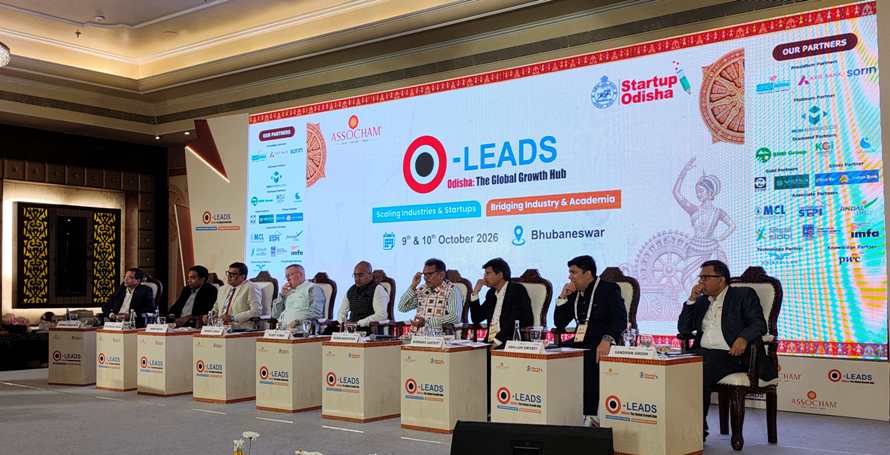
two-day O-LEAD 2026 conclave, organised by the Associated Chambers of Commerce
and Industry of India (ASSOCHAM) here, Poonia stressed the need to strengthen
industry-led skill development, promote research commercialisation and build
closer partnerships between industry, academia and startups to position Odisha
as a global growth hub.
The conclave, themed “Odisha: The Global
Growth Hub”, concluded with a strong emphasis on artificial intelligence
(AI)-driven education, future-ready skills, collaborative research and
responsible technology adoption to expand economic and social opportunities.
Speaking at the session held at Hotel Swosti
Premium, Poonia said students must acquire relevant skills at an early stage to
prepare for emerging employment opportunities and build productive careers
without being forced to migrate to metropolitan cities for low-paying jobs.
“Industry
must take the lead in skill development and institutional management. Research
and development should move beyond academic laboratories, with industry playing
a central role in innovation and commercialisation,” he said, citing the
semiconductor sector as an example of the need to integrate research with
industrial applications.
He called for a shift from limited
industry-institution partnerships towards a model in which industry assumes
greater ownership of implementation, research outcomes and innovation-led
economic growth.
Dr Andrew Fleming, British Deputy High
Commissioner for East and North East India, highlighted the opportunities for
India-UK collaboration under the India-UK Shared Vision 2035, particularly in education,
skills development and artificial intelligence.
On his 20th visit to Bhubaneswar, Fleming said
India's vast talent pool and scale could complement the UK's strengths in
higher education, research and AI development.
Emphasising the importance of international
cooperation, he said no single country could independently address all the
challenges and opportunities arising from AI. Partnerships should therefore
focus on co-creating solutions rather than merely exchanging knowledge, he
said.
Joint AI research, curriculum development,
teacher training and collaborative governance could connect educational
institutions and learners in Odisha with global knowledge networks while
ensuring that technological advancements address local needs, Fleming added.
Rajya Sabha MP Sujeet Kumar said artificial
intelligence could significantly expand access to education and improve
learning outcomes, provided its adoption was supported by appropriate policies,
infrastructure and capacity building.
Referring to the India AI Impact Summit and
the New Delhi Declaration, he underscored the importance of responsible AI,
trust-based governance and strengthening the country's technological
capabilities.
With a substantial proportion of India's
population comprising young people, AI could play a transformative role in
educating children and youth, he said, adding that the India AI Mission could
help promote innovation across sectors such as education, healthcare,
agriculture and disaster management.
Lok Sabha MP Rabinarayan Behera highlighted
the implications of AI for employment and called for greater attention to
India's linguistic diversity while developing and deploying emerging
technologies.
He said AI should be inclusive and accessible
to all sections of society, including senior citizens, women, children and
persons with disabilities. Integrating AI into student curricula was also
essential to prepare the next generation for a rapidly evolving technological
environment, he added.
In her vote of thanks, ASSOCHAM Senior
Director and Head of States and UTs Parminder Jeet Kaur stressed the need to
translate the conclave's deliberations into tangible outcomes through product
innovation, stronger industry ownership and closer collaboration among
industry, academic institutions and startups.
She advocated building a dense and
interconnected innovation ecosystem in which industry identifies real-world
challenges and invites academic institutions and startups to develop solutions
through a process of “reverse pitching”.
Under this approach, startups would be treated
as innovation partners rather than merely vendors, enabling businesses and
institutions to address skill gaps and develop solutions responsive to
community and industry requirements, she said.
The discussions at O-LEAD 2026 reinforced the
need to align education with Industry 4.0, scale industries and startups,
promote industry-academia collaboration and accelerate the transition of
research from laboratories to commercially viable products and services.
The two-day conclave brought together
policymakers, industry leaders, technology experts, entrepreneurs, universities
and research institutions to explore strategies for strengthening Odisha's
innovation and entrepreneurship ecosystem.
Among those present were ASSOCHAM Odisha State Development Council Chairman and MGM Group CMD Pankaj Lochan Mohanty; Odisha State Education Council Chairman and Kalinga Group of Institutions Chairman Alexzandar Das; ASSOCHAM Odisha State Development Council Co-Chair and SNM Group Managing Director Prabodh Mohanty; former Odisha chief secretary and adviser to the ASSOCHAM Odisha State Development Council Asit Tripathy; and Odisha State Startup Council Chairman and ZTOP IoT Solutions founder Abanis Nayak.
The conclave concluded with a shared emphasis on equipping young people with future-ready skills, encouraging responsible AI adoption, strengthening international cooperation and ensuring that innovation translates into sustainable economic growth and wider social benefits for Odisha.