
Is
Odisha’s rooftop solar revolution leaving consumers in the dark?
As Odisha accelerates towards its target of three lakh rooftop solar
installations by March 2027, the real challenge lies in ensuring consumer
protection through quality installations, accountability and reliable
post-installation support, writes Priyabrat Biswal
Odisha today stands proudly among India’s top performers under the PM
Surya Ghar: Muft Bijli Yojana. The state has won national accolades,
registered more than 2.49 lakh consumer applications, and completed over 1.04
lakh rooftop solar installations. Nationally, the scheme has crossed 71.64 lakh
applications and over 34.10 lakh installations. On paper, the numbers tell a
remarkable story of clean energy adoption and citizen participation.
Yet beneath the impressive statistics lies a growing chorus of consumer
complaints, unanswered questions and concerns that authorities appear reluctant
to confront.
The uncomfortable reality is that while Odisha has emerged as a solar
success story, thousands of consumers are still waiting for that success to
reach their rooftops. The gap between applications and actual installations
remains significant, raising questions about implementation efficiency,
accountability and transparency.
A closer look at the figures reveals the challenge. Out of 2,49,110
applications received in Odisha as on June 8, 2026, only 1,04,344 installations
have been completed. In simple terms, fewer than half of the applicants have
seen their solar systems commissioned. This means that more than 1.44 lakh
consumers who expressed interest in the scheme are still awaiting
installations.
Even among Odisha's four distribution companies, performance varies
sharply. TP Western Odisha Distribution Limited (TPWODL) has emerged as the
best performer with an application-to-installation conversion rate of slightly
above 50 per cent. TP North Odisha Distribution Limited (TPNODL) follows at
44.97 per cent, while TP Central Odisha Distribution Limited (TPCODL) stands at
41.34 per cent. TP Southern Odisha Distribution Limited (TPSODL) trails
considerably at 27.27 per cent.
These disparities raise a fundamental question: if consumer demand exists across the state, why are installations
progressing so unevenly? Is the problem a shortage of vendors? Is it inadequate
material availability? Or does it reflect administrative inefficiencies and
poor monitoring by implementing agencies?
The district-wise data paints an equally troubling picture. While
Khordha has recorded 10,557 installations, Kandhamal has managed only 420.
Malkangiri has achieved 497 installations and Deogarh 540. The difference
between Odisha's best-performing and worst-performing districts is staggering.
Such disparities suggest that the benefits of the solar revolution are
not reaching all sections of society equally. Urban and economically developed
districts continue to dominate adoption, while tribal and geographically remote
regions remain largely excluded from the programme's gains.
However, the concerns extend far beyond mere numbers.
As installation volumes have increased, so too have allegations regarding
workmanship and quality. Several consumers have reported delays, incomplete
civil works, poor wiring practices and inadequate post-installation support.
Industry observers argue that the race to achieve ambitious targets may be
overshadowing the equally important objective of ensuring quality.
One of the most worrying issues relates to accountability. Consumers
often find themselves trapped between vendors, distribution companies and
government agencies whenever problems arise. Once subsidy payments are
processed, many consumers claim they struggle to obtain corrective support for
defects or incomplete work.
A key question remains unanswered: who
is ultimately responsible when an installation fails to meet acceptable
standards?
The concern is particularly important because rooftop solar systems are
expected to function safely and efficiently for 20 to 25 years. Poor
installation practices can create serious long-term risks, including electrical
faults, equipment failure, structural damage and even fire hazards.
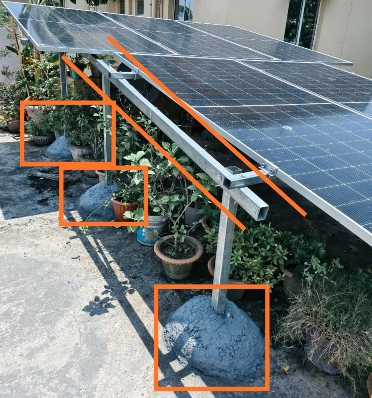
An alarming example emerged during this investigation when an aggrieved
consumer described an installation that allegedly took more than a month to
become operational despite assurances that it would be completed within two
days. According to the consumer, portions of the promised civil work remained
unfinished and repeated requests for rectification produced little response.
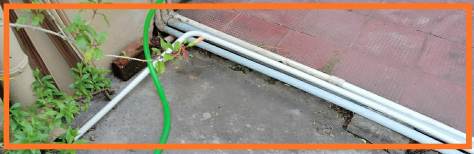
 Even more concerning was the allegation that the vendor laid the direct
current (DC) cable carrying electricity from the solar panels to the inverter
directly across the rooftop floor. Electrical experts warn that DC current can
be particularly dangerous because it does not naturally pass through zero
voltage like alternating current (AC), making faults potentially more hazardous
if not installed according to prescribed safety standards.
Even more concerning was the allegation that the vendor laid the direct
current (DC) cable carrying electricity from the solar panels to the inverter
directly across the rooftop floor. Electrical experts warn that DC current can
be particularly dangerous because it does not naturally pass through zero
voltage like alternating current (AC), making faults potentially more hazardous
if not installed according to prescribed safety standards.
The consumer also raised a more fundamental concern regarding the role
of the inspecting authorities. According to him, if critical safety norms and
installation standards were visibly violated, how did the concerned engineer
certify the system for commissioning? The consumer questioned whether a proper
site inspection was actually conducted before approval was granted. Industry
experts note that commissioning certification is intended to serve as an
important quality-control checkpoint, ensuring that installations comply with
prescribed technical and safety standards.
If deficiencies such as exposed or improperly laid DC cables, incomplete civil
works, or other safety lapses were present at the time of inspection, it raises
uncomfortable questions about the rigor of the verification process. The
episode has renewed calls for greater accountability and transparency in
inspections, with consumers demanding to know whether certification procedures
are being followed in both letter and spirit.
The consumer further alleged that complaints submitted to authorities
failed to trigger any meaningful intervention.
While a single case cannot be considered representative of an entire
programme, it nevertheless highlights weaknesses in grievance redressal systems
that are expected to protect consumers.
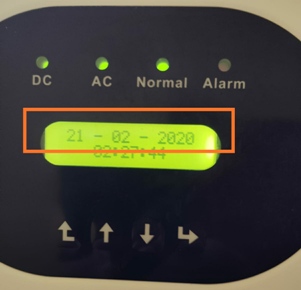 Another issue that has quietly surfaced concerns the age of equipment
being supplied. Reports indicate that
some vendors are installing solar inverters manufactured as far back as
February 2020.
Another issue that has quietly surfaced concerns the age of equipment
being supplied. Reports indicate that
some vendors are installing solar inverters manufactured as far back as
February 2020.
Vendors argue that warehouse storage does not affect inverter
performance. However, several technical experts disagree. They point out that
electronic components such as electrolytic capacitors naturally degrade over
time, even when equipment remains unused. As a result, consumers are justified
in questioning whether a six-year-old inverter can reasonably be expected to
deliver the same reliability and lifespan as a newly manufactured unit.
Surprisingly, there appears to be
little publicly available guidance regarding permissible inventory age, quality
certification protocols or mandatory disclosure requirements for such equipment.
The lack of transparency becomes even more troubling when viewed
alongside the silence of key stakeholders.
On May 22, 2026, a detailed set of questions was sent to Tata Power's
Corporate Communication Department seeking clarification on installation
standards, quality assurance mechanisms, pricing regulations, inspection
procedures, warranty responsibilities and billing methodologies under the
rooftop solar programme.
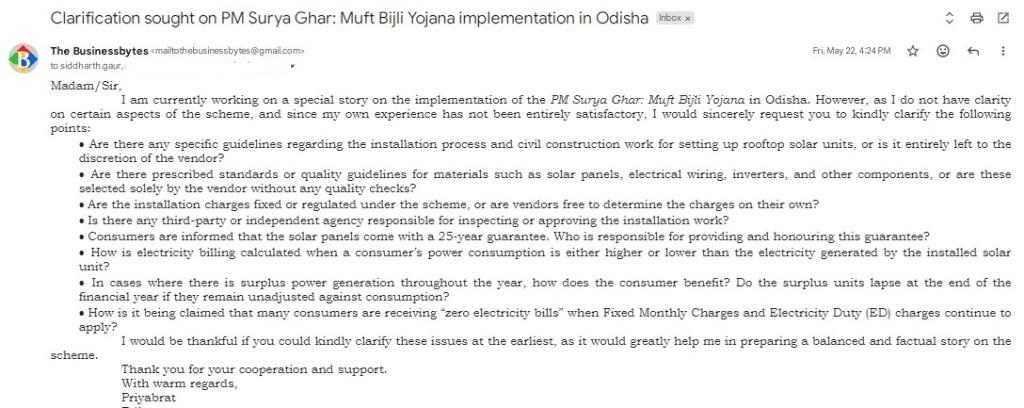 The queries specifically sought answers on whether installation quality
is independently verified, how vendor compliance is monitored, who bears
responsibility in cases of defective workmanship, and how consumers can enforce
the much-publicized 25-year solar panel warranty.
The queries specifically sought answers on whether installation quality
is independently verified, how vendor compliance is monitored, who bears
responsibility in cases of defective workmanship, and how consumers can enforce
the much-publicized 25-year solar panel warranty.
Additional questions addressed electricity billing practices, including
how surplus power exported to the grid is adjusted and whether promotional
claims regarding "zero electricity bills" adequately disclose fixed
charges and statutory levies that consumers may still be required to pay.
No response was received. A reminder sent on May 26 also went
unanswered.
Such silence is difficult to justify in a programme involving lakhs of
consumers and substantial public expenditure. Transparency is not merely a public relations exercise; it is essential
for sustaining public trust.
Confusion also persists regarding state-level incentives. While
awareness of Central Government subsidies has improved considerably, many
consumers remain uncertain about Odisha Government support mechanisms,
eligibility conditions, documentation requirements and subsidy timelines. The
absence of clear communication continues to create barriers, particularly for
lower-income households that stand to benefit most from reduced electricity
costs.
Odisha undoubtedly deserves recognition for its impressive achievements
under PM Surya Ghar: Muft Bijli Yojana. The state has demonstrated
that rooftop solar can scale rapidly when supported by policy, consumer
awareness and administrative commitment.
But success cannot be measured solely by installation counts and award
trophies.
The real measure of success lies in
whether consumers receive safe, reliable and high-quality systems; whether
complaints are addressed promptly; whether vendors are held accountable; and
whether authorities respond transparently to legitimate public concerns.
As Odisha races towards its ambitious target of three lakh rooftop solar
installations by March 2027, the challenge is no longer simply about expanding
numbers. It is about ensuring that consumers are not misled by promises,
abandoned after installation, or left struggling for answers when problems
arise.
The state's solar revolution has undoubtedly illuminated thousands of homes. The question now is whether policymakers, utilities and vendors are willing to shine the same light on the concerns consumers continue to raise. Until then, Odisha's solar success story risks being remembered not only for the power it generated, but also for the questions it failed to answer.
P.S.: As
Tata Power did not respond to my queries despite repeated requests, I proceeded
with the story based on the information, experience, and feedback available to
me. However, they are welcome to share their perspective, and I will gladly
incorporate their response and correct or remove any information they can
substantiate as inaccurate.