
THEBUSINESSBYTES
BUREAU
NEW DELHI, JULY 31,
2026
The National Digitization Drive has
received a major boost with over 1.2 crore manuscripts reported from across the
country, as the Centre on Thursday called for sustaining the momentum to
preserve India's vast manuscript heritage through a coordinated,
technology-driven national framework.
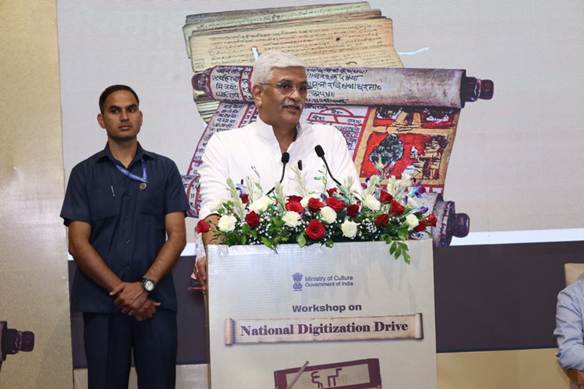
The announcement came at the National
Digitization Drive Workshop organised by the Ministry of Culture under the Gyan
Bharatam Mission at The Ashok here, where more than 200 representatives from
States and Union Territories, manuscript custodians, scholars, experts, Gyan
Bharatam Centres and technology partners deliberated on strengthening India's
manuscript preservation ecosystem.
Addressing the workshop, Union Culture
Minister Gajendra Singh Shekhawat described the reporting of over 1.2 crore
manuscripts as a remarkable national milestone achieved through the proactive
support of States, Union Territories, ministry officials, centres and
custodians.
He said the workshop reflected a collective
national resolve to safeguard centuries-old knowledge and uphold India's
civilisational legacy. Stressing that manuscripts created by sages and scholars
encompass philosophy, Ayurveda, literature, mathematics, yoga and several other
disciplines, the minister said it was the nation's responsibility to
categorise, codify and publish them for future generations.
Shekhawat called for maintaining the
current pace of work, saying digitisation demands precision, discipline and
collaboration. Preserving India's knowledge systems with accuracy and
integrity, he said, is a national responsibility.
Culture Secretary Vivek Aggarwal
emphasised the need for a time-bound, systematic and coordinated approach
involving all stakeholders to ensure uniform standards, quality assurance and
seamless integration across the country. Joint Secretary, Ministry of Culture,
Samar Nanda welcomed the participants and reiterated the mission's national
objectives, highlighting the collective responsibility to advance manuscript preservation
efforts.
Director of Gyan Bharatam Inderjeet
Singh presented an overview of the mission, outlining its national objectives,
digital infrastructure and implementation strategy. Project Director Prof.
Anirban Dash explained the mission's two-phase framework covering technical
digitisation and scholarly validation to ensure high-quality imaging and
rigorous knowledge authentication.
Structured around five thematic
sessions, the workshop reviewed national digitisation targets, standardised
imaging and metadata practices, implementation strategies and operational
challenges while formulating a coordinated roadmap for a unified,
standards-driven digitisation framework.
Representatives from Rajasthan, the
Bhandarkar Oriental Research Institute (BORI), Pune, Jammu and Kashmir, the
Asiatic Society, Kolkata, and Gyan Bharatam Centres including KOBA, Gujarat,
Vrindavan Research Institute, Sevadhi in Kerala and Jamia Hamdard, Delhi shared
field experiences, innovations and scalable models. Technology partners also
showcased solutions aimed at strengthening the national manuscript digitisation
programme.
The Ministry also unveiled India's emerging National Digital Manuscript Ecosystem, supported by artificial intelligence platforms and a structured access policy framework. Recognising the fragile condition of many manuscripts, officials said conservation and digitisation would progress simultaneously, with financial support being extended to States and centres to strengthen infrastructure, equipment and trained manpower.
The workshop concluded with a collective commitment to accelerate the National Digitization Drive, which the Ministry described as a significant step towards building a unified, AI-enabled manuscript ecosystem to preserve, digitise and make India's civilisational knowledge accessible for future generations.