THEBUSINESSBYTES
BUREAU
BHUBANESWAR,
OCTOBER 25, 2026
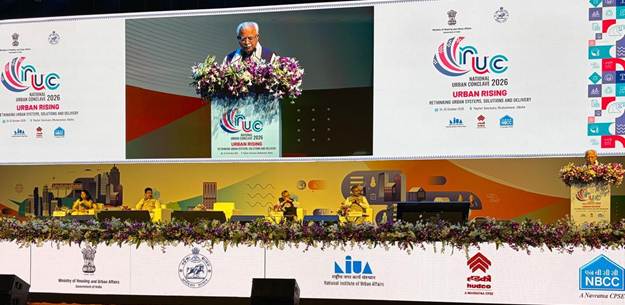
The two-day National
Urban Conclave 2026 concluded here on Sunday with a series of recommendations
for strengthening urban governance, empowering municipal bodies and improving
civic service delivery as India works towards the vision of Viksit Bharat 2047.
The conclave brought
together representatives from the Centre and state governments, urban local
bodies, industry, academia and knowledge institutions to deliberate on emerging
urban challenges and identify practical solutions through seven technical
sessions.
Union Housing and
Urban Affairs Minister Manohar Lal, delivering the valedictory address, said
the conclave aimed to deliberate on the future challenges facing Indian cities.
He highlighted the contribution of national programmes, including AMRUT, Swachh
Bharat Mission-Urban and PM SVANidhi, in expanding water and sanitation services,
improving waste management, strengthening urban mobility and promoting
financial inclusion.
Emphasising
sustainable urban development, the minister called for affordable housing near
employment centres and public transport, greater circularity in construction
practices and scientific remediation of legacy waste. He noted that more than
half of the country's legacy waste had been remediated and stressed the need to
sustain the progress while preventing fresh waste accumulation.
Satendra Singh, Secretary
in the Department of Urban Development under the Ministry of Housing and Urban
Affairs, said the success of urban initiatives should be measured by the
quality of services delivered rather than merely by the completion of projects.
He underscored the
need to strengthen institutional capacity, inter-agency coordination, municipal
finances and accountability, while reaffirming the Centre's commitment to
working with states and cities to implement the conclave's recommendations.
NITI Aayog member Rajiv
Gauba called for comprehensive reforms in urban governance, planning and
municipal finance to address India's accelerating urbanisation. He stressed
that smaller cities must be empowered through greater devolution of
administrative powers and financial resources to urban local bodies.
Gauba also advocated
stronger municipal accountability, improved mobilisation of own-source revenue
and reforms in conventional land-use planning. Higher-density development,
mixed-use neighbourhoods and transit-oriented planning, he said, could help improve
housing affordability and economic productivity.
He also highlighted
initiatives such as the Urban Challenge Fund and City Economic Regions, urging
states to undertake structural reforms and link funding under national urban
missions to their implementation.
The seven technical
sessions identified a range of measures to make cities more inclusive,
resilient and future-ready. The discussions on the 'Right to Walk' called for
incorporating pedestrian rights into statutory plans, securing pedestrian spaces,
improving accessibility and establishing dedicated funding mechanisms for
walking infrastructure.
The session on water,
waste and resource efficiency recommended integrated planning for water supply,
wastewater and solid waste management, greater reuse of treated water, circular
resource recovery and outcome-based service delivery. Sustainable financing
through public-private partnerships, municipal bonds and climate finance was
also emphasised.
On affordable
housing, participants recommended reserving land for economically accessible
homes, integrating housing with transport and employment centres, promoting
rental and transit housing and simplifying approvals. The discussions on
integrated urban development stressed GIS-based planning, transit-oriented
growth, coordinated infrastructure investments and stronger municipal
creditworthiness.
Other sessions called
for citizen-centric service delivery, digital monitoring, performance-based
contracts, simplified building regulations, climate-resilient construction
standards and greater transparency in urban approvals.
The conclave also
recommended empowering mayors with five-year tenures and clearly defined
executive powers, strengthening municipal fiscal autonomy and technical
staffing, and enhancing the role of ward and zonal committees.
Several initiatives
and publications were launched during the concluding day, including the Used
Water Marketplace under AMRUT 2.0, which will connect urban local bodies with
industries and other potential users of treated water.
The Urban Challenge
Fund portal was introduced to facilitate project submission, appraisal,
tracking and monitoring, while an Online Interactive Municipal Finance Data Hub
is intended to support knowledge-sharing and improve access to municipal revenue
and expenditure data.
Other launches
included Street Food Hubs under PM SVANidhi, the children's book 'Swachhata Ke
Superheroes', the CPWD Nirman project-monitoring application and CPWDway, a
digital learning platform for engineering professionals. An internship scheme
for engineering and architecture students through the National Internship
Portal was also announced.
The conclave further saw the signing of a memorandum of understanding between the Japan International Cooperation Agency and the Central Public Health and Environmental Engineering Organisation to promote the circular use of treated used water.
The recommendations emerging from the two-day event are expected to inform the next phase of urban reforms, with a focus on stronger institutions, integrated planning, sustainable financing and accountable service delivery.