THEBUSINESSBYTES BUREAU
GUWAHATI, FEBRUARY 22, 2026
The new terminal at Lokapriya Gopinath Bordoloi International Airport
(LGBIA) began commercial operations Sunday, raising annual passenger capacity
to 13.1 million and reinforcing Guwahati’s position as the principal aviation
gateway to India’s strategic North-Eastern region to South and Southeast Asia.
The transition followed a phased, operations-led activation, with live
trials conducted across check-in, baggage handling, security and aircraft
turnaround before full deployment. The terminal was inaugurated by Narendra
Modi on December 20, 2025.
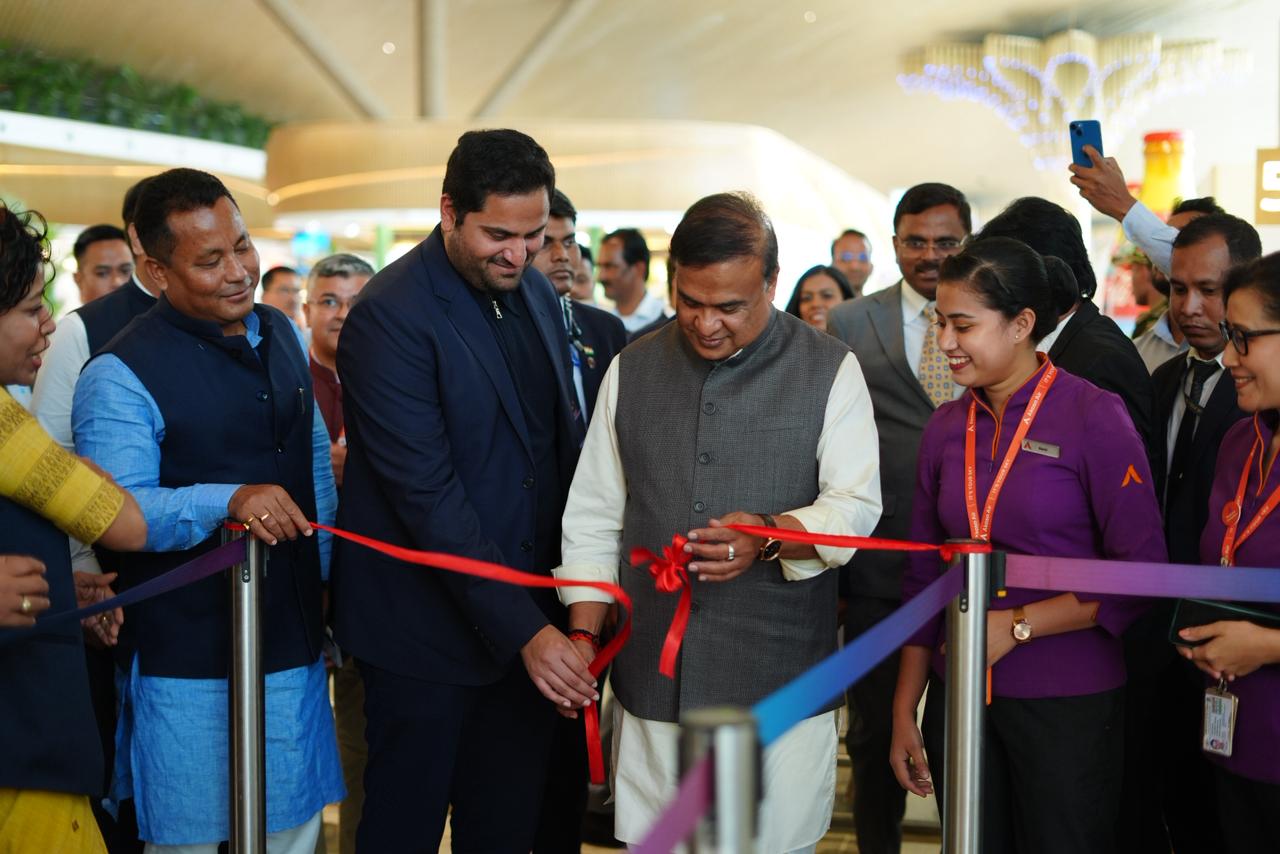
The commencement of operations was attended by Chief Minister Himanta
Biswa Sarma, and Jeet Adani, Director, Adani Airport Holdings Ltd (AAHL),
India’s largest private airport operator. The event was marked by the issuance
of a ceremonial boarding pass to the first departing passenger and the arrival
of an Akasa Air flight from Mumbai at the new facility. A traditional
lamp-lighting ceremony and cultural performances were held in the arrivals
forecourt, with participation from artisan communities, tea garden workers,
frontline staff and Central Industrial Security Force (CISF) personnel,
underscoring the region’s cultural identity alongside infrastructure expansion.
 Chief Minister of Assam, Dr Himanta Biswa Sarma said, “I express my
gratitude and we are thankful to Mr Gautam Adani for keeping his commitment of
investing Rs 50,000 crore made during Advantage Assam 2.0, last year.I believe
with the operationalisation of this new Terminal, Assam’s tourism will get a
boost. It will be a gamechanger for Assam.The culture of Assam has been
respected during the construction of this new airport terminal, and as
Assamese, we are proud of it.”
Chief Minister of Assam, Dr Himanta Biswa Sarma said, “I express my
gratitude and we are thankful to Mr Gautam Adani for keeping his commitment of
investing Rs 50,000 crore made during Advantage Assam 2.0, last year.I believe
with the operationalisation of this new Terminal, Assam’s tourism will get a
boost. It will be a gamechanger for Assam.The culture of Assam has been
respected during the construction of this new airport terminal, and as
Assamese, we are proud of it.”
Jeet Adani said the expansion reflects the region’s evolving demand and
long-term growth trajectory. “Today is more than a commercial milestone. It is
a proud moment for the people of Assam and the North-East. This achievement
belongs to the countless hands and hearts that turned vision into reality. It
resonates with the Hon’ble Prime Minister’s vision for future-ready
infrastructure and with the Hon’ble Chief Minister Shri Himanta Biswa Sarma’s
mission to position Assam as the economic engine of the North-East.”
Traffic
Growth and National Positioning
Guwahati has emerged as one of India’s fastest-growing non-metro
airports, recording consistent traffic expansion over the past decade. With
throughput crossing nine million passengers in recent years, the airport ranks
among the country’s top 10 to 12 busiest airports by passenger volume. The
expanded 13.1 million capacity provides headroom for route additions, higher
aircraft frequencies and international network growth.
The airport connects 21 domestic destinations and three international
routes, including Bangkok, Paro and Singapore and currently handles more than
130 aircraft traffic movements (ATMs) daily. The additional capacity is
expected to strengthen Guwahati’s role as a regional hub linking the North-East
with mainland India and Southeast Asia.
System validation exercises covered airline coordination, ground
handling, emergency protocols and digital integration. Digi Yatra-enabled
processing, integrated wayfinding and centralised communication systems are
operational. Retail and food services are being introduced in stages.
Architecture
and Cultural Identity
Designed by internationally acclaimed Indian architect Nuru Karim, the
terminal draws inspiration from Assam’s kopouphool (foxtail orchid) and
incorporates more than 140 metric tonnes (MT) of bamboo. Architectural
references to Assam’s bholuka bamboo craftsmanship and the bamboo-based
structural traditions associated with the Apatani tribe of Arunachal Pradesh
reflect the wider cultural fabric of the North-East.
A vaulted roofline enhances spatial continuity and natural light
distribution, while an amphitheatre-style arrivals forecourt introduces
travellers to regional art and performance traditions.
The design received the International Architecture Award 2025 for
integrating regional identity with contemporary infrastructure. The airport is
operated by AAHL through its subsidiary Guwahati International Airport Limited
(GIAL). AAHL also manages airports in Thiruvananthapuram, Mumbai, Navi Mumbai,
Lucknow, Jaipur, Ahmedabad and Mangaluru.