THEBUSINESSBYTES BUREAU
RAURKELA, AUGUST 11, 2026
In a move that could give plastic waste a new life while
making 3D printing more affordable and sustainable, researchers at the National
Institute of Technology Rourkela (NIT Rourkela) have patented a low-cost,
portable extrusion system capable of converting recycled plastic waste into
filament used in 3D printing.
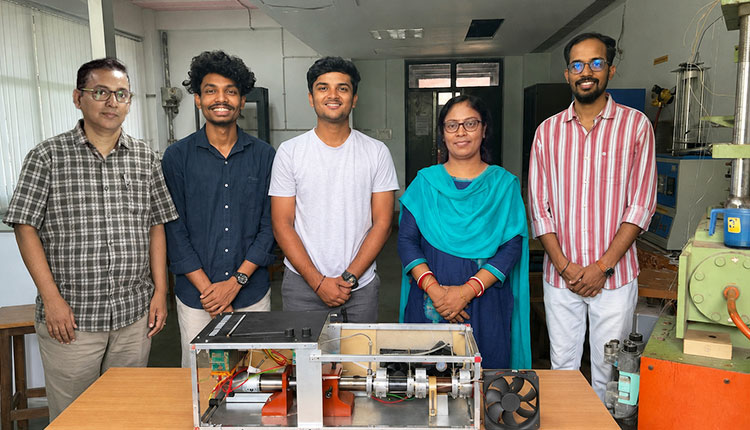
Developed at a cost of around Rs 45,000, the indigenous
system is designed to reduce dependence on virgin plastic and address two major
challenges confronting filament production — the high cost of commercially
available materials and considerable material wastage during processing.
The patented technology comprises an extruder, a controlled
cooling system and PID temperature controllers, among other components,
allowing precise control over the filament manufacturing process. The
researchers said the system can produce different types of filaments by
combining plastic particles with reinforcement materials to enhance their
strength and durability.
Laboratory-scale tests carried out by the team demonstrated
satisfactory mechanical properties and dimensional accuracy in the filaments
produced using the system, indicating its potential for applications where
performance and consistency of 3D-printed components are critical.
Three-dimensional printing has witnessed growing adoption in
India across biomedical, engineering, manufacturing and consumer applications.
Fused Deposition Modelling (FDM), among the most widely used 3D printing
technologies, relies on thermoplastic filament as its raw material. In the
process, the filament is melted and deposited layer by layer to build the
desired product.
However, high-quality thermoplastic and polymer filaments
available commercially can be expensive, while poor-quality filaments can
compromise the strength of finished components, print quality and dimensional
accuracy. Recycled filaments have emerged as a potentially cost-effective and
environmentally sustainable alternative, but their wider adoption has been
constrained by processing costs, material wastage and concerns over mechanical
strength and durability.
The NIT Rourkela researchers said their newly developed
extrusion system seeks to address these limitations by providing a relatively
inexpensive and portable platform for converting waste plastics into usable 3D
printing material.
Prof. Sandhyarani Biswas, Associate Professor in the
Department of Mechanical Engineering at NIT Rourkela, said the system offered
both technical and commercial advantages for the 3D printing industry.
“The developed
filament extrusion system represents an advancement in filament production
technology, offering compelling technical and commercial benefits for the 3D
printing industry,” she said.
According to Biswas, composite filaments manufactured through
the system can be used to produce 3D-printed components with improved mechanical
properties. At the same time, the use of recycled plastic can provide
significant environmental benefits by diverting waste material from disposal
and reducing the requirement for virgin polymers.
Prof. Sujit Sen, Professor in the Department of Chemical
Engineering at NIT Rourkela, said the technology could help create a
sustainable closed-loop mechanism for plastic waste management.
“The developed extruder system is highly useful for
converting various types of plastics into useful 3D printer filament, thereby
forming a sustainable closed-loop system,” he said.
The technology has potential applications in sectors such as
automotive, aerospace, consumer goods and electronics, besides offering
opportunities for educational and research institutions to conduct experiments
and material studies.
The researchers said the technology could also find
applications in the medical sector, where the filaments may be used to
manufacture components such as dental models, scaffolds, patient-specific
prosthetics and orthotics.
The research team comprises Prof. Sandhyarani Biswas, Prof. Sujit Sen, Jagdish Uday Khatu, Himanshu Singh and Kiran Suna. The team has secured a patent for the extrusion system under Application No. 202431068691, dated July 30, 2026.
The researchers said the technology has the potential to contribute to the principles of a circular economy by enabling the recycling, reuse and remanufacturing of waste plastics into value-added products. By converting discarded plastic into a useful feedstock for additive manufacturing, the system could help reduce material waste while opening up a more sustainable pathway for 3D printing.