New
materials change colour under UV light in response to heat and moisture,
opening up possibilities for security inks, humidity sensors and white LEDs
THEBUSINESSBYTES
BUREAU
ROURKELA,
OCTOBER 28, 2026
In a development that
could pave the way for safer lighting technologies and more reliable
anti-counterfeiting measures, researchers at the National Institute of
Technology (NIT) Rourkela, in collaboration with scientists from IIT Guwahati,
IIT Bombay and the National Institute of Science Education and Research
(NISER), Bhubaneswar, have developed lead-free materials that emit different
colours of light under ultraviolet (UV) illumination and respond reversibly to
changes in temperature and moisture.
The materials, based
on bismuth-containing compounds, offer a potential alternative to lead-based
photoluminescent materials, which have attracted considerable research interest
for their light-emission properties but pose significant environmental and
public health concerns owing to the toxicity of lead. The findings could have
applications in security systems, sensing technologies and advanced lighting
solutions.
Many materials used
in light-emitting technologies contain lead, raising concerns about their
long-term environmental impact and potential risks to human health. To address
this challenge, the researchers investigated bismuth-based compounds, a class
of materials that can combine organic and inorganic components to achieve useful
optical properties without relying on lead.
The findings have
been published in the Journal of Materials Chemistry C in a research paper
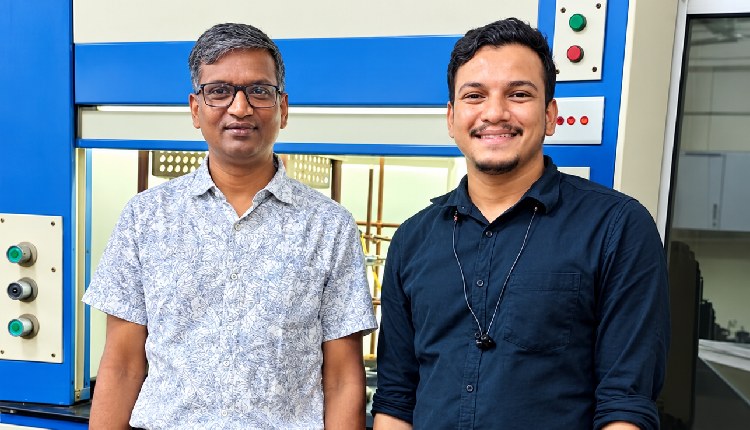
co-authored by Prof. Saroj L. Samal, Associate Professor in the Department of
Chemistry at NIT Rourkela, and his research scholar, Subhasish Sahoo. The other
authors are Prof. Parameswar K. Iyer and Chakali Srinivas from IIT Guwahati,
Rajanikanta Rana from IIT Bombay, and Prof. Himansu S. Biswal and Laxmipriya
Dash from NISER Bhubaneswar.
The bismuth-based
material developed by the team exhibits an unusual response to heat and
moisture. When heated, it loses water molecules trapped within its structure,
bringing about a structural change that enables it to emit blue light under UV
illumination. When exposed to moisture again, the material absorbs water and
the blue emission disappears. This reversible process allows its light-emitting
behaviour to be controlled by altering the surrounding environmental
conditions.
Speaking about the
material, Prof. Saroj L. Samal, Associate Professor, said, “The Bi-based
organic-inorganic hybrid halide compound is synthesised using cheaper and
environmentally friendly constituents through a simple synthesis technique. The
most interesting aspect of this material is its ability to undergo reversible
structural transformation in response to heat and moisture, accompanied by a
change in its light-emission properties.”
The discovery could
have significant implications for the protection of important documents and
commercial products against counterfeiting. Special inks incorporating the
material could be used on certificates, signatures and security labels. Their
distinctive optical response could then be examined under UV light following
controlled heating, potentially providing an additional means of verifying the
authenticity of documents and products.
The material could
also find applications in humidity-sensing technologies. Since its light
emission changes in response to moisture, it may serve as an optical indicator
of humidity levels in food packaging, storage facilities and other environments
where moisture needs to be monitored and controlled. Such applications could
help identify undesirable changes in storage conditions, subject to further
testing and device development.
In a related
development, the NIT Rourkela research team has also developed lead-free
light-emitting diode (LED) materials capable of producing yellow light under UV
illumination. By combining the yellow-emitting material with a commercially
available blue-light-emitting material, the researchers produced a white LED
with a cool, daylight-like appearance. The resulting white-light system
maintained stable emission during continuous operation, indicating its
potential for further development in solid-state lighting and light-conversion
technologies.
Highlighting the
potential applications of the research, Prof. Samal said, “The synthesised
compound shows promising potential for reversible luminescence switching,
moisture sensing, solid-state lighting and anti-counterfeiting applications.”
The next phase of the research will focus on improving the light-emission efficiency and long-term stability of the materials, while exploring ways to integrate them into practical devices. The researchers also plan to develop more efficient, stimulus-responsive luminescent materials for anti-counterfeiting applications, enhance the sensitivity and reliability of humidity sensors, and optimise the performance of white-light-emitting diodes.
These efforts could help bridge the gap between laboratory research and practical applications, with potential benefits for optical security, environmental monitoring and cost-effective, energy-efficient lighting. By developing materials that respond predictably to external stimuli without relying on lead, the team aims to contribute to the development of safer and more versatile technologies for everyday use.