THEBUSINESSBYTES BUREAU
NEW DELHI, NOVEMBER 3, 2026
In a major push towards strengthening India's strategic mineral security
and technological self-reliance, NITI Aayog and TEXMiN, an initiative of the
Department of Science and Technology (DST) at IIT (ISM) Dhanbad, have signed a
Joint Statement of Intent to accelerate indigenous research, innovation and
technology development in the critical and strategic minerals sector.
The collaboration is aimed at building resilient and sustainable critical
mineral value chains, strengthening domestic technological capabilities and
reducing vulnerabilities in strategic resource supplies, in alignment with the
objectives of the National Critical Mineral Mission (NCMM) and the vision of
Aatmanirbhar Bharat and Viksit Bharat 2047.
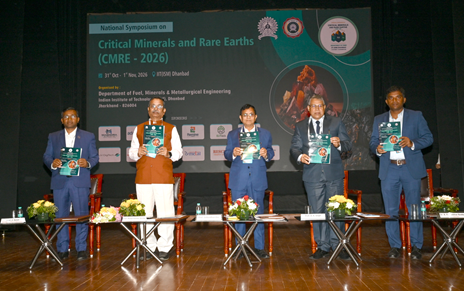
The agreement was signed during the visit of NITI Aayog Member Prof.
Gobardhan Das to IIT (ISM) Dhanbad, where he inaugurated the National Symposium
on Critical Minerals and Rare Earths (CMRE 2026) on October 31. The symposium
was organised as part of the 45th Annual National Conference of the Indian
Council of Chemists.
Addressing the gathering of policymakers, scientists, researchers,
technology developers and industry representatives, Das underscored the growing
strategic significance of critical minerals in safeguarding national security,
strengthening technological sovereignty and powering India's ambition of
becoming a developed nation by 2047.
Drawing attention to India's rich metallurgical heritage, he called for a
renewed focus on indigenous technological innovation, stronger
research-industry partnerships and the development of home-grown capabilities
to secure the country's critical mineral requirements.
Emphasising the need for a fundamental shift in India's approach to
mineral development, Das advocated moving beyond a mine-centric strategy
towards an integrated value chain covering exploration, extraction, processing,
refining, advanced materials manufacturing and recycling.
He also highlighted the enormous untapped potential of recovering
critical minerals from secondary resources, including coal fly ash, red mud,
mine tailings and electronic waste. Such alternative sources, he said, could
play an important role in augmenting domestic resource availability while
promoting sustainable and efficient utilisation of natural resources.
Stressing the importance of bridging the gap between laboratory research
and industrial application, Das called for translating scientific discoveries
into commercially viable technologies through coordinated efforts involving
government, academia, research institutions and industry.
The Joint Statement of Intent provides for cooperation across four broad
areas, including collaborative research and technology development, technical
and strategic studies, policy and institutional support, and capacity building
and knowledge exchange.
The partnership is expected to facilitate technology translation, deepen
institutional collaboration and create a stronger ecosystem for developing
indigenous solutions across the critical minerals value chain.
The symposium provided a platform for experts and stakeholders to deliberate on emerging technological challenges, research priorities and policy interventions required to strengthen India's critical minerals and rare earths ecosystem.
With critical minerals increasingly underpinning advanced manufacturing, clean energy technologies, electronics, defence and other strategic industries, the NITI Aayog-TEXMiN partnership is expected to support India's efforts to develop secure, sustainable and resilient supply chains while advancing its long-term goal of technological self-reliance.