THEBUSINESSBTES BUREAU
BONGAIGAON, FEBRUARY 26,
2026
NTPC Bongaigaon has reinforced its commitment
to community-centric development by supporting the Bodoland Sericulture Mission
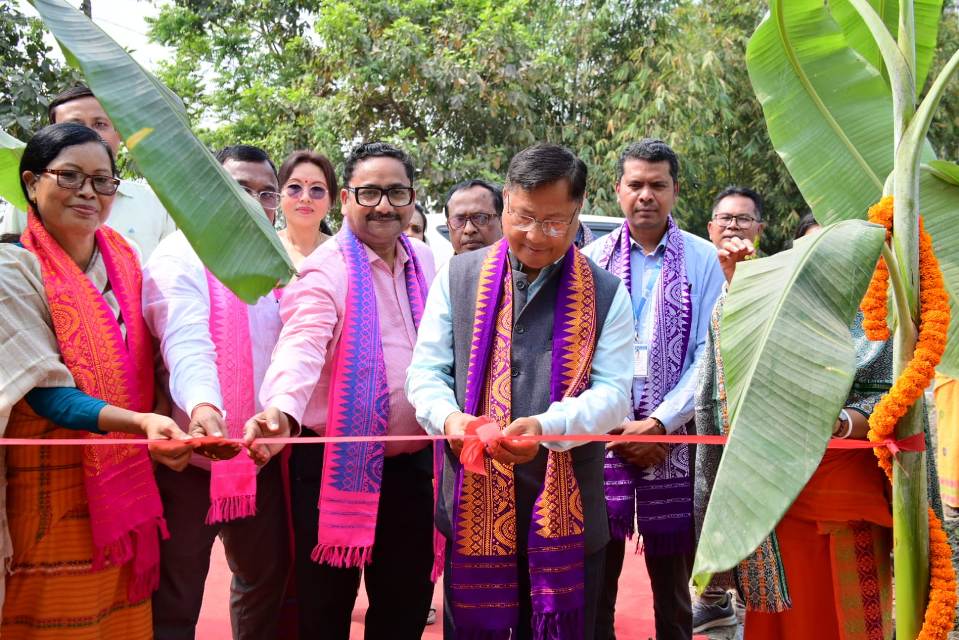
through the inauguration of a Sales-cum-Display Counter at Mothambil Forest
Village, near Raimona National Park. The initiative, implemented under NTPC’s
CSR programme, aims to strengthen sustainable livelihoods by promoting Eri silk
rearing and handloom weaving among rural women.
Launched in 2023 by the Bodoland Territorial Region (BTR) Government, the Bodoland Sericulture Mission seeks to transform the traditional silk sector into a high-income, sustainable livelihood ecosystem with a strong focus on Eri silk. The newly inaugurated counter forms part of the project titled “Promotion of Eri Silk and Handloom Village in Raimona National Park,” formally opened on 25 February 2026.
The programme was graced by Derhasat Basumatary, Executive Member (Health & Family Welfare), BTR Government, in the presence of Bhanulata Mushahary, Director of Sericulture, BTC, Ranjit Kumar Gogoi, Asst. Director, BTC, Amit Kumar Asthana, Addl. General Manager (HR), NTPC Bongaigaon, A.K. Chakravorty, former Director of Sericulture, BTR, Roshan Dungdung, DGM (HR), Smriti Das, Executive (CSR) and other officials from NTPC and BTC.
Implemented by the BTC Government in
collaboration with the Department of Sericulture and supported by NTPC
Bongaigaon, the project involves a total outlay of ₹30 lakh. Mothambil Forest Village has been identified as a model site to
link eco-tourism with livelihood generation through Eri silk production and
weaving. The initiative will directly benefit around 125 women — comprising 89
rearers and 36 weavers — while extending indirect support to hundreds of villagers
in the surrounding areas.
Speaking on the occasion, Derhasat Basumatary
stated that the Bodoland Sericulture Mission has been envisioned as a key
driver for rural livelihood enhancement in the region, with special emphasis on
women-led economic activities. He noted that the initiative at Mothambil Forest
Village represents a meaningful convergence of biodiversity conservation,
eco-tourism and the traditional silk heritage of the Bodo community. He further
conveyed that the creation of forward market linkages through the Sales-cum-Display
Counter donated by NTPC Bongaigaon will enable artisans to secure better value
for their products while encouraging youth and women to engage in sustainable
livelihood practices rooted in local resources and skills.
 Amit Kumar Asthana shared that NTPC Bongaigaon
remains committed to supporting community-centric development initiatives in
the Bodoland Territorial Region through its CSR programmes, with focus on
livelihood generation, skill development and women empowerment. He highlighted that
the Eri Silk and Handloom Village initiative reflects NTPC’s approach of
linking economic opportunities with local culture and environmental
sustainability. The project is expected to strengthen grassroots
entrepreneurship, enhance income opportunities for women beneficiaries and
contribute to preserving the rich handloom traditions of the region while
creating a unique eco-tourism experience around Raimona National Park, Asthana
added.
Amit Kumar Asthana shared that NTPC Bongaigaon
remains committed to supporting community-centric development initiatives in
the Bodoland Territorial Region through its CSR programmes, with focus on
livelihood generation, skill development and women empowerment. He highlighted that
the Eri Silk and Handloom Village initiative reflects NTPC’s approach of
linking economic opportunities with local culture and environmental
sustainability. The project is expected to strengthen grassroots
entrepreneurship, enhance income opportunities for women beneficiaries and
contribute to preserving the rich handloom traditions of the region while
creating a unique eco-tourism experience around Raimona National Park, Asthana
added.
Constructed at an estimated cost of ₹5.90 lakh, the Sales-cum-Display Counter has been designed in
traditional Assam-type architecture and equipped with dedicated display spaces
for locally produced Eri silk and handloom products. The facility will be
managed by women beneficiaries, enabling direct market access and improved
value realisation.
The broader intervention includes Kesseru plantations for silkworm rearing, construction of rearing houses, provision of spinning machines, supply of improved looms and quality Eri yarn, along with the creation of this dedicated marketing platform.
By integrating the natural heritage of Raimona National Park with the cultural legacy of the Bodo community, the project offers visitors an opportunity to experience traditional silk rearing and weaving alongside wildlife tourism. The initiative is expected to strengthen market linkages, promote women’s economic empowerment, preserve traditional crafts and advance sustainable livelihoods across the Bodoland Territorial Region.