THEBUSINESSBYTES BUREAU
BHUBANESWAR, AUGUST 11, 2026
In a significant step towards strengthening Odia as a
language of higher and technical education, the Commission for Scientific and
Technical Terminology (CSTT), under the Ministry of Education, has made
substantial headway in standardising thousands of technical terms in the fields
of electronics, broadcast and telecommunication during a five-day series of
national-level deliberations held at KIIT-Deemed to be University (KIIT-DU).
The meetings, aimed at developing and reviewing Fundamental
Glossaries in Odia, saw experts from universities, research institutions and
government organisations across the country undertake an intensive examination
of technical terminology, with the objective of creating scientifically
accurate, conceptually consistent and practically applicable equivalents in
Odia.
The exercise recorded significant progress in all three
domains. The Terminology Feedback Committee (TFC) on Electronics completed the
review of 2,827 technical terms that had previously been standardised. In
Broadcast, the First Expert Advisory Committee (EAC-I) evolved and finalised
standardised Odia equivalents for approximately 2,983 technical terms, thereby
achieving its entire target.
In the field of Telecommunication, the EAC-I developed
standardised Odia equivalents for around 2,100 technical terms, while the
remaining terms will be taken up for deliberation and finalisation at a subsequent
meeting.
The initiative is aimed at creating a comprehensive technical
vocabulary in Odia that can be effectively used in higher and technical
education, research, broadcasting, telecommunication and industry. The proposed
glossaries are expected to become important reference resources for students,
teachers, researchers, engineers, media professionals and policymakers, besides
contributing to the wider use of Odia as a medium of higher education in
keeping with the objectives of the National Education Policy (NEP) 2020.
The five-day deliberations were coordinated by Prof. Benu
Gopal Mohapatra, Director, Consultancy Services, KIIT, with subject-specific
coordination by Prof. Sudhakar Sahu for Electronics, Prof. Nirmal Rout for
Broadcast and Prof. Sudhanshu Sekhar Singh for Telecommunication.
Experts participating in the meetings examined each technical
term from multiple perspectives, including scientific accuracy, conceptual
clarity and linguistic suitability. Standard dictionaries, Sanskrit sources and
established technical literature were also consulted during the deliberations
to ensure that the proposed Odia equivalents were precise, consistent and
appropriate for professional and academic use.
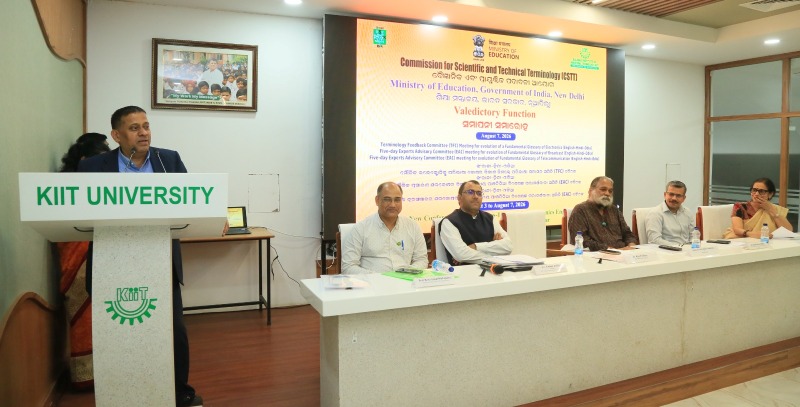
The valedictory session was attended by Dr. Ajay Pradhan,
Vice President, KIIT & KISS, as the Chief Guest, Prof. Adwaita Gadanayak,
Director General, KIIT Art Academy, as the Guest of Honour, and Dipak Kumar
Mishra, Deputy Director, Directorate General of Quality Assurance (DGQA),
Ministry of Defence, as the Special Guest.
Addressing the gathering, Mishra underlined the importance of
developing standardised technical terminology in Indian languages, saying such
efforts would play an important role in strengthening technical education,
facilitating wider dissemination of knowledge and advancing the implementation
of NEP 2020.
Presenting the outcomes of the meetings, Jai Singh Rawat,
Assistant Director and Officer-in-Charge of the programme, CSTT, emphasised
that the initiative was not merely an exercise in translating technical
vocabulary from one language to another. Rather, it represented an effort to
build a robust and standardised knowledge framework in Odia capable of
supporting education, research and professional communication.
The extensive deliberations at KIIT are expected to provide further momentum to the development of technical literature in Odia and help bridge the gap between specialised knowledge and learners and professionals seeking access to it in their mother tongue.
The CSTT initiative assumes added significance in the context of NEP 2020, which places emphasis on promoting Indian languages and facilitating access to quality education through them. The standardisation of technical terminology is seen as a key component in enabling Indian languages to effectively serve emerging academic, scientific and professional domains.