THEBUSINESSBYTES
BUREAU
BHUBANESWAR,
SEPTEMBER 3, 2026
Odisha Chief
Secretary Anu Garg on Thursday called for accelerated implementation of
development programmes, higher utilisation of approved budgetary allocations
and a stronger focus on quality and outcome-based execution, as the state
reviewed its financial performance and development priorities at a high-level
meeting held at Kharavela Bhawan here.
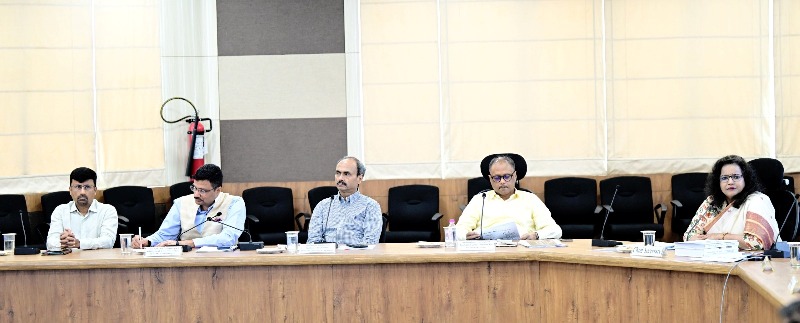
Chairing the
secretaries-level meeting, Garg advised departments to expedite the
implementation of development schemes and projects in line with approved budget
provisions and step up expenditure while ensuring that spending translates into
measurable outcomes for the people.
The meeting was
attended by Development Commissioner-cum-Additional Chief Secretary Deoranjan
Kumar Singh, the Additional Chief Secretary to the Chief Minister, Additional
Chief Secretaries and Secretaries of various departments. The officials
reviewed departmental programmes, financial performance, welfare initiatives
and ongoing development projects.
At the outset, the
Chief Secretary appreciated the significant public-oriented and welfare
initiatives undertaken by various state government departments during August.
She particularly commended the announcement to provide free textbooks to Class
IX and X students, removal of the limit on the number of attempts for appearing
in OPSC examinations, disbursement of the fifth instalment under the ‘Subhadra’
scheme, successful organisation of the second National GARIMA Conclave 2026,
and several important Cabinet decisions.
Garg said these
initiatives would make an important contribution towards human resource
development, women’s empowerment, good governance and inclusive growth in
Odisha.
The Finance
Department made a detailed presentation on the state’s revenue and expenditure
position. By the end of August in the current financial year, both total
expenditure and programme expenditure had improved compared with the
corresponding period of the previous year. Capital expenditure, too, recorded
significant growth.
The state also
registered higher growth in overall revenue collection compared with the same
period last year.
Reviewing the
expenditure position of various departments, Garg directed the Secretaries to
accelerate implementation of development schemes and projects and increase the
pace of expenditure in accordance with approved budgetary provisions. She
emphasised that departments should not only meet expenditure targets but also
ensure quality implementation and measurable outcomes from every programme.
With the broader
goals of Viksit Odisha 2036 and Viksit Bharat 2047 in view, Khordha District
Collector Amrit Ruturaj presented a detailed roadmap for 25 strategic development
projects aimed at transforming the district into a more integrated, modern and
economically vibrant region.
The roadmap gives
equal emphasis to industry, infrastructure, agriculture, sports, tourism,
heritage and knowledge-based development, with the objective of ensuring
balanced and rapid growth across the district.
At the Gram Panchayat
level, the roadmap proposes the development of model projects equipped with
multiple public amenities, including Kalyan Mandaps, rural markets, model parks
and ponds, creating useful community infrastructure at the grassroots.
The meeting discussed
developing the Begunia-Bolagarh and Tangi areas as industrial zones to attract
fresh investment, generate employment and promote ancillary industries based on
MSMEs.
To strengthen civic
and knowledge-based infrastructure at the grassroots, a proposal was also
discussed to develop modern block-level convention centres as hubs for public
gatherings, knowledge exchange, cultural exhibitions and government programmes.
A dual ring-road
strategy connecting the capital and coastal areas was discussed to ease traffic
congestion while strengthening industrial and logistics development and
promoting tourism.
The administration
also proposed expediting the process for the expansion and capacity
augmentation of the Khurda–Vizianagaram railway line.
The roadmap envisages
modern sports infrastructure, training facilities and fitness centres across
Khordha, with a focus on identifying sporting talent from both rural and urban
areas and providing them with high-level training.
Improvement of the
Jayadev Vihar–Nandankanan corridor through road widening, flyovers and better
connecting roads was proposed to make the important transport corridor
smoother, safer and more seamless.
The meeting also
discussed preservation and restoration of Khordha’s heritage monuments and the
development of tourism infrastructure so that heritage conservation can be
linked with the local economy and livelihood opportunities.
A proposal was made
to transform the Balakati brass and bell-metal handicraft cluster into an
organised craft hub equipped with modern common facilities, skill development,
design support, exhibition and marketing infrastructure.
Improvement of
irrigation infrastructure, canal systems and water-distribution mechanisms was
also discussed to ensure reliable irrigation for farmers and boost agricultural
productivity.
The administration
proposed expediting the Rajua Diversion Weir Project and developing Chilika as
a major integrated eco-tourism circuit while ensuring environmental protection.
The initiative is expected to create new livelihood opportunities for local
entrepreneurs, fishermen and community groups.
The proposed development of the Paika Memorial Cultural Centre as a major heritage and educational tourism destination was also discussed. The centre is envisioned to feature a digital museum, interpretation centre, research facilities and cultural exhibitions to preserve and showcase the glorious history of the Paika Rebellion.
At the same time, the Innovation Hub at Capital Science City is proposed to connect young people with science, technology, research and innovation, with the larger vision of positioning Khordha as a leading knowledge and innovation hub.