THEBUSINESSBYTES
BUREAU
BHUBANESWAR,
NOVEMBER 1, 2026
Odisha Chief Minister
Mohan Charan Majhi on Sunday announced a comprehensive relief package for
people affected by Cyclone Arnab, extending financial assistance to farmers,
families whose houses have been damaged, livestock owners, fishermen, women
self-help groups (SHGs), weavers, artisans and micro, small and medium
enterprises (MSMEs).
Under the package,
every affected family will receive 50 kg of rice and Rs 2,500 as immediate
assistance, while farmers suffering crop losses of 33 per cent or more will be
eligible for input subsidies ranging from Rs 8,500 to Rs 22,500 per hectare,
depending on the category of land and crop.
The announcement was
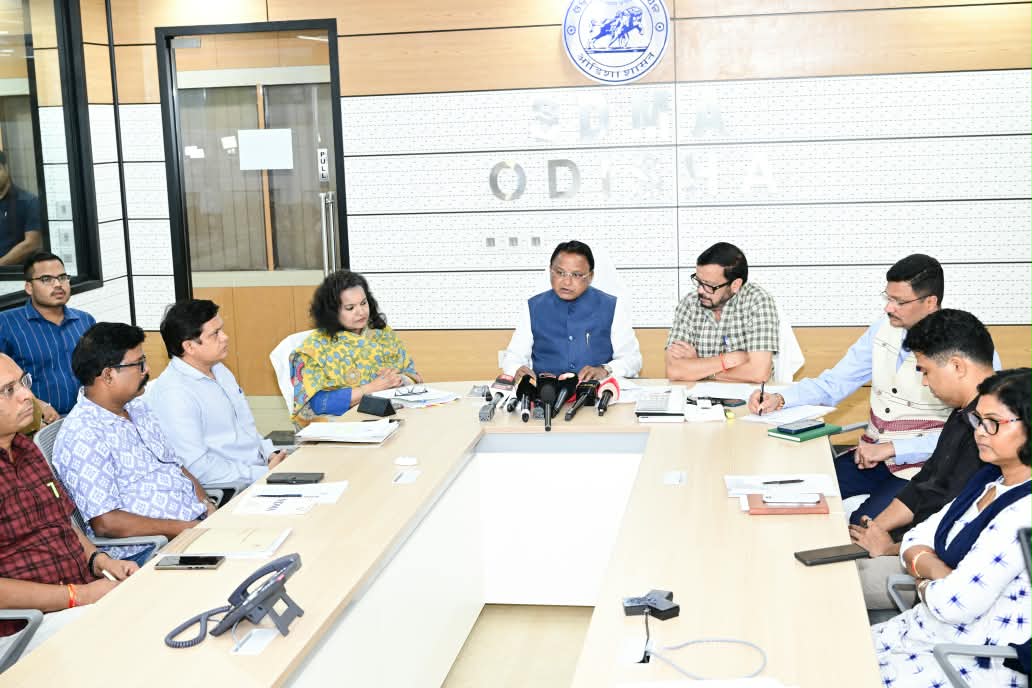
made by Majhi after chairing a high-level review meeting at the office of the
Special Relief Commissioner (SRC) here on Sunday evening to assess relief,
rehabilitation, reconstruction and damage assessment measures in the aftermath
of Cyclone Arnab.
Revenue and Disaster
Management Minister Suresh Pujari, Chief Secretary Anu Garg, Additional Chief
Secretary of the Revenue and Disaster Management Department Dr Arabinda Padhee,
and Special Relief Commissioner Rajesh Prabhakar Patil were among those present
at the meeting.
Briefing the media
after the meeting, the Chief Minister said he was in regular touch with the
Centre regarding the impact of Cyclone Arnab and the steps being taken by the
state government. He said he had also discussed the prevailing situation with
Union Home Minister Amit Shah.
A Central
Inter-Ministerial Committee will visit Odisha on November 2 to assess the
cyclone damage, particularly in the worst-affected districts of Ganjam,
Gajapati and Kandhamal, Majhi said.
Reiterating the
government's commitment to supporting all affected people, the Chief Minister
said the state government had extended assistance during previous disasters and
would ensure that all those affected by the present calamity also received
necessary support.
He also cautioned
that the impact of Cyclone Arnab had not completely subsided and there was a
possibility of another cyclone, Murass, approaching. Therefore, all government
teams currently deployed for relief, monitoring and supervision would remain
stationed in their respective areas and continue taking necessary measures
depending on the evolving situation, he said.
Under the immediate
relief component, every affected family will receive 50 kg of rice along with
Rs 2,500 as gratuitous assistance to meet their immediate requirements.
In the agriculture
sector, farmers who have suffered crop losses of 33 per cent or more will be
eligible for input subsidies covering a maximum of two hectares. The assistance
will be provided at the rate of Rs 8,500 per hectare for unirrigated land, Rs
17,000 per hectare for irrigated land and Rs 22,500 per hectare for perennial
crops. The minimum input assistance has been fixed at Rs 2,500 for perennial
crops, Rs 2,000 for irrigated land and Rs 1,000 for unirrigated land.
Farmers requiring the
removal of sand or silt deposits from their agricultural land will receive
assistance at the rate of Rs 18,000 per hectare, subject to a minimum
assistance of Rs 2,200 per farmer.
To facilitate
agricultural recovery, the government will distribute 1.20 lakh mini-kits of
pulses, 5,000 oilseed kits and 50,000 vegetable seed kits among farmers
affected by Cyclone Arnab. A total of 1.75 lakh special mini-kits will be
supplied under the programme.
For sugarcane
cultivation, special assistance will be provided in 2,000 hectares of affected
areas. Depending on farmers' requirements, financial support of Rs 27,500 per
hectare will be provided for demonstrating the space-transplanting method, or
Rs 12,500 per hectare for ratoon crop management.
The government will
also provide a 75 per cent subsidy on pesticides and bio-pesticides during the
Rabi season of 2026-27.
In another major
relief measure, short-term Kharif crop loans will be converted into medium-term
loans in areas where crop damage is 33 per cent or more. The facility will be
extended to farmers willing to avail themselves of the loan restructuring
arrangement.
The government will
also facilitate the formation of Joint Liability Groups (JLGs) during the
current Rabi season to ensure that tenant farmers, landless cultivators and
those cultivating land under oral agreements can access institutional credit.
For the housing
sector, families whose houses have been completely or severely damaged will
receive Rs 1.20 lakh in plain areas and Rs 1.30 lakh in hilly areas. Owners of
partially damaged pucca houses will be provided Rs 6,500, while those whose
kutcha houses have suffered partial damage will receive Rs 4,000. Assistance of
Rs 8,000 will be given for damaged huts and Rs 3,000 for damaged cattle sheds.
Families whose houses
have been washed away, completely destroyed or remained submerged for more than
two days will receive an additional Rs 2,500 for clothing and Rs 2,500 for
household utensils.
The package also
provides compensation to farmers who have lost livestock due to the cyclone. An
amount of Rs 37,500 will be paid for the death of milch animals, including cows
and buffaloes, while Rs 4,000 will be provided for each sheep, goat or pig
lost.
For large draught
animals such as camels, horses and bullocks, the compensation has been fixed at
Rs 32,000, while smaller draught animals, including calves, donkeys, ponies and
mules, will attract assistance of Rs 20,000. Poultry farmers will receive Rs
100 per bird, subject to a maximum compensation of Rs 10,000.
The government will
also provide subsidies to support 1,000 farmers in procuring replacement
livestock such as goats and bullocks. To help dairy farmers recover, 5,000 milk
producers in the affected areas will receive cattle feed at the rate of 100 kg
per animal, subject to a maximum of 500 kg per beneficiary.
Additionally, 200
poultry farms that have suffered more than 70 per cent damage will be supported
for restoration under the Chief Minister's Krushi Udyog Yojana.
In the fisheries sector,
fish farmers whose aquaculture operations have been damaged will receive
financial assistance of up to 75 per cent of the eligible cost, calculated at
Rs 1,12,500 per hectare.
For damaged fishing
assets, assistance of Rs 22,500 will be provided for fully or partially damaged
boats and Rs 15,000 for fishing nets. Marine fishermen and those operating in
Chilika Lake will receive Rs 60,000 for fully or partially damaged boats and Rs
15,000 for damaged fishing nets.
Assistance will also
be extended to fish farmers whose pond embankments have been breached or whose
ponds have suffered soil erosion. Community ponds leased by women self-help
groups will also be covered under the relief package, with financial assistance
of up to Rs 1.75 lakh per hectare.
The state government
has also included affected MSMEs, traders, shopkeepers, street vendors and
other commercial establishments in the relief package. The extent of damage to
commercial premises, cabins, stalls, machinery, fixtures, stocks and other business
assets will be assessed to determine eligibility for assistance.
Affected MSMEs,
traders and shopkeepers will be eligible for loan assistance of up to Rs 12
lakh. A subsidy of 25 per cent, subject to a maximum of Rs 3 lakh, will be
provided on the loan amount. The state government will directly transfer the
subsidy component to the concerned banks.
Street vendors,
temporary stall owners and kiosk operators will receive Rs 10,000, while shops
and other commercial establishments will be provided assistance of Rs 25,000.
Women self-help
groups affected by the cyclone will also receive additional financial support.
All eligible SHGs will be provided an additional seed money of Rs 5,000 to help
them revive their activities and restore their livelihoods.
In the handicrafts
and handloom sectors, weavers and artisans will receive Rs 5,000 per person to
replace damaged machinery, tools and equipment. An additional Rs 5,000 per
artisan will be provided to compensate for the loss of raw materials.
Sericulture farmers
have also been covered under the package. Farmers engaged in Eri, Mulberry and
Tasar silk cultivation will receive input assistance of Rs 6,000 per hectare,
while Muga silk farmers will be provided Rs 7,500 per hectare. In cases where
rearing houses have been completely damaged, affected sericulture farmers will
receive financial assistance of Rs 1.75 lakh each to rebuild the structures.
Meanwhile, the Odisha
Lift Irrigation Corporation will take immediate steps to repair lift irrigation
points in all affected villages on a priority basis. The Chief Minister has
directed the concerned authorities to ensure that all such irrigation points
are restored to operational condition before the commencement of the Rabi
season.
Emphasising the need for timely restoration of agricultural infrastructure, Majhi directed officials to undertake immediate repairs so that farmers could resume cultivation activities without delay.
The Chief Minister said the state government would continue to closely monitor the post-cyclone situation and take all necessary steps to ensure timely relief, rehabilitation and restoration of livelihoods across the affected regions.