
THEBUSINESSBYTES BUREAU
BHUBANESWAR, AUGUST 22, 2026
In a landmark move aimed at transforming the way sanitation
workers are protected, respected and socially secured, Odisha Chief Minister
Mohan Charan Majhi on Saturday announced that the fourth Saturday of August
will henceforth be observed as ‘Garima Diwas’, dedicated to creating greater
awareness about the safety, dignity and social security of sanitation workers.
The announcement came with a powerful message: in an era defined by artificial
intelligence, robotics and cutting-edge technology, no sanitation worker should
have to risk his or her life to perform a task that can be made safer through
innovation.
Addressing a national workshop on “Mission Zero – Ending
Fatality in Sanitation Work” in Bhubaneswar, Majhi said Odisha is determined to
make sanitation-related deaths a thing of the past by combining technology,
training, protective equipment and stronger social-security measures.
The Chief Minister announced that the state will soon deploy
modern technologies, including artificial intelligence, camera systems and
drones, to enhance the safety of sanitation workers, particularly those
required to enter septic tanks where toxic gases can cause fatal suffocation.
Majhi pointed out that sanitation workers often enter septic
tanks without knowing whether poisonous gases are present inside. He stressed
that technology must be used to determine whether a tank is safe before a
worker is permitted to enter it.
“Other people can also
see the inside view of the tank when one is working there by using technology,”
Majhi said, adding that the government plans to equip sanitation workers with
oxygen masks, helmets and other protective equipment to reduce the risks
associated with hazardous sanitation work.
Emphasising the government’s central objective, Majhi said
“Mission Zero” means zero casualties in sanitation-related work. The state, he
said, is moving towards a technology-driven sanitation system incorporating
safety equipment, oxygen systems, cameras, drones and AI.
“When India is making
rapid advances in robotics, artificial intelligence and other emerging technologies,
why can’t such innovations be deployed to safeguard sanitation workers?” he
asked. He also directed officials to ensure proper training so that sanitation
workers can operate modern equipment effectively and safely.
Majhi said the government’s approach must shift decisively
from compensation after a tragedy to prevention before it occurs. “Our goal is
not to help after death, but to protect them before death,” he said,
underscoring the need to make zero fatality the defining benchmark for
sanitation work.
The Chief Minister also highlighted the Centre’s NAMASTE
(National Action for Mechanised Sanitation Ecosystem) scheme and reiterated
Odisha’s commitment to strengthening social security for sanitation workers and
their families.
Recalling the state’s initiatives, Majhi said Odisha had
announced Rs 10 lakh life insurance coverage for sanitation workers last year.
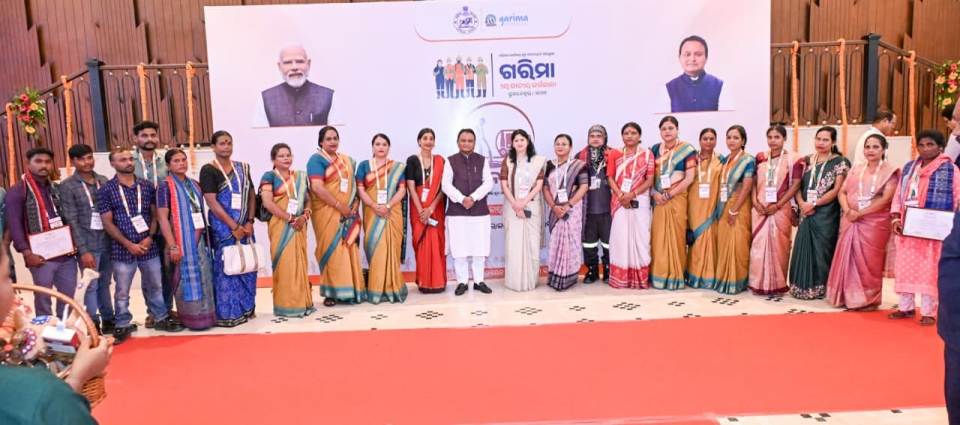
At the workshop, two beneficiaries were handed over insurance benefits of Rs 10
lakh each.
Majhi also credited Prime Minister Narendra Modi with
bringing the issue of dignity for sanitation workers into the national
discourse, saying that cleanliness has now emerged as a major subject of
governance alongside areas such as economics and defence.
The national workshop brought together experts,
sanitation-sector officials from eight states and sanitation workers, providing
a platform to deliberate on ways to eliminate fatalities and modernise
sanitation operations.
The Chief Minister also inaugurated an exhibition showcasing
modern safety equipment for sanitation work and handed over work orders for
houses to sanitation workers, reinforcing the government’s focus on both
workplace safety and social welfare.
Union Social Justice Secretary Sudhansh Pant appreciated Odisha’s initiatives for the welfare of sanitation workers and said the state had emerged as a model for others through the implementation of the ‘Garima Yojana’.
Chief Secretary Anu Garg reaffirmed the state government’s resolve to eliminate fatalities in sanitation work, declaring that the objective goes beyond policy statements and has become a firm administrative commitment. “Zero fatality is not just a slogan for us; it is a resolution,” she said.