THEBUSINESSBYTES BUREAU
NEW DELHI, AUGUST 11, 2026
Odisha is poised to emerge as a major science and
technology-driven growth hub on India’s eastern coast, with the Centre and the
state working on an integrated roadmap linking the proposed Rare Earth Corridor
with marine biotechnology, critical minerals, space technology, life sciences
and deep-ocean resources, Union Minister Dr. Jitendra Singh said on Tuesday.
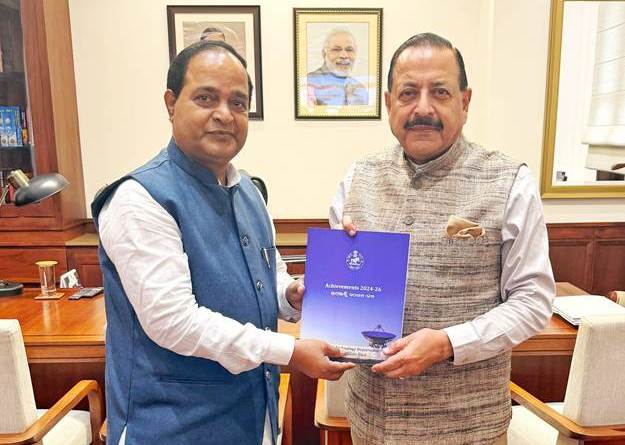
Dr. Singh, Union Minister of State (Independent Charge) for
Science and Technology and Earth Sciences and MoS in the PMO, held discussions
with Odisha Cabinet Minister for Science and Technology Krushna Chandra Patra
on expanding the state's scientific and technological ecosystem and said the
Eastern Coastal Region could play a much larger role in India's emerging
nuclear and marine roadmap.
A key decision was to expand the Department of
Biotechnology's Institute of Life Sciences (ILS), Bhubaneswar, with the Odisha
government to provide an additional 50 acres of land. The expanded facility is
expected to strengthen life sciences and biotechnology research and support
initiatives under the Bio-E3 framework -- Biotechnology for Economy,
Environment and Employment.
The discussions also focused on the Odisha Marine
Biotechnology Research & Innovation Corridor (OMBRIC), which has
partnerships with IIT Bhubaneswar, Berhampur University, Fakir Mohan
University, NIT Rourkela, IISER Berhampur and ILS Bhubaneswar. The next phase
will seek closer integration with the Ministry of Earth Sciences, CSIR and the
Department of Biotechnology to link Odisha's marine resources with advanced
research, biotechnology applications and industrial innovation.
Dr. Singh said convergence of marine science, earth sciences,
biotechnology and mineral-resource research could open new avenues for
sustainable utilisation of Odisha's extensive coastline, marine biodiversity
and coastal resources, including applications in health, food, materials and
environmental solutions.
The meeting also explored closer alignment of Odisha's space
capabilities with ISRO and the possibility of setting up a Space Research and
Manufacturing Centre in public-private partnership mode. The proposed ecosystem
could bring government institutions, space agencies, research organisations and
industry together for space applications, technology development and
manufacturing.
Odisha's role in India's emerging rare-earth ecosystem
figured prominently in the discussions. The Union Budget 2026-27 has proposed
dedicated Rare Earth Corridors in Odisha, Kerala, Andhra Pradesh and Tamil
Nadu, covering mining, processing, research and manufacturing to build an
integrated domestic value chain for rare earths and strengthen strategic
sectors and advanced materials.
With its coastal mineral resources and existing scientific
capabilities, Odisha is well placed to take forward rare-earth exploration and
technology development, while connecting the effort with national priorities
relating to atomic minerals and strategic technologies. The state already has
an important presence in India's rare-earth processing ecosystem.
The broader coastal agenda also covered the Deep Ocean
Mission and opportunities in deep-sea fisheries. Odisha's recently launched
Deep Sea Fishing Mission (2026-2036) seeks to unlock offshore and deep-sea
fisheries potential and develop stronger value chains around the marine
economy.
The proposed Science City in Odisha was discussed as a
public-facing initiative to promote scientific awareness, innovation and
experiential learning among young people. The Centre and state also explored
greater collaboration among Odisha's network of national scientific
institutions working in marine sciences, earth sciences, biotechnology,
critical minerals and space applications.
Odisha's participation in the forthcoming 'Swachh Sagar, Surakshit Sagar' campaign was also discussed, with coastal districts set to work with district administrations to promote public participation, coastal cleanliness and awareness about marine-environment protection.
Dr. Singh and Patra agreed on the need for sustained Centre-State coordination, with the proposed convergence of marine resources, biotechnology, critical minerals, space technology and scientific infrastructure aimed at creating a distinctive science-led development model for Odisha and the Eastern Coastal Region while advancing India's goals of technological self-reliance and sustainable resource utilisation.