THEBUSINESSBYTES BUREAU
BHUBANESWAR, FEBRUARY 8, 2026
Odisha is entering a decisive phase in its economic journey. Recent
business summits have recorded investment intents exceeding ₹1 lakh
crore, reflecting strong momentum across manufacturing, metals and
infrastructure. The challenge now before policymakers is to translate these commitments into durable, long-term economic
gains while ensuring that growth reaches Odisha’s own regions — particularly
those that remain economically lagging despite their abundant natural
resources.
One of the most promising pathways to achieve this balance lies in the
strategic development of domestic bauxite resources.
According to Dr Siba Mahakud, former Director of the Geological Survey of
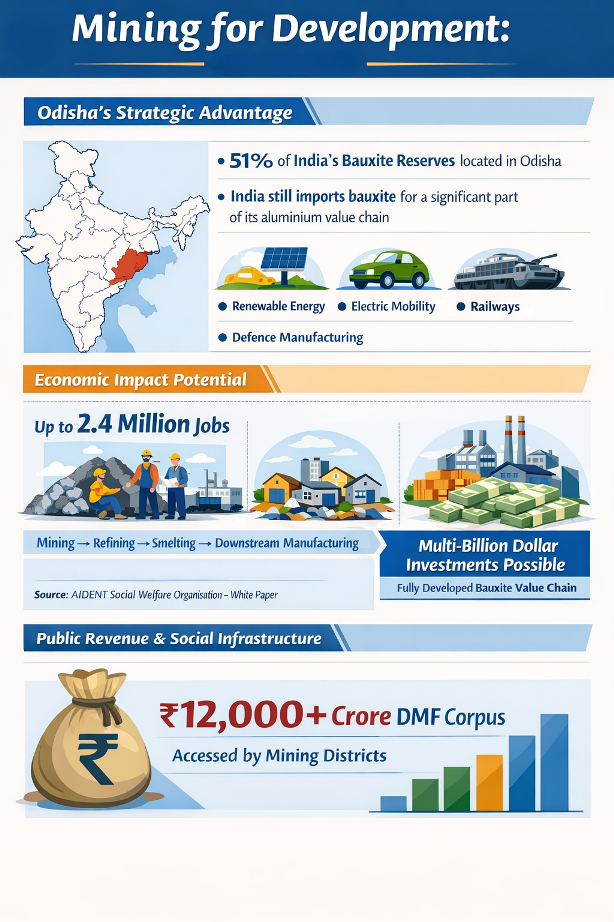
India, Odisha accounts for nearly 51 per cent of India’s bauxite reserves,
making it the country’s most critical source of raw material for aluminium
production. Yet, a significant portion of India’s aluminium industry continues
to rely on imported bauxite, exposing manufacturers to global price volatility
and supply-chain uncertainties. With aluminium demand rising sharply — driven
by renewable energy, electric vehicles, railways and defence production — this
dependence underscores an opportunity India has yet to fully harness.
 Beyond raw material security, bauxite development carries far-reaching
implications for employment and revenue generation. A recent white paper by
AIDENT Social Welfare Organisation (ASWO), a non-profit and non-partisan Indian
NGO, highlights that unlocking Odisha’s bauxite potential could create up to
2.4 million jobs across mining, refining, smelting and downstream
manufacturing. The study also estimates that more than 10,000 small and medium
enterprises could integrate into the aluminium ecosystem, while a fully
developed bauxite value chain could attract multi-billion-dollar investments into
the state over time.
Beyond raw material security, bauxite development carries far-reaching
implications for employment and revenue generation. A recent white paper by
AIDENT Social Welfare Organisation (ASWO), a non-profit and non-partisan Indian
NGO, highlights that unlocking Odisha’s bauxite potential could create up to
2.4 million jobs across mining, refining, smelting and downstream
manufacturing. The study also estimates that more than 10,000 small and medium
enterprises could integrate into the aluminium ecosystem, while a fully
developed bauxite value chain could attract multi-billion-dollar investments into
the state over time.
“These numbers matter most for
districts such as Kalahandi, Koraput, Rayagada and parts of Sundargarh — regions
that sit atop mineral wealth but continue to lag in income, infrastructure and
employment indicators,” said Dr Mahakud. “The aluminium value chain is
labour-intensive and geographically distributed. Mining generates direct
employment, while refineries, transport networks, maintenance services,
fabrication units and logistics hubs create sustained indirect jobs.”
Kalahandi offers a glimpse of how this transition can unfold. Once known
primarily for distress and migration, the district has witnessed gradual
economic diversification following industrial activity. The growth of ancillary
businesses, service enterprises and non-farm livelihoods has been documented
around industrial clusters, reducing dependence on subsistence agriculture and
daily wage labour while encouraging local entrepreneurship.
Revenue generation is another critical dimension of mining-led
development. Mining and downstream processing contribute through royalties,
taxes and local economic activity. Odisha already channels mining-linked funds
through the District Mineral Foundation (DMF), which supports healthcare,
education, drinking water, roads and livelihood programmes in affected
districts. The AIDENT white paper notes that mining districts have collectively
accessed a DMF corpus exceeding ₹12,000 crore, funding
hospitals, schools, mobile health units and women-led self-help group
enterprises.
Environmental and social considerations remain central to any expansion
of mining activity. The key question today is not whether bauxite should be
mined, but how. Advances in environmental monitoring, digital compliance
systems and clearer mine-closure norms have strengthened regulatory oversight.
When combined with transparent governance and meaningful community
participation, responsible mining can balance ecological protection with
economic development.
Globally, competition for critical minerals is intensifying, and recent supply-chain disruptions have highlighted the risks of import dependence. For India, strengthening domestic aluminium supply is an economic necessity. For Odisha, it represents a significant development opportunity.
As the state works to convert investment intent into on-ground growth, the responsible development of domestic bauxite can play a pivotal role — creating jobs, generating revenue and driving regional progress in districts that need it most. Done right, mining can move beyond extraction to become a foundation for inclusive and durable development.