THEBUSINESSBYTES
BUREAU
BHUBANESWAR,
APRIL 11, 2026
A focused
aluminium-led strategy could unlock Odisha’s next phase of industrial growth,
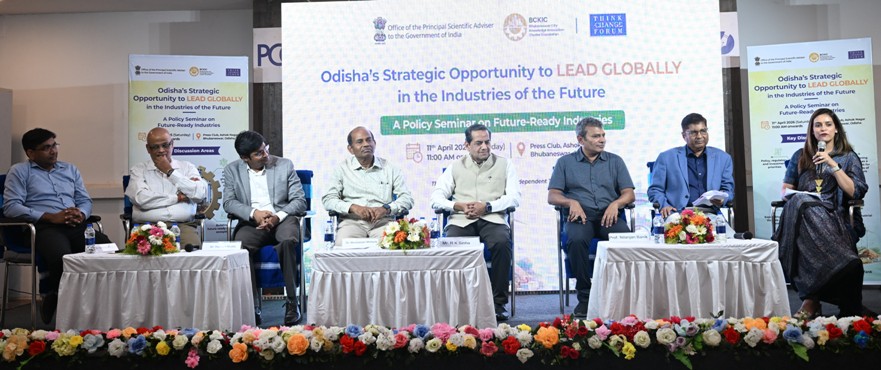
experts asserted at a policy seminar organised on Saturday by the Think Change
Forum in collaboration with the Bhubaneswar City Knowledge Innovation Cluster
Foundation under the Office of the Principal Scientific Adviser to the
Government of India.
The seminar, titled
“Odisha’s Strategic Opportunity to Lead Globally in the Industries of the
Future,” brought together policymakers, industry leaders, scientists and
environmental experts to deliberate on how the state can convert its vast
bauxite reserves into a globally competitive aluminium ecosystem. Discussions
focused on aligning Odisha’s Vision 2036 with actionable industrial outcomes by
strengthening value chains, boosting manufacturing competitiveness and creating
jobs.
A key concern raised
was the imbalance in Odisha’s industrial progress. While the state has advanced
significantly in steel through large-scale project approvals and
operationalisation of iron ore mines, the aluminium sector remains
underdeveloped despite Odisha holding the world’s fifth-largest bauxite
reserves and over 50 per cent of India’s total deposits. This gap has resulted
in rising imports, with India bringing in millions of tonnes of bauxite
annually and finished aluminium products worth over ₹70,000 crore, reflecting a missed
opportunity for domestic value addition and employment.
 Opening the
discussion, Prof. Mrutyunjay Suar, Chairman of BCKIC, stressed the need to
connect mineral strength with downstream manufacturing, MSME development and
innovation. He noted that Odisha’s industrial transformation must be
future-ready and anchored in value-added production.
Opening the
discussion, Prof. Mrutyunjay Suar, Chairman of BCKIC, stressed the need to
connect mineral strength with downstream manufacturing, MSME development and
innovation. He noted that Odisha’s industrial transformation must be
future-ready and anchored in value-added production.
Experts highlighted
aluminium’s growing importance in emerging sectors such as electric mobility,
renewable energy, transmission infrastructure, aerospace and advanced
manufacturing. In this context, Odisha is uniquely positioned to build
leadership, provided it accelerates the operationalisation of bauxite resources
and strengthens downstream linkages.
R.K. Sinha, former
Controller General of the Indian Bureau of Mines, emphasised that responsibly
unlocking bauxite reserves is critical to reducing import dependence and
driving industrial growth. He underlined that long-term success would depend on
aligning government, industry and communities, with active participation of
local populations through transparent and inclusive processes.
The seminar also
underscored the importance of faster project execution and tighter integration
across the aluminium value chain. Participants pointed out that upstream
development alone cannot deliver sustained economic benefits unless
complemented by downstream expansion that enables MSME growth, local enterprise
development and large-scale employment. Projects such as the Lanjigarh refinery
were cited as important anchors for regional industrial ecosystems.
From a policy
perspective, Kalyan Charan Mohanty of the Industrial Promotion and Investment
Corporation of Odisha Limited reaffirmed the state government’s commitment to
attracting investments and strengthening value addition. He said Odisha aims to
make aluminium a central pillar of its industrial growth over the next five to
six years through proactive facilitation and time-bound support.
Economist Prof.
Nilanjan Banik highlighted that while policy frameworks are largely sound,
execution gaps continue to hinder outcomes. He advocated for a bauxite-led
industrial corridor to drive integrated development in mineral-rich regions and
ensure alignment among stakeholders.
Estimates shared at
the seminar indicated that operationalising just three bauxite mining clusters
could add around ₹18,000
crore annually to the state’s GSDP, generate nearly 15,000
direct jobs and over 50,000 indirect jobs, and attract up to USD 2.5 billion in
downstream investments. Experts stressed that these gains would depend on how
effectively Odisha integrates mining, refining, manufacturing, logistics and
skilled manpower into a cohesive industrial ecosystem.
Speakers also
highlighted the role of advanced technology, research and sustainability. Dr.
Chinmay Sarangi of CSIR-IIMT emphasised the need for innovation-driven
capabilities in high-value aluminium applications, while environmental expert
Dr. Nihar Ranjan Sahu stressed that industrial expansion must be guided by
strong environmental governance and responsible mining practices.
Odisha stands at a
critical strategic inflection point, with its future industrial trajectory
closely tied to how effectively it strengthens the aluminium value chain and
utilises its vast bauxite resources. Accelerating key projects, deepening
downstream capabilities and building an integrated, sustainable and inclusive
industrial ecosystem will be crucial in positioning the state as a leader in
the industries of the future.