THEBUSINESSBYTES
BUREAU
NEW
DELHI, MAY 11, 2026
A large-scale study
tracking progress across 3,000 villages in four Indian states has found that
strong local institutions can play a transformative role in driving rural
well-being and building self-reliant villages. The findings of the
collaborative study by Observer Research Foundation and Reliance Foundation,
titled ‘A Decade of Doing More:
Evaluating Development Interventions in India’s Rural Frontiers’, were
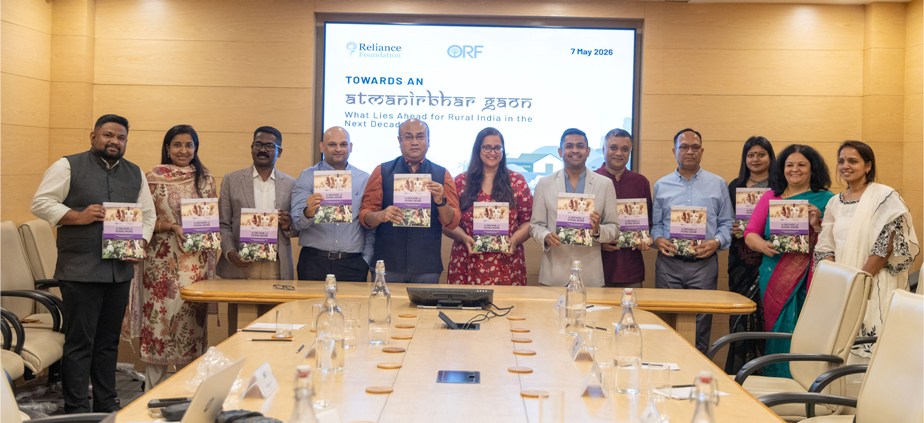
unveiled at a roundtable on “Towards an Atmanirbhar Gaon: What Lies Ahead for
Rural India in the Next Decade,” held here on Monday.
The study assesses
the long-term impact of development interventions over a 10-year period across
four clusters — Balangir in Odisha, Mandla in Madhya Pradesh, Adoni in Andhra
Pradesh, and Radhanpur in Gujarat. It closely examines changes in livelihoods
and living standards among more than 2,100 households to evaluate the outcomes
of these interventions.
 The evidence-based
insights and field learnings from the publication were presented by Dr Soumya
Bhowmick and Dr Saji M. Kadavil. The report highlights how integrated,
community-led development models are contributing to sustainable rural
transformation and advancing the vision of Aatmanirbhar Bharat. One of the key
findings of the study is that lasting rural transformation requires integrated
approaches and stronger collaboration among community-led institutions, civil
society, researchers, the private sector, and government stakeholders to scale
successful development models across rural India.
The evidence-based
insights and field learnings from the publication were presented by Dr Soumya
Bhowmick and Dr Saji M. Kadavil. The report highlights how integrated,
community-led development models are contributing to sustainable rural
transformation and advancing the vision of Aatmanirbhar Bharat. One of the key
findings of the study is that lasting rural transformation requires integrated
approaches and stronger collaboration among community-led institutions, civil
society, researchers, the private sector, and government stakeholders to scale
successful development models across rural India.
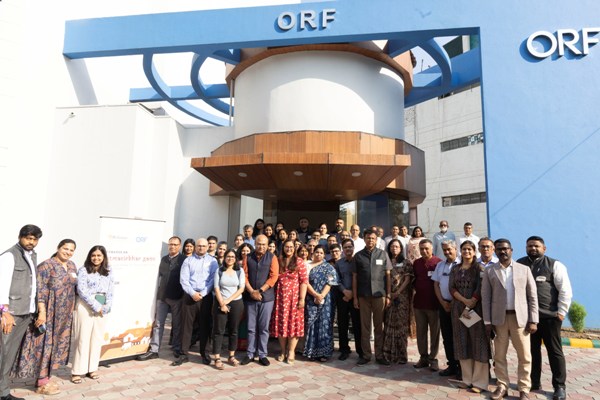
At the roundtable in
New Delhi, policymakers, development practitioners, and sector experts
deliberated on pathways for rural transformation in India.
Dr Nilanjan Ghosh,
Vice President, Development Studies, ORF, underscored the importance of
context-driven progress, stating that “True progress is context-driven, rooted
in resilience, inclusion and sustainability. When institutions evolve,
communities find agency, and stakeholders work together through integrated
action, we move beyond poverty alleviation towards creating self-reliant
ecosystems that are robust, replicable and built for long-term change.”
Sudarshan Suchi,
Chief Development Officer, Reliance Foundation, highlighted the importance of
community ownership and collaboration. “An Atmanirbhar Gaon is built when
communities find their voice, strengthen local institutions, and come together
to co-create solutions. Through collaboration, resilience, and collective
action, Reliance Foundation aims to bring people together and continuously
raise the bar for self-reliance,” he said.
Emphasising
institutional strength and technology-led transformation, Abhinav Sen, Head,
Rural Transformation Programme, Reliance Foundation, said, “Through
convergence, community participation, and the power of data and AI, Gram
Panchayats can be enabled to strengthen local governance, helping create
resilient, inclusive and future-ready villages.”
The roundtable
explored actionable pathways and the broader implications for India’s rural
development policy and future practices, while examining lessons from public
programmes, CSR initiatives, and community-based institutions. Participants
stressed the need for stronger institutional capacities, greater participation
of women and youth, and enhanced focus on environmental stewardship alongside
the responsible use of digital technologies.
The deliberations aimed to foster a shared commitment towards strengthening rural institutions, enhancing livelihoods, and enabling resilient, self-reliant villages — paving the way for a vibrant ‘Aatmanirbhar Gaon’ movement across India.
Reliance Foundation, the philanthropic arm of Reliance Industries Limited, seeks to play a catalytic role in addressing India’s development challenges through innovative and sustainable solutions. Led by Nita M Ambani, Founder and Chairperson, the Foundation works across rural transformation, education, healthcare, sports for development, disaster management, women empowerment, urban renewal, and arts, culture and heritage, and has impacted over 97 million people across India in more than 91,500 villages and urban locations.