THEBUSINESSBYTES
BUREAU
NEW
DELHI, MAY 19, 2026
Emphasising that
global volatility must be transformed into a catalyst for domestic reform and
long-term resilience, Union Commerce and Industry Minister Piyush Goyal on Tuesday
called for deeper and more structured collaboration between industry and
government to accelerate India’s journey towards Viksit Bharat 2047. Addressing
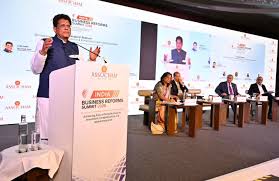
the ASSOCHAM India Business Reform Summit 2026 in New Delhi, the Minister said
the time demands sharper reforms, stronger competitiveness and a shared
commitment to building future-ready economic systems amid global uncertainties.
Highlighting the
evolving geopolitical and economic landscape, Goyal said current global
disruptions, including tensions in West Asia, should be viewed not with
apprehension but as an opportunity to strengthen India’s business ecosystem,
streamline processes and reinforce supply chain resilience. He underscored that
India, under the leadership of Narendra Modi, has consistently turned crises
into opportunities, citing the country’s successful navigation of challenges
such as the COVID-19 pandemic.
Speaking at the
ASSOCHAM India Business Reform Summit 2026, the Minister urged businesses to
remain alert yet composed, advocating smarter operations through productivity
enhancement, waste reduction and energy efficiency. He noted that digital
transformation and remote working models, accelerated during the pandemic, have
now become integral to India’s evolving economic architecture.
Goyal pointed to the
rapid expansion of Global Capability Centres (GCCs) in India, stating that
nearly 1,800 GCCs are currently operating in the country, generating around two
million direct and nearly ten million indirect jobs. He said this reflects
global confidence in India’s skilled talent pool and its growing position as a
trusted partner for international business operations.
Underscoring India’s
strength in services and emerging technologies, the Minister said sectors such
as artificial intelligence, cybersecurity and cloud computing will define the
next phase of economic growth. He added that the government is actively
building an enabling ecosystem for data centres and cloud services through
trusted global partnerships, expanded renewable energy capacity and robust
power infrastructure. He also noted that cloud services from Indian data
centres to global markets have been granted 100 per cent tax exemption till
2047, a move expected to attract significant long-term investments.
Referring to India’s
trade performance, Goyal highlighted that despite global headwinds, the
country’s exports reached a record USD 863 billion last year, driven by growth
in both merchandise and services. He said India is engaging with the world from
a position of strength, supported by 38 Free Trade Agreements that open new
avenues for investment and export expansion.
The Minister also
emphasised the need to move up the value chain in manufacturing and exports,
urging greater focus on automobiles, electronics, agro-based products and
consumer goods so that primary producers benefit from enhanced value addition.
He called for a shift from raw material exports to finished goods that can
compete on global shelves.
Reiterating the
government’s role as an enabler, Goyal spoke about ongoing reforms under
initiatives such as Bhavya and the planned development of 100 industrial parks,
20 of which are already underway. He also suggested exploring a unified
single-window mechanism within industrial parks to streamline approvals and
improve ease of doing business.
Calling for greater private sector participation in governance reforms, the Minister urged industry stakeholders to actively engage in improving systems such as the national single-window clearance mechanism. He also announced internal reforms within the Commerce Ministry to consolidate its 482 offices across 216 cities into integrated, digitally connected single-point service centres.
Goyal concluded by urging industry and government to jointly build a culture of quality, innovation, localisation and efficiency, suggesting shared scorecards to track progress across key economic parameters. He reaffirmed that India’s Amrit Kaal journey must remain outcome-driven, collaborative and focused on transforming global challenges into sustained economic opportunity.