By PRADYUMNA PANDA
Picture
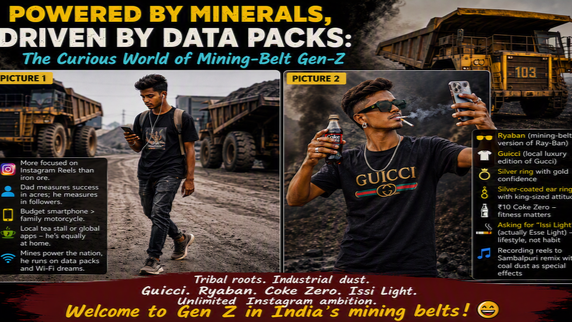
this: A 22-year-old from a mining town walking past
giant dumpers, more concerned about whether his Instagram Reel hit 10,000 views
than the minerals beneath his feet. The dust of the mine settles on his
clothes, but his dreams are shaped by YouTube influencers, viral trends, and
startup stories. While his father measures success in acres of land, he
measures it in smartphone storage, bike upgrades, and follower counts. Armed
with a budget smartphone that gets more attention than the family motorcycle,
he's equally at home in a village tea stall and the digital world. One moment
he discusses local jobs, the next he's debating the latest gadget, fantasy
cricket team, or AI app. The mines may power the nation's economy, but his
world runs on data packs, online sales, and Wi Fi-powered ambitions.
&
Picture
this: A Gen Z youngster who looked as if he had missed
a connecting flight to Milan Fashion Week and accidentally landed beside a coal
mine. Sporting a perfectly sculpted fade haircut, oversized black or green
"Ryaban" sunglasses (the
mining-belt version of Ray-Ban, where the spelling may vary but the swagger
remains premium), a flashy "Guicci" T-shirt (the local luxury edition of Gucci, where creativity extends even to the
logo), and a silver-coloured ring on his finger worn with the attitude of
someone flashing a gold heirloom, he stood beside a twenty-ton dumper as
confidently as if it were a Lamborghini. To complete the look, he sported a
silver-coated ear ring carried with the unmistakable confidence of a
mining-belt king convinced it belonged in a jewellery showroom's premium gold
collection. In one hand, he carried a ₹10 bottle of Coke Zero because fitness apparently
matters. In the other, he was asking the tea stall owner for an "Issi
Light" cigarette (actually Esse Light), proving that in the Gen Z universe, smoking is
sometimes treated more as a lifestyle accessory than a habit. Meanwhile, he
held his phone at the perfect selfie angle, recording a reel to a high-energy
Sambalpuri remix, with swirling coal dust providing free cinematic special
effects.
The scene was
beautifully ironic. His grandparents measured wealth in land, livestock, and
harvests. His parents measured it in jobs and monthly income. But this young
man measures success in reel views, follower counts, bike modifications,
branded knock-offs, and mobile data packs. The mine beneath his feet may be
producing minerals but he is busy mining likes, comments, and social-media
validation.
Welcome
to Gen Z in India's mining belts: tribal roots, industrial dust, Guicci,
Ryaban, and silver-coated ear ring worn
with gold-level confidence, Coke Zero, Issi Light (actually Esse Light), and unlimited Instagram
ambition, all standing proudly beside a giant dumper that has somehow become
the newest fashion accessory.
Forget everything you
thought you knew about rural consumer behavior. Set aside the old theories of
agrarian market cycles, monsoon-driven spending, and cooperative-income
economics. If you want to see where consumption is accelerating in the
hinterlands of Bharat, head to the red-dust edges of Odisha, Jharkhand, and
Chhattisgarh, especially the roadside tea stalls outside mines.
There, perched on a
plastic crate beside a rumbling twenty-ton dumper, sits a nineteen-year-old
tribal youngster in distressed jeans and a flashy branded T-shirt, using a
smartphone propped against a sack of coal dust to record the perfect transition
reel. The backdrop may be industrial, but the aspirations are entirely digital.
This generation has
moved well beyond survival shopping. Their purchasing decisions are
increasingly shaped by Instagram Reels, YouTube creators, Data packs, and the
relentless pursuit of social-media relevance. Whether formally educated or not,
they possess a remarkable ability to spot trending products, replacing
traditional grooming habits with vibrant hair colours, glow-enhancing face
washes, stylish accessories, and the latest energy drinks. The mine may power
the country's economy, but their aspirations are powered by algorithms, influencers,
and unlimited mobile data.
This deep dive
explores the eccentric, and fiercely modern consumer behavior patterns of Gen-Z
in India's mineral-rich mining corridors.
1. The Algorithm as the Ancestral Oracle: How Social Media Replaced Local
Wisdom
For generations,
consumer habits in India’s tribal belts were shaped by tradition and local
availability. If your grandfather used a neem twig or a locally made oil after
a hard day's work, you did the same. The supply chain was local, practical, and
rarely questioned.
Then came Gen-Z,
armed with smartphones and unlimited data. Their trusted advisor is no longer
the village elder but an Instagram algorithm serving skincare tips from
influencers hundreds of miles away while they sit outside a mine.
Today, social media
is their marketing dictionary. If an influencer features a face wash, body
spray, or grooming product in a viral reel, that product can become the next
must-have item at the local kirana store. Viral appeal often outweighs
traditional wisdom.
The irony is hard to
miss. A young man earning daily wages around a mine may spend part of his
income on a charcoal face wash promising "urban pollution defense"
because an influencer claimed it delivers "glass skin." The fact that
he's about to walk straight back into a cloud of coal dust is almost
irrelevant. The product is not just skincare, it's a small ticket to a more
modern, aspirational lifestyle.
2. The Great Hydration Paradox: Bottled Water as a Designer Handbag
When studying the
hydration habits of mining-belt Gen-Z, logic suggests that clean drinking water
should be their top priority. In reality, the story is far more entertaining.
These youngsters will
happily pool their money to buy soft drinks and brightly coloured energy drinks
while hanging out with friends, yet return home and drink regular tap or
tube-well water without a second thought. Rational consumer behaviour, meet
Gen-Z reality.
The comedy peaks at
the weekly haat bazaar. Stroll through the crowd and you'll often spot young
people carrying branded mineral water bottles. Are they desperately thirsty?
Not necessarily.
For many, the bottle
is as much a fashion accessory as a hydration tool. In a setting where drinking
from a handpump or carrying a steel water container feels too ordinary, a
sealed mineral water bottle becomes a subtle status symbol. And if a few Gen-Z
girls happen to be walking through the haat, the transformation is remarkable.
Suddenly, the weekly haat is no longer a village marketplace. In their minds,
it becomes a grand Sanjay Leela Bhansali film set, with slow-motion walks,
imaginary background music, carefully adjusted hairstyles, and the mineral
water bottle playing a starring role as the ultimate lifestyle accessory.
It quietly signals
modernity, hygiene, aspiration, and just enough disposable income to stand out
from the crowd. In the mining belt's emerging neo-middle class, that
transparent bottle often does more than quench thirst. It serves as a low-cost
luxury prop in a personal blockbuster, where every stroll through the haat is a
red-carpet moment and every passing glance is an audience review.
3. The Retail Theatre: Turning the Local Kirana into a Runway
In a Tier-5 mining
township where shopping once meant choosing between loose oil, glucose
biscuits, and dusty detergent packets, Gen-Z has transformed even the simplest
retail purchase into a performance.
When a young tribal
consumer walks into a kirana store, they don't just buy shampoo. They inspect
the sachet, ask for the "new vitamin C variant," and politely reject
local alternatives that don't have the right brand appeal. Their choices are
driven less by necessity and more by whatever is trending on Instagram or
YouTube.
If a popular brand
launches a flashy new neon-coloured package that looks good in a reel, it can
become an instant bestseller in the mining colony, regardless of what's
actually inside. For this generation, packaging is often as important as the
product.
Even the payment is
part of the show. Though the shopkeeper may prefer cash, they proudly pull out
a smartphone, scan the QR code, complete a UPI payment, and casually announce,
"Cash Nain Dharbar Mamu (Uncle, I don't carry cash anymore.)" In a
way, they are the unintended brand ambassadors of Jan Dhan, UPI, and Digital
India. Their grandparents may have opened bank accounts to receive benefits,
but the grandchildren use those accounts to buy trending face washes, energy
drinks, and mobile data packs with a level of confidence that would impress any
fintech executive. The QR code isn't just a payment tool. It's a supporting
actor in their personal story of becoming digitally savvy, hyper-connected, and
just a little more urban than the previous generation
4. The Economics of Vibe: Disposable Income Meets Local Volatility
To understand why
this generation can spend ₹50
on a flashy energy drink one day and cut costs the next, you need to understand
the unique economics of India's mining belts.
Unlike rural youth
whose spending is often tied to crop cycles, mining-belt Gen-Z grows up around
irregular bursts of cash. A land compensation payout, overtime driving a
dumper, earnings from transport contracts, or a few profitable days in the
scrap-metal trade can suddenly put money into a household.
On payday weekends,
local markets come alive. These youngsters pool their money to buy
imported-looking chips, trendy chewing gums, hair gels promising "extreme
spike hold," and deodorants with names that sound like action-movie
villains. For a few hours, a mining township feels less like rural India and
more like a shopping street in a big city.
More importantly,
they are actively rejecting the "rural" label. Every FMCG purchase is
a small declaration of aspiration. They want to smell like synthetic lavender,
style their hair like a K-pop star, and carry products that look as if they
belong in an influencer's reel rather than a village kirana store. In their
minds, the coal mine may provide the income, but the shopping basket provides
the identity.
5. The Payday Plate: From Humble Desi Chicken to Neon-Red Chilli Chicken
But step into a
roadside dhaba on a Saturday evening when the weekly mining wages or contractor
cash hits their pockets, and the menu undergoes a radical aesthetic upgrade.
Gone is the rustic home-style curry. Instead, this cohort proudly orders a
plate of heavy, neon-red chilli chicken dripping in artificial food colouring,
glistening under the fluorescent bulbs of a local eatery. It is spicy, it is
aggressively urban-styled, and most importantly, it looks like the dishes featured
in food vlogs. Just like their skincare, their weekend plate isn't just about
eating; it’s a sensory performance of metropolitan status.
6. The Ladies' Haat Bazaar Evolution: Aesthetics Meet Utility
Their clothing
choices have undergone an equally sharp transformation. Gone are the days when
traditional handloom sarees or standard ethnic suits were the only options.
Today’s tribal Gen-Z girls are walking down village lanes rocking oversized
graphic t-shirts, wide-leg cargo pants, and vibrant pastel kurtis paired with
chunky white sneakers. They want comfort and breathable fabrics that let them
dance effortlessly for their reels without worrying about a wardrobe
malfunction, while still screaming "Delhi-Mumbai street style" on
camera.
7. Split-Screen Romance: Dating Couples
8. The Local Icon: The "Rich Friend with a Car" as the First
Influencer
Long before
algorithms and metropolitan content creators captured their imagination, the
original trendsetter of the mineral belt was much closer to home: the local
"rich friend" blessed with family land compensation or contractor
money who actually owned a car.
In these remote
pockets, a car is not just a vehicle; it is a mobile status empire. The typical
behaviour of this local baron is a masterclass in community-driven aspiration.
On weekends, he rolls up to his close circle of friends, loads them into his
SUV, and plays tour guide to nearby Tier-2 or Tier-3 cities (like Rourkela,
Sambalpur, or Bhawanipatna). This road trip is a carefully orchestrated ritual
of patronage and peer upliftment. He treats his crew to local roadside
eateries, feeds them urban fast food they normally wouldn't splurge on,
This friend acts as
the very first ground-level influencer for these aspirational Gen-Z youth. By
redistributing his purchasing power and setting the blueprint for what cool
looks like in real life, he validates their desire for urban mobility long
before they ever see it on an Instagram reel.
9. The Digital Oracle & The Lightning-Fast Counterfeit Supply Chain
This demand has
created one of the most fascinating features of the mining-belt economy: an
incredibly fast counterfeit supply chain. While urban consumers may wait months
for new fashion trends to reach stores, youngsters in remote mining areas are
often already sporting the latest global styles. Not necessarily the originals,
of course, but proudly misspelled and wonderfully creative versions. Within
days of a trend going viral, local markets and weekly haats are stocked with
"Gucci," "Nike," "Supreme," and other look-alike
brands, bringing global fashion aspirations to tribal corridors faster than
many suburban malls can manage.
In the mining belt,
authenticity may be negotiable, but aspiration certainly isn't.
10. What This Means for Brands: The Death of Patronizing "Rural"
SKUs
Gen-Z in India’s
mining corridors possesses a razor-sharp bullshit detector. Having grown up
watching monstrous industrial machinery reshape their ancestral landscapes,
they are unimpressed by corporate condescension. If you try to sell them a
watered-down, visually dull product labelled explicitly as a "budget rural
pack," they will laugh it out of the shop.
Instead, brands that
want to win this high-velocity, high-aspiration market must realize that the
reel is the new television commercial, and the mining haul road is the new
fashion runway. Winning here requires delivering uncompromised aesthetic value,
vibrant packaging that looks good on camera, and functional products that align
with their digital self-image.
Ultimately, the
tribal Gen-Z consumer of India's mineral belt is rewriting the rules of retail.
They are proving that aspiration knows no geography. Give them a smartphone, a
few friends, and a world of possibilities, and they'll turn dust into dreams.
And yet, beneath the
Ryaban sunglasses, Guicci T-shirts, and endless reels lies something
beautifully simple: the ability to find happiness in small joys, whether it's a
bike ride with friends, a new outfit from the weekly haat, a viral reel, or a
shared plate of chilli chicken. Their ambitions may be global, but their
happiness remains wonderfully local.
Perhaps that's the
lesson hidden beneath the coal dust and Instagram filters: happiness isn't
about having everything, it's about finding joy in whatever life gives you.
Disclaimer:
This article is a light-hearted and
observational take on evolving consumer trends in India's mining belts, written
with a smile and a healthy respect for the communities that inspire it. The
characters and situations are drawn from real-life market observations but are
intentionally sprinkled with humour, irony, and a little creative exaggeration.
Not every youngster sporting "Ryaban," wearing "Guicci," or
chasing reel views fits these descriptions. If you happen to see a bit of
yourself in these stories, take it as friendly market research rather than a
personality report.
The
author, a specialist in Strategy, Communications, and Public Policy, may be
reached at [email protected]