New
and Renewable Energy Minister Pralhad Joshi announces major push under PM-KUSUM
THEBUSINESSBYTES
BUREAU
BHUBANESWAR,
OCTOBER 21, 2026
Union Agriculture
Minister Shivraj Singh Chouhan on Wednesday called for a farmer-centric
AgriVoltaics policy that integrates solar power generation with crop
cultivation, saying the technology could transform Indian farmers into both
food and energy providers while boosting their incomes.
Inaugurating the
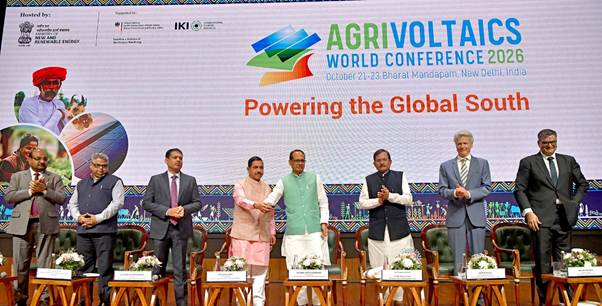
three-day 7th AgriVoltaics World Conference at Bharat Mandapam here, Chouhan
stressed that the model must be designed to suit the needs of small and
marginal farmers, who account for more than 85 per cent of the country's
farming community and have an average landholding of just 0.96 hectares.
He said farmers
should not have to sacrifice agricultural production to generate solar power,
emphasising that solar installations must allow efficient cultivation,
ploughing and crop rotation. The height of panels, spacing between support
structures and farm operations must be carefully planned to ensure that
agricultural productivity is not compromised, he added.
Under Prime Minister
Narendra Modi's leadership, farmers could move beyond being 'annadatas' or food
providers to become 'urjadatas' or energy providers as well, Chouhan said,
describing the integration of agriculture and solar energy as an opportunity to
improve rural prosperity and contribute to global welfare.
Drawing attention to
the practical challenges of implementation, the minister called for effective
rainwater drainage and collection systems to prevent soil erosion and conserve
water. He also stressed the need for assured electricity procurement, reliable
grid connectivity and transparent, timely payments to farmers.
Farmer Producer
Organisations should be actively involved in the initiative, while rural youth
and women should be trained in operating, repairing and maintaining solar
equipment to create employment opportunities within villages, he said.
Chouhan also called
for safeguards to protect farmers from financial and physical liabilities if
companies abandoned projects midway or solar panels had to be removed after the
expiry of contracts. Farmers, who invest their hard-earned money in
cultivation, must not be exposed to risks arising from poorly designed
projects, he said.
Highlighting the
broader progress of Indian agriculture, Chouhan said the country had moved from
dependence on foodgrain imports to a position of overflowing granaries, backed
by farmers' hard work. The sector continues to register a growth rate of 4.5
per cent, while agricultural exports have reached a record USD 52.55 billion,
he said.
He also noted that
sowing for the 2026-27 rabi season had commenced, with a particular focus on
pulses and oilseeds, underscoring the need for innovative approaches that
sustain agricultural output and improve farm incomes.
Union Minister for
New and Renewable Energy Pralhad Joshi, who also holds the Consumer Affairs,
Food and Public Distribution portfolio, said India was poised to expand
AgriVoltaics through the next phase of the PM-KUSUM scheme, under which the
government would soon launch what he described as the world's most ambitious
programme in the sector.
Citing a study by The
Energy and Resources Institute (TERI), Joshi said around 47.5 million hectares
of India's agricultural land were technically suitable for AgriVoltaics.
Maharashtra, Rajasthan, Andhra Pradesh, Madhya Pradesh, Karnataka and Uttar
Pradesh together account for about half of this suitable area.
If installations
covered just 10 per cent of the technically suitable land, India could meet its
projected electricity demand up to 2050 through the approach, he said, citing
the study. AgriVoltaics had also been found to increase crop yields by 10 to 20
per cent, offering the potential to combine food production with clean energy
generation.
Joshi said 30 lakh
agricultural pumps had already been connected to solar energy under PM-KUSUM,
helping farmers avoid the difficulties associated with irrigating fields at
night and providing access to daytime electricity.
The sector could
generate around 3.32 lakh full-time local jobs, according to studies, he said,
adding that such opportunities could help rural youth find livelihoods closer
to home instead of migrating to district headquarters and major cities.
On India's renewable
energy progress, Joshi said the country's total electricity generation capacity
had increased from around 249 GW before 2014 to more than 560 GW, while
installed non-fossil energy capacity had crossed 308 GW. India had added 100 GW
of non-fossil capacity in the preceding two-and-a-half years, he said.
The cost of
non-fossil electricity had also declined from Rs 11 per unit in 2012-13 to Rs
2.60 per unit currently, reflecting the impact of large-scale production, Joshi
added. He further noted that India had recorded GDP growth of 7.8 per cent in
the first quarter of the current financial year, describing the country as the
world's fastest-growing major economy.
Chouhan assured Joshi
that the Agriculture Ministry would work closely with the Ministry of New and
Renewable Energy to develop a model that supports farm productivity, expands
renewable energy and strengthens farmers' economic well-being.
The conference was attended by Minister of State for New and Renewable Energy Shripad Yesso Naik, German Ambassador to India and Bhutan Dr Jasper Wieck, Renewable Energy Secretary Santosh Kumar Sarangi, Agriculture and Farmers' Welfare Secretary Atish Chandra, ICAR Director General and Agricultural Research and Education Secretary Mangi Lal Jat, and International Solar Alliance Director General Ashish Khanna.
Technical tools and communication materials designed to help farmers and other stakeholders make informed decisions on AgriVoltaics were also released at the inaugural session, with the aim of supporting practical implementation and integrating agricultural operations with solar energy generation.