 By JAYAJIT DASH
India's oldest love
affair is now a national liability, and Prime Minister Narendra Modi's
uncomfortable ask deserves an honest answer.
There is something
almost Shakespearean about the moment. A civilisation that has worshipped gold
for 5000 years — that weaves it into marriage vows, embeds it into temple
walls, measures a daughter's worth in sovereigns — is being asked, gently but
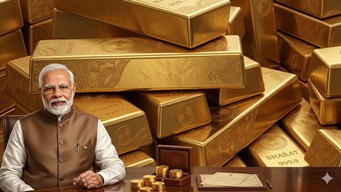
urgently, to stop. The Prime Minister’s appeal to Indians to defer gold
purchases for a year will be dismissed by many as political theatre. It is not.
It is an economic distress signal dressed in patriotic clothing, and the
numbers behind it are staggering enough to warrant serious attention.
Start with the
arithmetic. India imported $72 billion worth of gold in FY26 alone — a 24 per
cent jump from the previous year. To put that in perspective, gold now accounts
for nearly one rupee in every ten that India spends on imports. It sits
alongside crude oil, vegetable oils, and fertilisers as one of four commodities
that collectively drain over $240 billion from the country's foreign exchange
every year. Unlike oil, which powers factories and kitchens, or fertilisers,
which feed a billion people, the overwhelming bulk of India's gold ends up around
necks and in lockers. It is an imported desire, paid for in dollars, India
increasingly cannot spare
The broader context
makes the appeal even less easy to wave away. The Strait of Hormuz has been
effectively blockaded for over 70 days, courtesy of an Iran-US confrontation
that shows no signs of resolution. Crude prices have crossed $100 per barrel.
The rupee is under pressure. The IMF projects India's current account deficit
widening to $84.5 billion this year — roughly two percent of GDP. India's forex
reserves, though substantial at around $690 billion, slipped from a February
peak of $728 billion as global uncertainty intensified. The economy is not in
crisis, but it is in a posture where every unnecessary dollar that exits matters.
Think of India's
forex reserves as a dam. The water level is still reassuring. But two channels
are simultaneously draining it — one is expensive oil, and the other is
discretionary gold. You cannot shut the oil tap. You can, arguably, slow the
gold one.
Critics will
correctly point out that this is not a diktat but an appeal, and that personal
consumption choices in a market economy are not the government's business. Fair
enough. But the framing ignores something important: India's gold obsession is
not purely a market choice. It is culturally mandated spending — particularly
around weddings, where gold functions less as jewellery and more as social
currency.
The average Indian
family does not buy gold because it has done a portfolio analysis; it buys gold
because not buying it would be an affront to tradition. That is precisely what
makes Modi's appeal both bold and politically risky. He is not asking people to
give up a luxury. He is asking them to defer a ritual.
Where the
government's case grows weaker, however, is in its conspicuous silence about
structural complicity. India's own Free Trade Agreement with the UAE has, by
offering tariff concessions on precious metals, functionally subsidised the
surge in gold imports that officials now lament. The Global Trade Research
Initiative was blunt about this: the India-UAE FTA has "significantly
contributed" to the recent spike. You cannot light a fire, watch it
spread, and then ask citizens to please stop fanning the flames. If the
government is serious about protecting forex reserves, it must review the
concessions it has granted — not merely appeal to individual conscience.
There is also the
practical question of where this deferred capital should go. The suggestion to
shift toward Gold ETFs or SIPs is sensible — it keeps money within the Indian
financial system, allows gold price participation without dollar outflow, and
keeps capital productive. This should not be a footnote in the conversation; it
should be the headline. Give people an alternative worth choosing, and the
appeal becomes a policy. Without it, it is merely a request.
India's relationship
with gold is ancient, emotional, and economically irrational in equal measure.
Modi has done something that politicians rarely do — he has told a nation its
most beloved habit is currently unaffordable. The honest response is not to
mock that ask, but to acknowledge the arithmetic behind it, demand that the
government fix its own structural failures, and then, perhaps, leave the gold
in the vault for just a little while longer.
The
author – a Corporate Communications Leader, Award winning Author and Blogger –
leads the Corporate Communication Department of CSM Technologies Pvt. Ltd