
THEBUSINESSBYTES
BUREAU
NEW
DELHI, MAY 11, 2026
Emphasising that the
convergence of agriculture and healthcare can transform India’s public health
landscape, Union Health Minister JP Nadda on Monday said the integration of
scientific research, nutrition and farming systems would help deliver
“low-cost, high-quality and scientifically validated solutions” for the
country.
The remarks came as
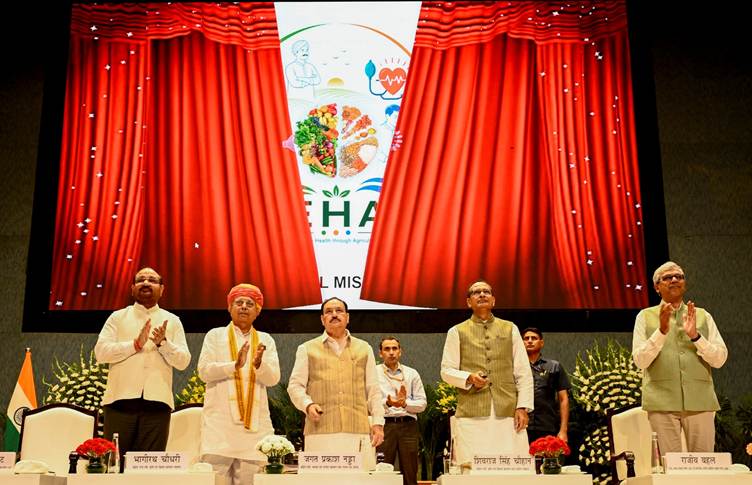
Union Health and Family Welfare Minister JP Nadda and Union Agriculture and
Farmers’ Welfare Minister Shivraj Singh Chouhan jointly launched the ‘SEHAT
Mission’ in Delhi — a major national initiative under the leadership of Prime
Minister Narendra Modi aimed at linking agriculture, nutrition and public
health through scientific collaboration.
Jointly launched by
the Indian Council of Agricultural Research and the Indian Council of Medical
Research, the mission seeks to establish a framework for “Healthy Food, Healthy
Farms and a Healthy India”. Union Minister of State for Agriculture and
Farmers’ Welfare Bhagirath Choudhary, ICMR Director General Dr Rajiv Bahl and
ICAR Director General Dr ML Jat were also present at the launch programme.
Addressing the
gathering, Nadda described the ‘SEHAT Mission’ as a transformational shift in
India’s policy approach, where governance is no longer centred only on
treatment but increasingly focused on prevention, early detection and
continuous care. He said the initiative reflects India’s transition towards a
proactive rather than reactive healthcare model.
Nadda noted that
agricultural and health institutions in the country had functioned
independently for decades, but the coming together of ICAR and ICMR marks the
beginning of a new era of science-based and evidence-driven policymaking. He
said the mission would play a key role in tackling both malnutrition and the
rapidly growing burden of non-communicable diseases such as diabetes,
hypertension and cancer.
“Low-cost,
high-quality and scientifically validated solutions will be the most useful for
the country, and ICMR is fully committed to working in this direction,” Nadda
said.
The Union Health
Minister further stated that the ‘SEHAT Mission’ is not merely a standalone
programme but a “whole of government” and “whole of systems” initiative where
science, policymaking and implementation mechanisms work in an integrated
manner. He expressed confidence that the mission would significantly contribute
towards building a healthier and stronger India.
Union Agriculture
Minister Shivraj Singh Chouhan described the launch of the mission as a
historic and unprecedented step that would create a robust framework for integrating
farming, nutrition and healthcare.
Chouhan said Indian
tradition has always regarded a healthy body as the greatest source of
happiness and stressed that good health fundamentally depends on proper food.
He said the country must now move beyond the objective of merely increasing
agricultural production and instead focus on producing nutrition-rich food
capable of improving quality of life and protecting people from diseases.
Referring to the
Indian philosophical principles of “Hitbhuk, Mitbhuk and Ritubhuk”, Chouhan
said beneficial, balanced and seasonal food remains the true foundation of
health even today. He underlined the need for the country to deliberate not
only on “what people should eat” but also on “what the country should grow”.
According to Chouhan,
the ‘SEHAT Mission’ aims to create a scientific chain connecting farms, food
plates and public health through coordinated efforts of ICAR and ICMR. The
initiative will focus on bio-fortified crops, nutrient-rich food products, integrated
farming systems, farmer health and safety, dietary solutions for lifestyle
diseases and the ‘One Health’ approach.
The Union Agriculture
Minister said that while India has achieved sufficient foodgrain production,
the next major national target should be nutrition-oriented agriculture. He
emphasised the promotion of bio-fortified crops enriched with zinc, iron and other
nutrients, along with traditional grains such as kodo millet, kutki, jowar,
ragi and bajra.
Chouhan also
highlighted the importance of integrated farming systems, stating that crop
cultivation combined with fruits, vegetables, animal husbandry, fisheries and
beekeeping can improve family nutrition and healthier lifestyles in rural
India. He said the health and safety of farmers and agricultural labourers
would also form an important component of the mission through scientific
interventions, safe farming practices and awareness initiatives aimed at
reducing risks from pesticide exposure and hazardous agricultural conditions.
The Union Minister
further observed that if scientific research is undertaken on proper food
habits and suitable crop selection, food itself can function as medicine.
Referring to diabetes, hypertension and other lifestyle diseases, he stressed
the need to develop food alternatives capable of preventing illnesses and
supporting disease management.
Officials associated
with the programme said the mission seeks to establish stronger institutional
coordination between agriculture and medical research systems so that food
production, public nutrition and disease prevention can be addressed through
integrated scientific planning.
Among the expected outcomes of the initiative are improved nutritional quality, reduction in hidden hunger and micronutrient deficiencies, prevention of non-communicable diseases, better health and safety for farmers, sustainable food systems and stronger science-based policy support. The mission will also encourage long-term research on the relationship between food systems, nutrition patterns and disease trends in India
Congratulating scientists, officials and participating institutions associated with the initiative, Chouhan said the coming together of agriculture and healthcare would benefit not only India but humanity as a whole. Officials also outlined that the mission’s full form — “Science Excellence for Health through Agricultural Transformation” — reflects its objective of linking agriculture with better nutrition, disease prevention, farmer welfare and evidence-based policymaking.