THEBUSINESSBYTES
BUREAU
BHUBANESWAR,
OCTOBER 26, 2026
When institutional
commitment meets individual courage, the result can be transformative. The
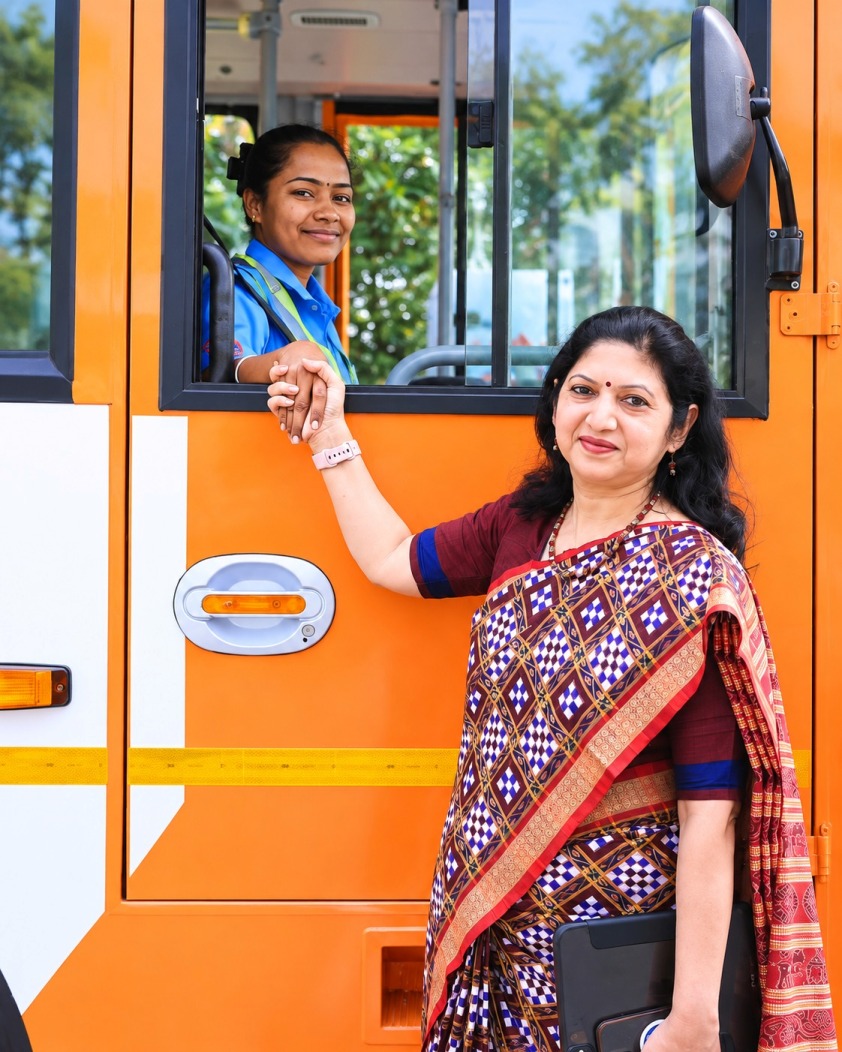
meeting between Usha Padhee, Additional Chief Secretary, Housing and Urban
Development Department, and Subhalaxmi Mahananda, Odisha’s first woman
electric-bus driver from Keonjhar district, captured the human story behind the
State’s evolving urban mobility landscape — one in which women are not merely
beneficiaries of change but active participants in shaping it.
More than a
photograph, the encounter symbolised the convergence of policy support,
opportunity and personal determination. It underscored how sustained
institutional efforts can help women challenge social conventions, enter
non-traditional professions and carve out new avenues for economic
independence.
The meeting took
place against the backdrop of the 19th Urban Mobility India (UMI) Conference
and Exhibition and the second National Urban Conclave (NUC), hosted in
Bhubaneswar from October 23 to 25, 2026. With UMI being held in eastern India
for the first time, the twin events brought Odisha’s vision of accessible
public transport, inclusive urban growth and liveable cities into the national
spotlight.
From Keonjhar to the
driver’s seat of an electric Ama Bus, Subhalaxmi’s journey gives a human face
to this larger vision. For young girls who see her behind the wheel, a
profession once regarded as unconventional is becoming a tangible career
possibility. Every journey she undertakes carries a message that women can do
more than participate in public services; they can help lead and shape the
essential systems that keep cities moving.
This progress
reflects coordinated institutional efforts involving the Commerce and Transport
Department, the Transport Commissioner and the managing director of Capital
Region Urban Transport (CRUT). Their work across policy formulation, skills
development, livelihood generation and transport operations is helping create
an enabling environment in which women can enter the sector, acquire
professional competence and build sustainable careers.
CRUT’s initiatives to
widen women’s participation in public transport include advanced electric-bus
driving training for 20 women who hold Heavy Motor Vehicle licences. Women
employed as drivers, conductors and feeder-service personnel are contributing
to a more inclusive public transport system while demonstrating their
professional capabilities to thousands of commuters. Their growing presence is
also helping challenge established perceptions about women’s roles in
occupations traditionally dominated by men.
The broader ambition
is reflected in Atmanirbhar MAhila SuVahak (AMA SuVahak), an initiative that
envisages the creation of 2,450 women-led transport enterprises across Odisha.
The scheme provides for interest-free loans of up to ₹10 lakh for vehicle purchases, an
additional incentive of ₹2 lakh for electric vehicles, and free driving and
entrepreneurship training, along with licensing support. Priority assistance
for members of Self-Help Groups and other eligible women,
coupled with integration with ride-hailing platforms, is intended to bridge the
gap between skills, vehicle ownership and viable income-generating
opportunities.
By combining
financial assistance with training and market access, the initiative seeks to
enable women to move beyond employment into entrepreneurship. Access to
vehicles, professional licences and digital platforms can help create pathways
to independent livelihoods while expanding the pool of women participating in
the transport economy. The emphasis on electric vehicles also links livelihood
generation with the wider transition towards cleaner and more sustainable urban
mobility.
These efforts are
unfolding alongside the expansion of Odisha’s public transport network. CRUT
has grown from a single-city operation into a network of 770 buses operating
across 138 routes, with electric buses accounting for 51 per cent of its fleet.
Nearly 48 per cent of ticketing transactions are cashless, indicating the
growing adoption of digital payment systems and technology-enabled passenger
services. The expansion reflects a broader effort to improve connectivity while
making urban transport more efficient, accessible and responsive to commuters’
needs.
At UMI 2026, the CRUT
pavilion showcased this transformation through displays and presentations on
Ama Bus services, electric mobility, Odisha Yatri, intelligent transport
management, digital ticketing, safety and accessibility initiatives. The
pavilion offered visitors a glimpse of how technology, service innovation and
public transport infrastructure can work together to improve the urban
commuting experience. CRUT also contributed to the planning, coordination and
execution of the event, helping bring Odisha’s experience in public mobility to
a national audience.
Guided by the theme
“Urban Accessibility and Liveability in the Digital Age”, UMI examined how
transport systems can connect people with opportunities and make cities more
inclusive, accessible and sustainable. The discussions highlighted the
importance of placing people at the centre of urban planning and ensuring that
mobility solutions respond to the needs of diverse communities. Alongside the
National Urban Conclave, the conference reinforced the vision of building future-ready
cities in which efficient transport, digital innovation and social inclusion
advance together.
Within this larger
conversation, the meeting between Usha Padhee and Subhalaxmi acquired a
significance that extended beyond the formal proceedings of a national
conference. It brought the policy framework and its intended social impact into
a single frame: an administrator working to create opportunities and a woman
whose determination has enabled her to seize one. Their encounter illustrated
how institutional commitment can translate into individual achievement and, in
turn, inspire others to follow a similar path.
Subhalaxmi’s story is
a reminder that the transformation of public transport is not measured solely
by the number of buses deployed, routes added or digital transactions
completed. It is also reflected in the people who gain access to new
professions, the barriers that begin to fall and the aspirations that become
attainable. Behind every woman taking the wheel are opportunities created, skills
nurtured, support systems strengthened and the courage to take the first step.
As Odisha continues to expand its public transport network and promote women’s participation in the mobility sector, stories such as Subhalaxmi’s offer a glimpse of the social change that can accompany infrastructure development. The challenge ahead is to ensure that such opportunities reach more women across the State and translate into lasting employment, entrepreneurship and economic independence.
At the heart of Odisha’s mobility vision lies a simple but powerful proposition: inclusive cities require inclusive opportunities. As the State moves forward, institutional commitment can open doors, individual courage can drive change, and a new generation of girls can begin to see themselves not merely as passengers in the journey of development, but as drivers of its future.