
THEBUSINESSBYTES
BUREAU
SAMBALPURR,
JANUARY 12, 2026
“The ability to see the future is one of the
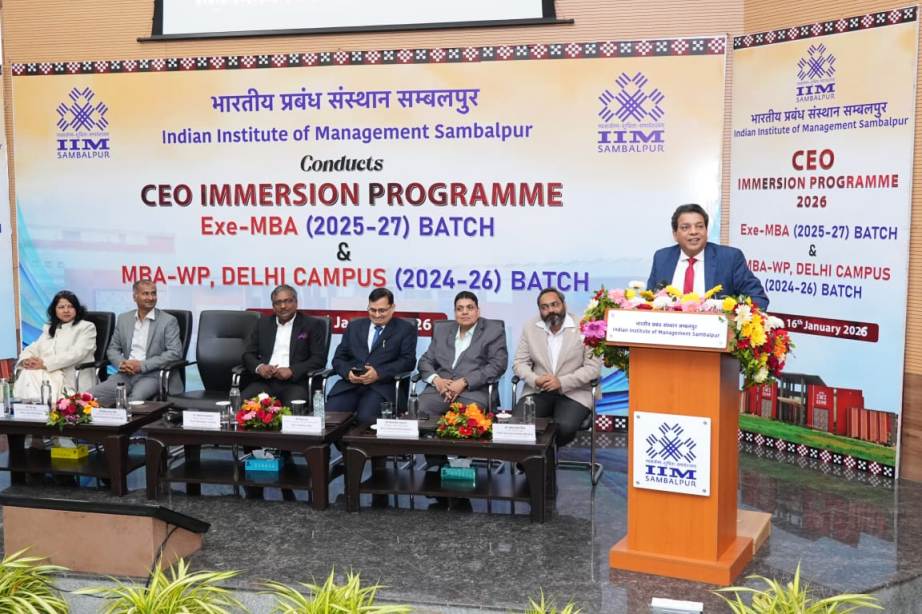
most critical leadership skills for survival and growth,” said Brijendra Pratap
Singh, CMD, NALCO, as he addressed participants at the CEO Immersion Programme
hosted by IIM Sambalpur, urging leaders to change before disruption arrives if
they wish to lead rather than merely survive. His message set the tone for the
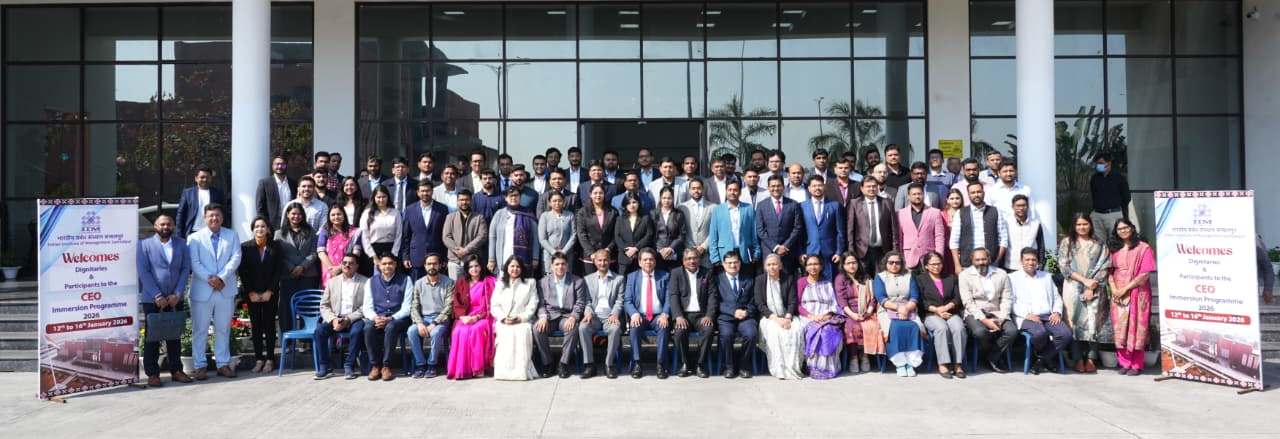
five-day CEO Immersion Programme held for the Executive MBA (2025–27) and MBA
for Working Professionals (2024–2026) batches at the institute’s Delhi Centre.
 Speaking on
leadership in times of transformation, Brijendra Pratap Singh emphasised
proactive change, noting that organisations which anticipate disruption and
adapt early emerge as leaders in their sectors. His address resonated strongly
with the programme’s focus on future-readiness and strategic foresight.
Speaking on
leadership in times of transformation, Brijendra Pratap Singh emphasised
proactive change, noting that organisations which anticipate disruption and
adapt early emerge as leaders in their sectors. His address resonated strongly
with the programme’s focus on future-readiness and strategic foresight.
Organised
around the theme “The Future & Nature of Work: Skills, Culture, and
Sustainability,” the programme reflected the rapidly evolving workplace
landscape where technology, adaptive organisational cultures, continuous skill
development, and sustainability are redefining leadership and business models.
The initiative aimed to provide participants with practical exposure to emerging
industry trends and leadership perspectives through close interaction with
senior industry professionals.
The programme
was graced by Prof. Mahadeo Jaiswal, Director, IIM Sambalpur; Brijendra Pratap
Singh, CMD, NALCO, as the Chief Guest; Keshav Rao, Director (Personnel),
Mahanadi Coalfields Limited, as Guest of Honour; Biswajit Mahapatra, Head of
Customer Solutions and CIO Advisory, India and South Asia, Amazon (AWS), as
Guest of Honour; and Narendra Babu, CTO, PayU Payment, as the Keynote Speaker.
Welcoming the
guests and participants, Prof. Mahadeo Jaiswal highlighted the structural
shifts shaping tomorrow’s workplace, saying, “By way of this event, we must
understand that future of work will be shaped by what we call the 3D
Disruption- digitalization, decarbonization, and democratization of business.
Globally, organisations are reorganising themselves around Global Capability
Centres (GCCs), and today 53 per cent of these GCCs are based in India, making
the country a centre of excellence for global business. New jobs and skills
will emerge from clean energy sectors such as solar, nuclear, and bio-energy.
Traditional automobile companies will give way to electric vehicles, and petrol
pumps will eventually be replaced by charging stations.”
Highlighting
IIM Sambalpur’s broader societal role, Keshav Rao praised the institution’s
decade-long journey, saying, “In just ten years, the institution has
demonstrated tremendous hard work and commitment to institution building, with
deep engagement not only with the academic community but also with industry and
the local community. Such engagement has helped community members improve their
incomes and manage their affairs more effectively, reflecting the institution’s
holistic approach to growth and development as well as giving importance to
women empowernment.”
The CEO
Immersion Programme stands as one of IIM Sambalpur’s flagship initiatives,
designed to bridge academia and industry by fostering meaningful dialogue
between corporate leaders and management students. The sessions featured
insights from CEOs and senior leaders from organisations such as Tesla India,
United Breweries Trading Ltd, the Consulate General of India in Auckland,
Deloitte Digital, Tata Business Excellence Group, Fidelity National Information
Services, Inc. (FIS), and Mahanadi Coalfields Limited, offering participants a
rich, real-world perspective on navigating the future of work through skills,
culture, and sustainable business practices.