
Corporate
communication is ultimately about preserving credibility, and even in 2026,
that credibility still rests on the most basic professional courtesy: returning
a call, says Priyabrat
Biswal
I spent nearly two
decades on the edit desk of a media house before walking away when self-respect
became non-negotiable. My work was largely confined to editing, punctuated
occasionally by visits to corporate press conferences. Yet those rare field
assignments, combined with years of interacting with corporate communication
teams from behind a desk, offered a revealing education in how public relations
in India has steadily drifted from relationship-building to hierarchy
management.
For journalists
outside the handful of “elite” media brands, invisibility is often the default
setting. The experience repeats itself in conference hall after conference
hall: the same event, the same questions, the same deadlines — but very
different treatment. At an FMCG press conference in 2014, I asked the COO for
his business card and was told he was “out of stock.” Minutes later, I watched
him warmly hand out cards to reporters from two leading national dailies,
smiling with the enthusiasm reserved for circulation figures and television
ratings. I never asked again. Dignity, I realised, should not require a
masthead.
The problem, however,
goes far beyond selective hospitality. Accuracy itself is now often treated as
an inconvenience. Once, while reviewing a press release issued by a reputed
private aluminium company, I pointed out a glaring factual error to the PR
agency handling the account. Instead of appreciation, I received a lecture. The
agency representative — eager to flaunt his “25 years in print media” before
moving into PR — dismissed me as “too young” to identify mistakes in their
copy. The error stayed. Ego mattered more than credibility. Somewhere along the
way, fact-checking began to be viewed not as professional responsibility, but
as an act of defiance.
The one-way nature of
corporate courtesy became even clearer in my interactions with the
communications head of a power distribution company operating in Odisha. Out of
professional courtesy, I routinely flagged errors in their press releases
through calls, texts and emails. None were acknowledged. No reply. No “thank
you.” No correction update. Yet the moment I published a fact-based report that
portrayed the company unfavourably, the machinery sprang to life. Calls arrived
instantly. PR intermediaries were activated. The message was blunt: take the
story down.
That, increasingly,
is the modern corporate communication model. Engagement exists for damage
control, not dialogue. Courtesy is optional. Criticism is treated as a crisis.
Behind this behaviour
lies an unwritten but rigidly enforced pecking order. Many corporate communication
and PR professionals first judge journalists by the brand they represent, then
by the designation they hold within that organisation, and finally by their
usefulness in either amplifying corporate messaging or suppressing inconvenient
truths. Satisfy all three conditions and doors open effortlessly. Fail one, and
messages remain unread, calls unanswered, invitations selectively withheld.
What has disappeared
is not merely professionalism, but basic human regard. Many PR executives who
once maintained cordial working relationships now struggle to extend even the
elementary courtesy of acknowledgment. The experience increasingly feels transactional
to the point of indignity — journalists are useful during moments of
vulnerability, then instantly discarded once the crisis passes.
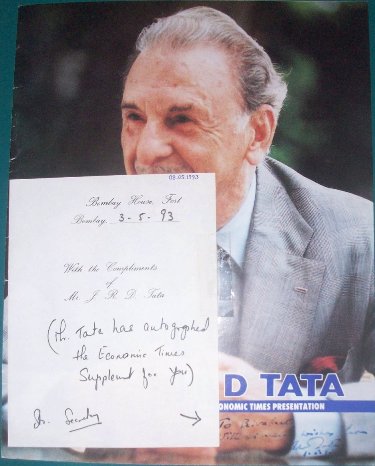 The contrast with an
earlier era is striking. Long before I entered journalism, I wrote a letter to
J. R. D. Tata through the corporate communication department of Tata Steel. The
letter reached his office, and his secretary arranged for an autographed
photograph to be sent back. There was no audit of my social standing, no
scrutiny of institutional affiliation, no calculation of utility. There was
simply an institutional culture that valued responding to people with dignity.
That culture now appears dangerously diminished.
The contrast with an
earlier era is striking. Long before I entered journalism, I wrote a letter to
J. R. D. Tata through the corporate communication department of Tata Steel. The
letter reached his office, and his secretary arranged for an autographed
photograph to be sent back. There was no audit of my social standing, no
scrutiny of institutional affiliation, no calculation of utility. There was
simply an institutional culture that valued responding to people with dignity.
That culture now appears dangerously diminished.
What should corporate
communication and public relations actually represent? At its best, the profession
demands individuals mature enough to understand that they are custodians of an
institution’s credibility, not gatekeepers protecting personal ego. A
journalist who points out an error is preventing public embarrassment, not
staging rebellion. Respect cannot be conditional on the size of a newsroom
because media landscapes are fluid. Today’s regional reporter may become
tomorrow’s national editor, influential independent journalist, or RTI activist
exposing an environmental or financial lapse.
Courtesy must also
function both ways. If a company expects journalists to attend a 10 a.m. press
conference, it should be willing to answer their calls when an industrial
accident occurs at midnight. If a WhatsApp message sent late at night can
request that a damaging story be withheld, then a simple acknowledgment when
factual errors are pointed out should not be considered excessive effort.
More importantly, the
profession must rediscover the difference between relationships and
transactions. Relationships survive difficult quarters and uncomfortable
headlines. Transactions collapse the moment coverage turns critical.
Above all, corporate
communicators must remember one uncomfortable truth: they are not the story.
Their role is not to manufacture reality or police access to it. Their
responsibility is to facilitate the flow of truthful information between
institutions and the public. They are meant to be bridges, not bouncers.
This brand-tier
approach to public relations is quietly creating a media underclass, and the
consequences are corrosive. Journalists who are repeatedly ignored do not
disappear. They become cynical. They stop calling to verify facts. They stop
extending the benefit of doubt. When every interaction is reduced to
transactional utility, public trust erodes alongside corporate credibility.
Corporate
communication is not celebrity management. It is credibility management. And
credibility, even in 2026, still begins with the simplest professional decency
of all: returning a call.
(The views expressed in this article are
those of the author and do not necessarily reflect the views of the website or
its management.)