THEBUSINESSBYTES
BUREAU
BHUBANESWAR,
JANUARY 18, 2026
The global
economic order is undergoing a profound and rapid transformation. Fragmented
supply chains, intensifying geopolitical risks, and growing competition for
strategic resources are redefining how nations plan their industrial futures.
Against this backdrop, the discussion surrounding Odisha’s bauxite resources
has moved far beyond the confines of mining or regional development. It has
emerged as an issue of national urgency. At a time when strategic autonomy and
supply security have become indispensable, India can ill afford to leave
substantial domestic bauxite reserves underexplored and underutilised.
Unlocking Odisha’s bauxite potential is increasingly central to safeguarding
economic sovereignty, strengthening industrial resilience, and securing India’s
position in a fast-changing global order.
“One global trend brings this urgency into
sharp focus. China today accounts for about 60 per cent of global aluminium
production, giving it unmatched influence over a metal that is essential to
sectors ranging from infrastructure and transport to renewable energy and
defence manufacturing. This dominance rests on access to raw materials,
particularly imported bauxite. China sources a substantial share of its bauxite
imports from Guinea, making global aluminium supply chains vulnerable to
regulatory, political, and logistical disruptions in a handful of geographies.
Recent policy shifts and export restrictions in resource-rich countries have
repeatedly demonstrated how quickly these dependencies can destabilise
markets”, said Dr. Siba Mahakud, Director (Retd.) Geological Survey of India.
 In this
evolving landscape, Odisha occupies a position of exceptional strategic
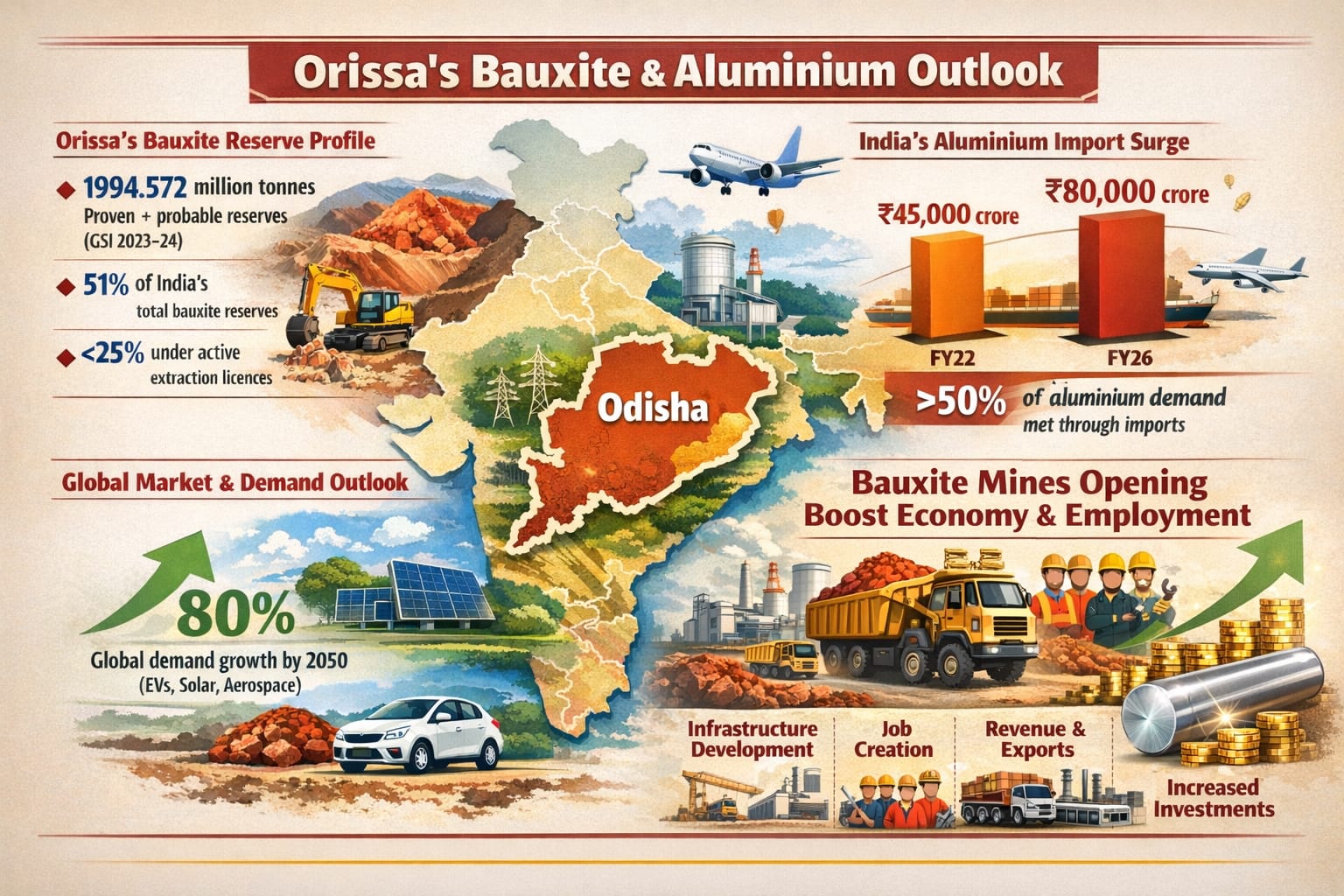
significance. India possesses nearly 3.9 billion tonnes of bauxite resources,
of which Odisha alone accounts for over 50 per cent. The state’s extensive
bauxite-bearing plateaus across districts such as Kalahandi, Koraput,
Sundargarh, Bolangir, and Sambalpur form the backbone of the country’s
aluminium raw material base. This endowment is not merely a geological
advantage; it represents a strategic asset at a time when advanced economies
are actively seeking secure, diversified, and responsibly sourced mineral
supply chains.
In this
evolving landscape, Odisha occupies a position of exceptional strategic
significance. India possesses nearly 3.9 billion tonnes of bauxite resources,
of which Odisha alone accounts for over 50 per cent. The state’s extensive
bauxite-bearing plateaus across districts such as Kalahandi, Koraput,
Sundargarh, Bolangir, and Sambalpur form the backbone of the country’s
aluminium raw material base. This endowment is not merely a geological
advantage; it represents a strategic asset at a time when advanced economies
are actively seeking secure, diversified, and responsibly sourced mineral
supply chains.
According to
Dr. Siba Mahakud, Director (Retd.) Geological Survey of India, recent
international policy discussions further reinforce this shift. Outcomes from G7
engagements have consistently underscored critical mineral security, supply
diversification, and responsible sourcing as cornerstones of economic stability
and the energy transition. Nations are increasingly inclined to partner with
jurisdictions that demonstrate transparency, regulatory predictability, and
democratic accountability. With its expanding industrial ecosystem and
improving governance frameworks, Odisha is well positioned to play a meaningful
role in this emerging global landscape. Yet, potential by itself does not
translate into impact without decisive and timely action.
The economic
cost of continued inaction is significant. Despite abundant domestic availability,
India continues to import large volumes of bauxite, reflecting regulatory and
structural bottlenecks rather than any scarcity of resources. These imports
expose the aluminium value chain to global price volatility and supply
disruptions, eroding the competitiveness of domestic manufacturers. Meanwhile,
aluminium demand is poised for sharp growth as India scales up renewable energy
capacity, electric mobility, railways, urban infrastructure, and defence
manufacturing. Ensuring reliable access to raw materials at home is therefore
fundamental to sustaining this trajectory of growth.
A fully
integrated aluminium value chain — encompassing mining, alumina refining,
primary metal production, and downstream manufacturing — offers substantial
economic dividends. It can generate significant employment across skill levels
and geographies, from mining and logistics to fabrication and advanced
manufacturing. Such integration also has the potential to anchor long-term
industrial development in eastern India, much as steel investments have
transformed Odisha’s economic landscape over the past decade. Downstream
sectors including automotive components, electric vehicle structures,
packaging, and specialised alloys stand to gain from assured and competitive
domestic aluminium supplies.
Environmental
and social considerations must remain at the core of any expansion in mining
activity. These concerns are legitimate and non-negotiable. The challenge
before policymakers today is not whether mining should take place, but how it
should be conducted. Advances in remote sensing, digital monitoring, and
data-driven compliance systems have significantly enhanced the ability to
oversee environmental performance and improve transparency. Globally,
responsible mining is increasingly defined by rigorous safeguards, continuous
monitoring, and clearly articulated closure and rehabilitation plans.
Equally
critical is ensuring that communities in mineral-bearing regions are direct
beneficiaries of development. Instruments such as the District Mineral
Foundation, established under the MMDR Amendment Act, 2015, are intended to
channel mining-related revenues into healthcare, education, infrastructure, and
livelihood programmes in affected districts. When implemented effectively,
these mechanisms can build trust and create a tangible link between resource
extraction and inclusive local development.
The global
race for critical minerals is accelerating, and countries are moving swiftly to
secure their industrial and strategic futures. Delays carry tangible economic
and strategic costs. Odisha’s bauxite resources present India with a vital
opportunity to strengthen supply-chain resilience, reduce import dependence,
and anchor manufacturing growth on robust domestic foundations.
The choice
before India is not between development and conservation. It is between leading
the way in responsible, high-standard resource utilisation or remaining
dependent on fragile and uncertain global supply chains. A mature, data-driven,
and decisive policy approach to Odisha’s bauxite resources is no longer
optional. It is essential to India’s long-term economic strength and strategic
future.