THEBUSINESSBYTES BUREAU
LUCKNOW, AUGUST 15, 2026
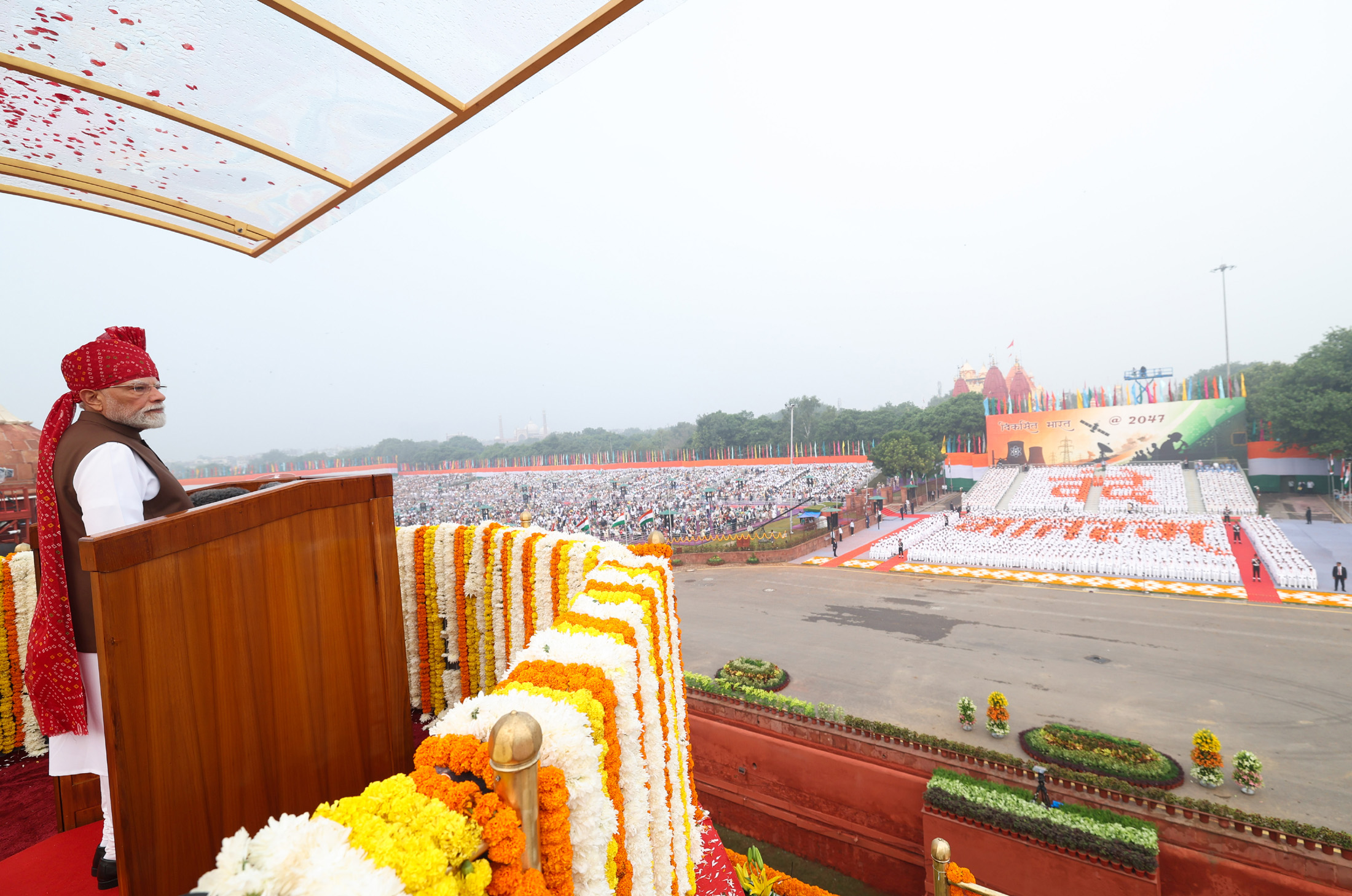
Prime Minister Narendra Modi on Saturday announced that India
will train 1 crore young people in artificial intelligence skills over the next
one year, calling for the country's youth to lead the world in the rapidly
expanding AI era, as he laid out an ambitious roadmap for a developed India by
2047 from the ramparts of the Red Fort on the occasion of the country's 80th
Independence Day.
Addressing the nation, Modi said India's journey towards
becoming a 'Viksit Bharat' by the centenary of Independence in 2047 would have
to be powered by the capabilities, dreams and determination of its 140 crore
citizens. He said the world's most populous nation setting itself the goal of
becoming a developed country would also change the way the world looks at
India.
The Prime Minister said India's progress over the past 12
years had created the confidence to pursue the 2047 goal, citing the lifting of
25 crore people out of poverty and India's emergence from the 'Fragile Five' to
become the fastest-growing major economy. He highlighted sharp increases in
defence production, Khadi and village industries, electronics manufacturing,
railway coach production, mobile phone manufacturing, internet usage, patents
and digital transactions.
He said India would pursue self-reliance with renewed vigour,
stressing 'Make in India', 'Swadeshi' and 'Vocal for Local' while urging Indian
manufacturers and MSMEs to use the opportunities created by free trade
agreements with nearly 40 countries since 2014. Indian products, he said, must reach
global markets and compete on quality, reliability and precision, with the
entire value chain — from components and design to finished products — developed
within the country.
Agriculture and food processing will form another major
pillar of this effort, Modi said, pointing to the opportunities opened up for
farmers by India's trade agreements. He called for greater emphasis on
chemical-free farming and urged farmers to meet global standards so that Indian
agricultural products can move from farms to international markets. He also
underlined the government's support for farmers, noting that urea costing Rs
3,000 in the global market is being made available to farmers for Rs 300, while
DAP costing Rs 5,000 is being supplied at Rs 1,350.
Technology and innovation, Modi said, would be central to
India's next phase of growth. He highlighted the country's advances in UPI and
Digital Public Infrastructure and said India must become a global innovation
hub rather than merely a market for the world. He set out an ambition for
Made-in-India 6G to reach every corner of the globe and said India must take
the lead in next-generation communication technologies.
On semiconductors, the Prime Minister said three plants had
already been initiated and that another five to eight plants were expected to
be established in the coming seven to eight years. He linked semiconductor
self-reliance with India's broader objective of becoming a developed nation.
Energy security emerged as another key priority, with Modi
setting a target of 100 GW of nuclear power capacity by 2047 following the
passage of the SHANTI Act. He said India was working to commission five new
nuclear reactors during this decade and had crossed a major milestone by
mastering Fast Breeder Reactor technology, strengthening the country's path
towards self-reliance in nuclear fuel.
The Prime Minister also pointed to the rapid expansion of
renewable energy, saying India's solar capacity had risen from 2 GW 12 years
ago to 160 GW. He said more than 50 lakh households had adopted solar energy
under the PM Surya Ghar Muft Bijli Yojana, with many households seeing their
electricity bills effectively reduced to zero and some earning by selling
surplus power. The government, he said, was providing Rs 80,000 assistance to each
family under the initiative.
Modi said India would seek global leadership in green
hydrogen, renewable energy, energy storage, green mobility and green
manufacturing, describing the green and blue economies as major sources of
future employment. He also highlighted the expansion of piped gas distribution
from 70 cities to 700 cities and the rise in household piped-gas connections
from barely 20-22 lakh before 2014 to nearly 1.75 crore.
In infrastructure, the Prime Minister highlighted the rapid
electrification of the railway network, saying that while only about 30 per
cent had been electrified between 1925 and 2015, the remaining work had been
completed in a decade. He also pointed to a 21-fold increase in modern railway
coach production and India's first hydrogen-powered train, which he described
as the longest and most powerful hydrogen-powered train.
On defence and national security, Modi said self-reliance in
defence was no longer optional and called for the development of
next-generation defence technologies, including drones, counter-drone systems
and hypersonic defence capabilities. Defence exports, he said, had risen nearly
50-fold, with Indian weapons and equipment reaching around 100 countries.
He also announced the creation of a vibrant civil defence
network in the days ahead, saying citizens and civil defence personnel would be
equipped with modern systems and technologies and trained in contemporary
preparedness methods as the nature of warfare changes beyond conventional
battlefields and borders.
Modi declared that Naxalism and Maoist violence had been
substantially defeated, while cautioning that the 'Naxal mindset' continued to
pose a challenge. He called for such elements to be isolated and India's youth
to be connected with the mainstream path of nation-building.
Connectivity under Gati Shakti, meanwhile, would focus on
high-speed rail, modern highways, inland waterways, airports and multimodal
logistics. The Prime Minister called for ports to evolve beyond traditional
cargo-handling functions towards port-led development and highlighted
opportunities in fisheries, coastal tourism and ocean technology. He said free
trade agreements had also opened new possibilities for Indian seafood and
shrimp exports.
Tourism and India's soft power also figured prominently in
the address. Modi said India's more than 100 national parks, spiritual and
cultural heritage, yoga, Ayurveda, films, handicrafts, VFX, animation, gaming
and digital content offered enormous opportunities to attract the world. He
also stressed the potential of the concert economy and India's ambition to host
major international sporting events.
On the economy, Modi asked why India should not aim to have
50 companies among the Fortune 500 within the next decade, and said an Indian
bank should figure among the world's top five banks. He also called for Indian
pharmaceutical, technology, consulting and accounting companies to emerge among
global leaders and for Indian brands to become an identity of the country in
international markets.
In healthcare, he highlighted the expansion of
social-security coverage to 100 crore citizens within a decade and said senior
citizens aged 70 years and above were now eligible for free treatment and
medicines worth up to Rs 5 lakh under Ayushman Bharat. He also said India
should aim to place one or two of its pharmaceutical companies among the
world's five largest.
Education and skills, too, were placed at the heart of the
2047 vision. Modi said nearly 650 new universities had been added in 10-12
years, taking the country towards 1,000 universities, while medical education
capacity had expanded substantially. More than 10,000 Atal Tinkering Labs have
been established to nurture children's interest in technology and innovation,
and the government plans to build a network offering free online coaching to
young people preparing for examinations.
The Prime Minister's AI-skilling announcement formed the
centrepiece of his youth-focused agenda. With more than 2.5 lakh registered
start-ups and India's young entrepreneurs increasingly entering areas such as
space and biotechnology, he said the government would ensure that resources did
not become a constraint for young innovators. An Innovation Fund of Rs 1 lakh
crore has been announced, while India's bioeconomy, he said, had expanded from
Rs 60,000 crore before 2014 to Rs 20 lakh crore.
Sports also received a major push. Modi said India was moving
forward as a strong contender to host the 2036 Olympics and was set to host the
Commonwealth Games in 2030. A nationwide talent-hunt campaign will identify
children aged five to 15 with sporting potential across villages, cities and
schools and provide them specialised training. He also called for a collective
effort to build a drug-free India.
On women-led development, Modi said the target of creating
three crore 'Lakhpati Didis' had already been surpassed and announced an
expanded goal of six crore Lakhpati Didis, describing the creation of three
crore additional financially empowered women as a major transformation of the
rural economy. He also appealed to all political parties to ensure 33 per cent
representation for women in state legislative assemblies and the Lok Sabha at
the earliest.
The Prime Minister highlighted gains in basic amenities,
saying tap-water connections had been provided at an average rate 15 times
faster than before, gas connections six times faster, construction of toilets
for the poor four times faster and housing for the poor three times faster. He
said 25 crore citizens had moved out of poverty while social-security
protection had been extended to 100 crore people within a decade.
In aviation and manufacturing, Modi said the sector was
creating new airports, routes and jobs, including opportunities in maintenance
and overhaul. He pointed to the successful flight of the Made-in-India C295
defence transport aircraft as an example of India's growing manufacturing
capability.
Calling for continued reforms, Modi said thousands of
compliance requirements had been eliminated and hundreds of obsolete laws
repealed. He urged state governments and local bodies to accelerate reforms and
said India could not enter the future with policies and rules designed for the
past.
He also urged young people to actively participate in the
ongoing Census, stressing that accurate data was essential for effective
policymaking and India's long-term development roadmap.
Reiterating the larger objective of building a self-confident and globally competitive India, Modi said the country must develop brands that attract the world and make India a destination for global investment, talent and innovation. He recalled the 'Panch Pran' and called for the continued eradication of the mentality of slavery, placing national interest above individual interest and making duty the defining identity of citizens.
Concluding his address, Modi called upon citizens to convert dreams into resolve, resolve into strength and strength into success, urging the nation to move together towards the goal of a developed India.