
THEBUSINESSBYTES BUREAU
BENGALURU, JUNE 24, 2026
Calling for BRICS nations to move beyond consultation and
embrace co-development, co-innovation and co-creation, Union Minister Dr.
Jitendra Singh on Wednesday pitched the concept of a “BRICS Space Economy” as
the next frontier of global growth, saying deeper cooperation among member countries
can unlock unprecedented opportunities in innovation, investment,
entrepreneurship and sustainable development.
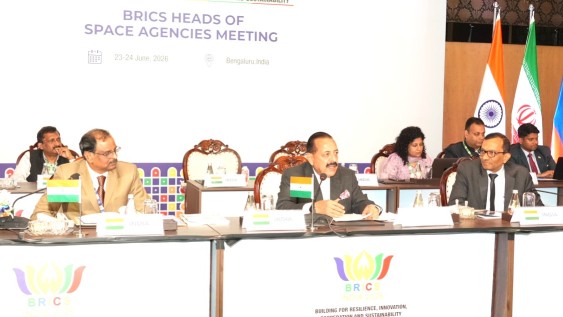
Addressing the valedictory session of the BRICS Heads of
Space Agencies (HOSA) Meeting in Bengaluru, Dr. Singh underscored the
transformative potential of collaborative space initiatives and said the future
of the global space economy would be shaped not by isolated efforts but by
partnerships driven by shared ambition and innovation.
 “The future of the
space economy will not be shaped by nations working in isolation. It will be
shaped by partnerships, shared innovation and collective ambition. BRICS
countries have the potential to become one of the strongest pillars of this
emerging global space ecosystem,” Dr. Jitendra Singh said.
“The future of the
space economy will not be shaped by nations working in isolation. It will be
shaped by partnerships, shared innovation and collective ambition. BRICS
countries have the potential to become one of the strongest pillars of this
emerging global space ecosystem,” Dr. Jitendra Singh said.
Hosted by the Indian Space Research Organisation (ISRO) under
India’s BRICS Chairship 2026, the two-day meeting brought together heads of
space agencies and senior officials from Brazil, China, Egypt, Ethiopia,
Indonesia, Iran, Russia, South Africa and the United Arab Emirates. The
concluding session was attended by ISRO Chairman and Secretary, Department of
Space, Dr. V. Narayanan, IN-SPACe Chairman Dr. Pawan Goenka, senior officials
from the Department of Space, and representatives from India’s space industry and
NewSpace startup ecosystem.
The meeting reviewed the progress of BRICS space cooperation
and deliberated on a range of strategic issues, including space sustainability,
debris-free missions, strengthening the BRICS Remote Sensing Satellite
Constellation (RSSC), expanding the participation of newer BRICS members in
existing cooperation mechanisms, and advancing discussions on the proposed
BRICS Space Council. Future collaboration in disaster management, Earth
observation, capacity building and knowledge sharing also featured prominently
in the discussions.
Highlighting the growing significance of space technology in
modern economies, Dr. Singh said it has emerged as a powerful catalyst for
economic transformation and societal advancement by strengthening communication
networks, navigation systems, disaster preparedness, agriculture, healthcare,
education and environmental monitoring. He noted that global challenges such as
climate change, food and water security, environmental degradation and
sustainable urbanisation increasingly require collective solutions enabled by
advanced space technologies.
The Minister observed that BRICS countries collectively
represent a substantial share of the world’s population, economic output,
scientific expertise and technological capability. He said stronger
collaboration among member nations could accelerate innovation, industrial
partnerships, technology transfer, investment flows and economic growth while
addressing common developmental priorities.
Dr. Singh noted that the BRICS Remote Sensing Satellite
Constellation has already demonstrated the value of collaborative space
applications through satellite data sharing among member nations. He expressed
confidence that institutional mechanisms such as the proposed BRICS Space
Council would provide greater momentum and continuity to future cooperation in
the sector.
Reaffirming India’s commitment to inclusive space
development, the Minister said the country’s space programme has consistently
focused on ensuring that the benefits of space technology reach ordinary
citizens. Guided by Prime Minister Narendra Modi’s vision, India’s space sector
has undergone sweeping reforms that have opened new opportunities for private
industry, startups, academia and international partnerships, helping create one
of the world’s fastest-growing space ecosystems.
He also highlighted India’s landmark achievements, including
Chandrayaan-3, Aditya-L1 and the ongoing Gaganyaan mission, stating that these
missions have expanded the frontiers of science and technology while creating
fresh avenues for global collaboration in advanced space research and
applications.
Emphasising sustainability as a critical priority, Dr. Singh
stressed that the future of space activities depends on preserving outer space
as a safe, secure and sustainable domain. He called for greater international
cooperation, transparency, responsible conduct and capacity building to tackle
challenges posed by increasing space traffic and orbital debris. He welcomed
discussions on debris-free missions and sustainable space operations as
important steps towards safeguarding the space environment for future
generations.
“BRICS nations must
move beyond consultation and work towards co-development, co-innovation and
co-creation. By bringing together our scientists, engineers, industries,
startups and young innovators, we can develop solutions for global challenges,
create new economic opportunities and build a stronger framework for scientific
advancement and shared prosperity,” he said.
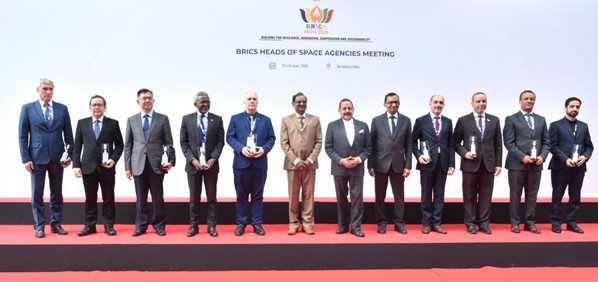
During the event, Dr. Singh also released the Indian Space
Industry Brochure, exchanged mementoes with participating heads of space
agencies and interacted with representatives of India’s rapidly expanding
NewSpace sector, showcasing the capabilities of Indian space startups and
private enterprises before visiting BRICS delegations.
Reiterating India’s commitment to collaborative progress, Dr.
Singh said the country remains dedicated to working closely with all BRICS
partners to translate shared aspirations into tangible outcomes and ensure that
space continues to serve as a powerful force for development, resilience,
innovation, sustainability and international cooperation.