THEBUSINESSBYTES BUREAU
NEW DELHI, JUNE 24, 2026
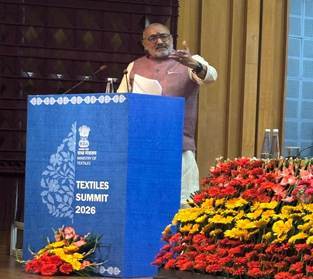
The two-day Textiles Summit 2026 concluded on Wednesday with
a strong emphasis on sustainability, export competitiveness, market
diversification and effective utilisation of Free Trade Agreements (FTAs), as
policymakers, industry leaders and academia outlined a comprehensive strategy
to propel India’s textile exports to USD 100 billion by 2030.
Organised by the Ministry of Textiles from June 23 to 24, the
summit served as a key platform for collaborative dialogue among State
Governments, industry stakeholders and experts, focusing on the future growth
trajectory of India’s textile sector and strengthening its position in global
markets.
Concluding the summit, Union Textiles Minister Giriraj Singh
stressed that the focus must now shift from planning to implementation. He
called for proactive execution of district and state-level strategies,
underscoring the importance of achieving the right product-market mix, increasing
value addition, adhering to sustainability and environmental standards,
leveraging FTAs and promoting niche products to enhance global competitiveness.
Secretary, Ministry of Textiles, Neelam Shami Rao described
the summit’s deliberations as a decisive step from dialogue to action. She said
the recommendations emerging from States, districts, industry stakeholders and
Export Promotion Councils would be translated into a comprehensive National
Textile Export Roadmap. Highlighting the sector’s future priorities, she said
India would focus on high-value segments, quality enhancement, innovation and
sustainability, backed by stronger institutional coordination to boost exports
and expand the country’s global textile trade footprint.
A special session of the summit featured Commerce Secretary
Rajesh Agrawal, who urged the textiles industry to swiftly capitalise on
recently concluded FTAs to maximise export gains. He identified information
asymmetry at the district level as a major challenge and stressed the need to
equip exporters with better awareness and access to FTA-related opportunities.
Agrawal also highlighted the Centre’s extensive export promotion initiatives
and commended the publication of the booklet, “Leveraging Recent FTAs – A
Textiles Perspective.” Noting that the Department of Commerce had conducted
around 500 workshops on export promotion, he encouraged States and Union
Territories to actively participate in the revived Districts as Export Hubs
(DEH) programme.
The second day of the summit began with presentations by
representatives of States and Union Territories, who shared key outcomes from
the breakout sessions held on the opening day. The presentations highlighted
strategic recommendations and actionable measures aimed at strengthening
textile exports and aligning sectoral growth with the ambitious USD 100-billion
export target.
Among the major discussions on the concluding day was a
session on “Quality, Sustainability Certifications and Sourcing Decisions,”
which explored ways to integrate global brand requirements into state-level
cluster strategies. Participants deliberated on promoting digital product
passports for traceability, advancing closed-loop recycling systems,
strengthening textile waste management through collaboration between municipal
bodies and states, and bridging the gap between academic research and
commercially viable recycling technologies. The session also emphasised
simplifying compliance requirements for MSMEs and aligning national policies
with evolving international sustainability standards.
The summit concluded with a high-level session on “Export
Enablement, FTA Utilisation and Market Diversification,” which outlined a broad
roadmap for strengthening India’s textile export ecosystem. Speakers from
government, industry and academia highlighted the need to leverage tariff
advantages under FTAs while prioritising sustainability, quality standards and
mutual recognition frameworks. Discussions focused on improving ease of doing
business, diversifying export markets, attracting anchor investors and
accelerating product diversification, particularly in man-made fibres (MMF).
The session also underscored the importance of developing
in-house design capabilities, adapting to changing consumer preferences and
nurturing globally competitive “Champion MSMEs.” Enhanced export finance, risk
mitigation mechanisms and strategic market access initiatives were identified
as critical drivers for boosting exports and promoting Brand India in international
textile markets.