THEBUSINESSBYTES BUREAU
BHUBANESWAR, AUGUST 11, 2026
Chief Minister Mohan Charan Majhi on Tuesday called for a
more efficient revenue mobilisation system and faster execution of capital
projects, saying stronger revenue collection coupled with higher public
spending would be critical to accelerating Odisha’s growth and achieving the
state’s vision of a prosperous Odisha by 2036.
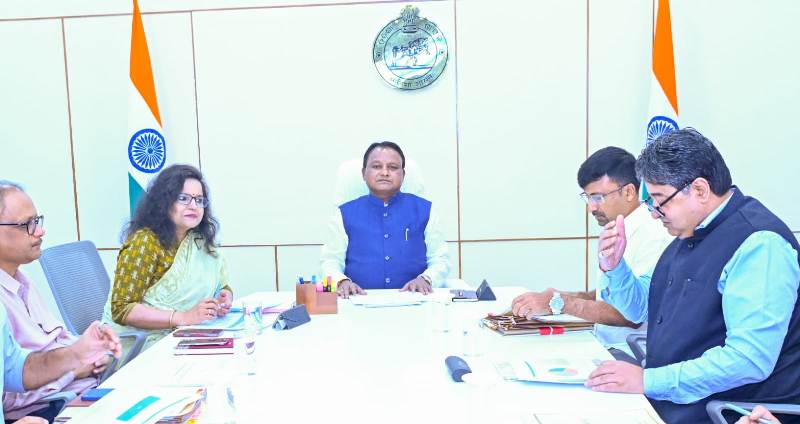
Reviewing the Finance Department at Lok Seva Bhawan here,
Majhi said the state needs to simultaneously strengthen its revenue base and
expand capital as well as programme expenditure to drive overall development.
“An efficient revenue collection system is essential for the
state’s overall development,” the Chief Minister said, emphasising the need to
further scale up both capital and programme spending. He also advised
departments to accelerate implementation so that higher allocations translate
into greater capital expenditure on the ground.
The review meeting highlighted a positive trend in Odisha’s
finances during the first four months of the current financial year.
According to data presented by the Finance Department,
Odisha’s total revenue collection from various sources stood at ₹61,593
crore up to July 2026, marking a 7.3 per cent increase over the corresponding
period of the previous financial year.
The state’s own revenue performance was even stronger. Total
own revenue rose 11.9 per cent year-on-year up to July.
Within this, own tax revenue increased by 9.3 per
cent, while non-tax revenue registered a growth of
14.8 per
cent over the corresponding period of the previous
year.
The revenue structure presented at the meeting showed that
the state’s overall revenue receipts comprise 10 per cent Union Government grants, 31 per
cent share in central taxes, 31 per
cent own tax revenue and 28 per
cent own non-tax revenue.
The government’s expenditure performance also showed
significant improvement.
Programme expenditure up to July this financial year was 19.1 per
cent higher than during the same period last year,
indicating a faster pace of spending on government programmes and
development-related activities.
The bigger jump, however, was recorded in capital
expenditure.
Odisha’s total capital expenditure, or capex, stood at ₹11,300
crore by the end of July 2026, compared with ₹9,399 crore during the corresponding period last year. This represents
a 20.2 per
cent year-on-year increase in capital expenditure.
The rise in capex assumes significance as the state
government seeks to accelerate infrastructure development and create the
physical foundation required for long-term economic expansion.
Majhi said the state government is preparing several
initiatives with the long-term objective of building a prosperous Odisha by
2036. Large-scale investment in infrastructure, he stressed, will be essential
to achieve that vision.
While acknowledging the improvement in revenue collection,
programme expenditure and capital spending, the Chief Minister called for
further progress rather than complacency.
He directed departments to make the revenue collection
mechanism more efficient and work at a faster pace to ensure greater expenditure
under the capital budget.
The message from the review meeting was therefore two-fold:
strengthen the state’s ability to generate revenue while accelerating
productive public spending, particularly on infrastructure and capital
projects.
Principal Secretary of the Finance Department Sanjeev Mishra presented the detailed data on revenue receipts and expenditure during the review.
Chief Secretary Anu Garg, Development Commissioner D.K. Singh, Additional Chief Secretary to the Chief Minister Shashwat Mishra, Finance Department Special Secretary Yamini Sarangi, and other senior officials of the Finance Department attended the meeting.