
THEBUSINESSBYTES
BUREAU
NEW
DELHI, MAY 11, 2026
Union Minister for
Environment, Forest and Climate Change Bhupender Yadav on Monday underscored
the crucial role of corporate participation in wildlife protection, asserting
that industry funding and partnerships are vital for habitat restoration,
technology-driven monitoring and community-based conservation of big cats.
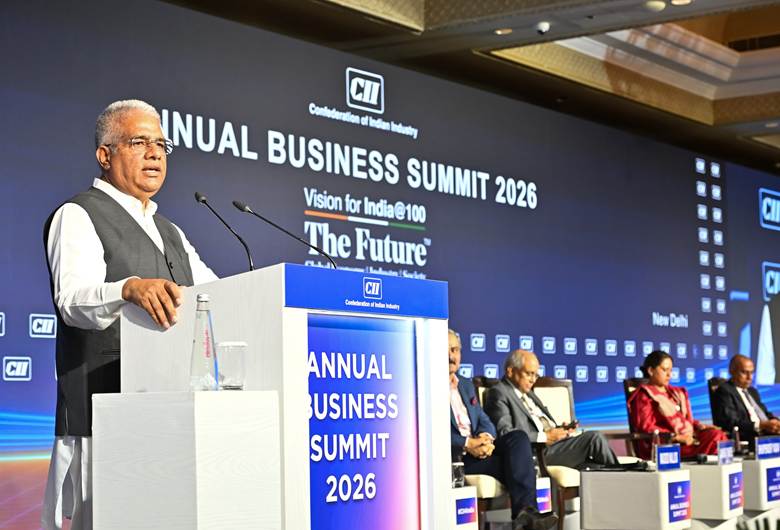
Addressing the
Confederation of Indian Industry (CII) conference on ‘Future of the Global
Economy, Industry and Society, and the Vision for India@100’, the Minister also
announced that India will host the first International Big Cat Summit in New
Delhi on June 1 and 2 as part of global efforts to strengthen conservation
initiatives.
Speaking at the
event, Yadav said that the International Big Cat Alliance (IBCA) is Prime
Minister Narendra Modi’s initiative to protect the world’s seven big cats —
tiger, lion, cheetah, leopard, snow leopard, jaguar and puma — and invited
industry leaders to become active partners in the mission.
Highlighting the
importance of private sector involvement, the Minister said, “Corporate funding
is essential to support critical areas of big cat conservation such as habitat
restoration, technology driven monitoring and surveillance, community based
conservation, capacity building, and conservation awareness.”
Yadav urged all
stakeholders to contribute towards safeguarding wildlife and ecological
balance. “In saving their future”, he said, “we are also saving our own because
as apex predators and ‘umbrella species’, the big cats maintain ecological
balance, protecting vast landscapes, biodiversity, and water resources”. He
also noted that the Confederation of Indian Industry already has an MoU with
IBCA.
Speaking on India’s
long-term development vision, the Minister observed that the world is currently
witnessing a transformational phase shaped by artificial intelligence, green
technologies, digital economies, geopolitical shifts and climate challenges. “In
many ways, this is not merely an era of change; it is a change of era,” he
said.
He stated that India
is uniquely positioned to emerge as a global leader by balancing innovation
with resilience and economic growth with sustainability. Referring to the country’s
economic and environmental progress, Yadav said India has become the world’s
fastest-growing major economy while driving global change through renewable
energy expansion, digital public infrastructure, manufacturing and startup
growth.
The Minister informed
that India now ranks third globally in renewable energy installed capacity,
with cumulative solar capacity reaching 150 gigawatts as of March 2026 compared
to 2.82 GW in 2014. He added that nearly 50 per cent of the country’s installed
electricity capacity now comes from non-fossil fuel sources, achieving the
target well ahead of the 2030 deadline.
Yadav further said India reduced the emissions intensity of its GDP by 36 per cent between 2005 and 2020 and recently released its first Biennial Transparency Report under the UNFCCC and Paris Agreement framework. According to the report, India achieved a 37.38 per cent reduction in emissions intensity while maintaining low per capita emissions and meeting non-fossil fuel capacity targets ahead of schedule.
Outlining the roadmap for India@100, the Minister said economic transformation, human capital development, sustainable growth, social inclusion and India’s expanding global role would shape the country’s journey towards becoming a developed nation by 2047. “Our vision is clear: To build a developed, inclusive, innovative, sustainable, and self-confident India that contributes meaningfully to global peace and prosperity,” he concluded.