
THEBUSINESSBYTES BUREAU
NEW DELHI, FEBRUARY 20, 2026
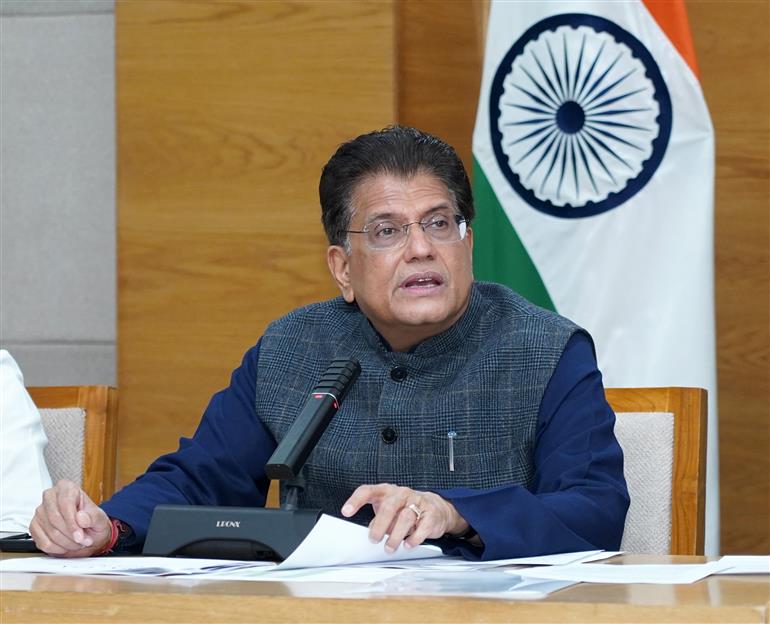
The Export Promotion Mission is set to significantly expand global market
access for India’s MSMEs even as the country records double-digit merchandise
export growth in the first half of February, Union Commerce and Industry
Minister Piyush Goyal announced on Friday while unveiling seven new
interventions under the flagship programme.
Describing the initiative as a structural push to transform India into a
globally competitive export powerhouse, the Minister said the Mission is
designed to address long-standing bottlenecks faced by small exporters, promote
inclusive trade growth and ensure that the benefits of globalisation reach
enterprises at the grassroots level. Commerce Secretary Rajesh Agarwal was also
present on the occasion.
Linking export-led growth with the broader theme of social equity on
World Day of Social Justice, Shri Goyal emphasised that true development lies
in empowering those at the bottom of the economic pyramid. He said enabling
MSMEs, startups and first-time exporters to participate in international trade
is central to achieving inclusive prosperity.
Highlighting India’s growing technological and geopolitical confidence,
the Minister noted that the country is emerging as a key player in artificial
intelligence, machine learning, quantum computing and data infrastructure,
which are expected to catalyse investments and create new export opportunities
for the youth. He credited Prime Minister Narendra Modi for positioning India
at the centre of global technology and trade conversations, including through
the recent AI Summit and the successful G20 presidency.
Goyal underscored that India’s expanding network of Free Trade Agreements
has dramatically improved market access, with nine concluded FTAs providing
preferential entry into 38 developed and emerging economies that together
account for nearly 70 per cent of global GDP and two-thirds of world trade. He
said India is now engaging with developed markets from a position of strength,
protecting sensitive sectors while securing gains in areas of competitive
advantage.
The Minister pointed out that since 2022, India has accelerated trade
negotiations, reduced compliance burdens, decriminalised multiple business laws
and improved the ease of doing business, creating a more enabling environment
for exporters. The strong double-digit growth in merchandise exports in early
February, he said, reflects rising global demand for Indian goods and growing
confidence among domestic industry.
At the core of the Export Promotion Mission is a unified ecosystem
approach combining financial enablers under ‘Niryat Protsahan’ with trade
facilitation measures under ‘Niryat Disha’, supported by digital monitoring and
coordinated implementation across ministries, financial institutions, export
bodies and Indian missions abroad.
Under Niryat Protsahan, the government introduced support for export
factoring with a 2.75 per cent interest subvention to ease working capital
constraints for MSMEs, alongside structured credit facilities for e-commerce
exporters with partial guarantees and concessional financing for overseas
inventory. A dedicated mechanism to support exporters entering new and
high-risk markets aims to improve liquidity and reduce transaction risks.
The Niryat Disha interventions focus on strengthening the trade ecosystem
through compliance, logistics and market intelligence. The TRACE initiative
will reimburse a substantial portion of testing, inspection and certification
costs to help exporters meet international regulatory standards. FLOW will
support overseas warehousing and global fulfilment networks, including integration
with e-commerce export hubs and strategic facilities such as Bharat Mart in
Dubai, enabling access to markets across the GCC, Africa, Central Asia and
Europe.
To address regional disparities, the LIFT programme will partially offset
freight costs for exporters located in low export intensity districts, while
the INSIGHT platform will enhance trade intelligence, cluster-level capacity
building and the Districts as Export Hubs initiative. Together, these measures
aim to reduce the cost of capital, diversify trade finance instruments, improve
compliance readiness and overcome logistics disadvantages that have
historically constrained MSME exports.
The Mission is being implemented by the Department of Commerce in coordination with the Ministries of MSME and Finance, EXIM Bank, CGTMSE, NCGTC, regulated lenders and industry stakeholders. Three interventions — market access support, interest subvention for pre- and post-shipment credit, and collateral support for export credit — were already operational, taking the total number of active measures to ten out of the eleven planned components.
Industry bodies and export promotion councils, including FIEO, EEPC, GJEPC, CII, FICCI, PHDCCI, ASSOCHAM and NASSCOM, welcomed the initiative, expressing confidence that the integrated policy framework would deepen India’s export base, bring new firms into global value chains and accelerate the country’s march towards becoming a leading trading nation.