Why the 2026 MMDR amendment could shape the State’s next economic cycle —
from mines and transport to steel, manufacturing and tribal livelihoods
THEBUSINESSBYTES
BUREAU
BHUBANESWAR,
AUGUST 31, 2026
In
Odisha’s mineral belt, the economics of a mine rarely ends at the mine gate.
A
truck bought on bank finance in Keonjhar, a tyre shop in Joda, a roadside
eatery along the Joda–Bamebari road, a contract worker’s monthly wage and a
steel plant’s raw-material bill are all part of the same economic chain. When
mineral production expands, the benefits travel outward. When a mine becomes
unviable, the shock travels in the opposite direction.
That
is why the debate over the 2026 amendment to the Mines and Minerals
(Development and Regulation) Act, particularly the proposed national framework
under Section 9D, has implications that extend well beyond the question of
taxation.
At
its heart is a deceptively simple question: should Odisha seek to maximise the levy collected
from every tonne of mineral today, or maximise the economic value generated
from its mineral endowment over the next 25 years?
The
distinction matters for a State whose mineral revenue has risen sharply — from
roughly ₹5,000 crore in 2014 to around ₹50,000
crore now — following mining-sector reforms and transparent auctions. The
amendment, according to the case advanced in the accompanying analysis, does
not dismantle this revenue architecture. Royalty, auction premium, District
Mineral Foundation (DMF) contributions and the National Mineral Exploration
Trust (NMET) contribution remain intact.
For
iron ore, the 15% royalty remains untouched and accrues to the State, while
auction premium and DMF continue. Around 90% of overall mining revenue
presently accrues to States, according to the Centre cited in the analysis.
What changes is the scope for an additional, open-ended and retrospectively
recoverable State levy.
That
distinction could prove consequential.
The
economics of certainty
Mining
is unlike many other businesses. It involves long gestation periods, large sunk
investments and reserves whose economic viability can change with prices, costs
and regulatory conditions.
For
an investor, a known tax may be easier to accommodate than an uncertain future
liability.
The
argument is not that taxation itself is harmful. Rather, excessive or
unpredictable cumulative levies can raise the breakeven cost of mining, make
marginal reserves uneconomic and defer expansion. Fewer dispatches can then
mean lower utilisation of contractors and transport networks, weaker downstream
investment and, ultimately, a smaller base for royalty, auction premium, DMF
and employment.
The
chain can become a fiscal paradox: a higher levy on a shrinking production base may yield less than a
predictable levy on an expanding one.
This
is particularly relevant to Odisha because the State still has considerable
room to expand mineral production. Of the 79 mineral blocks auctioned in the
State, 35 had been operationalised by 2025-26. The remaining 44 represent a
substantial opportunity for future production.
Between
2020-21 and 2025-26, Odisha collected approximately ₹87,000 crore in
auction premium. The larger prize, therefore, may not lie in extracting another
levy from mines that are already producing, but in bringing more blocks into
operation and ensuring that more mineral is processed within the State.
The
measure of success consequently needs to move beyond “tax per tonne” towards
“State value captured per tonne.”
That
value includes not only royalty and auction premium, but DMF, State GST-related
receipts, wages, local procurement, electricity consumption, port and railway
activity and the additional value generated when ore is processed and
manufactured within Odisha.
When
a mine closes, the shock travels
The
social consequences are equally important.
Keonjhar
and Sundargarh, with their large Scheduled Tribe populations, have economic
ecosystems closely connected to mining and mineral-linked transportation. A
prolonged contraction in mining can therefore become a highly localised
livelihood crisis.
The
first employment ring comprises mine employees and contract workers. The second
extends to truck owners and drivers, loading and material-handling workers,
equipment repair and engineering contractors, tyre and spare-parts businesses,
security personnel, canteens and other local services.
Then
comes the third ring: pellet plants, sponge iron units, ferro-alloy and steel
plants, aluminium, fabrication, construction and logistics.
The
implication is stark. A mine closure is not simply a production statistic. For
a truck owner who has taken a bank loan, it can become an EMI crisis. For a
driver, a wage crisis. For a roadside business, a loss of customers. For a
family dependent on the mineral economy, it can become a reason to migrate.
The
analysis therefore makes a distinction between mineral deposits and producing economic assets.
Tribal districts, it argues, need the latter.
The
price of the mineral reaches the household
The
mineral economy also has a less visible connection with the common household.
Iron
ore feeds steel, pellets and sponge iron, which ultimately enter houses,
bridges, railways, automobiles, appliances and public infrastructure. Limestone
feeds cement used in homes, schools, hospitals, roads and irrigation works.
Coal is an input into electricity, steel, cement and industrial heat. Bauxite
feeds alumina and aluminium used in electrical conductors, transport,
construction and packaging.
Critical
minerals, meanwhile, are increasingly linked to batteries, magnets,
electronics, defence and renewable-energy systems.
An
abnormal increase in mineral levies can therefore add cost pressure to steel,
cement, electricity and fertilisers. It cannot be assumed that a lower mineral
tax will automatically translate into lower retail prices, but the fiscal
argument is that avoiding an unnecessary layer of cost pressure can help
preserve competitiveness.
This
becomes especially significant for Odisha's manufacturing ambitions.
From
mineral State to manufacturing State
Mining
and quarrying account for about 23.1% of Odisha’s industrial Gross Value Added,
while manufacturing accounts for approximately 45.6%, according to the figures
cited in the analysis.
The
strategic opportunity, therefore, is not simply to extract more iron ore,
chromite, bauxite or coal and send it elsewhere.
The
larger ambition is: Mineral in Odisha → processing in Odisha → manufacturing in Odisha → skilled employment in Odisha → tax and household income in Odisha.
A
steel mill, aluminium smelter, ferro-alloy plant or mineral-processing facility
makes decisions over decades. An investor considering a ₹10,000
crore or ₹50,000 crore plant near an ore belt must be able
to estimate the long-term cost of locally sourced raw material.
The
equation is consequently straightforward: assured geology, predictable
taxation, ports and rail connectivity and a developed industrial ecosystem make
a stronger case for locating value addition close to the resource.
The
State Economic Survey has reported 275 investment MoUs involving proposed
investments of roughly ₹15.1 lakh crore and significant
prospective employment across sectors. The ability to convert such investment
intentions into operating assets will depend, among other things, on the
competitiveness and predictability of Odisha's mineral ecosystem.
The
analysis cites industry estimates from FIMI that one mining job creates 10
indirect jobs and that, for a 1% increase in sector GDP, mining creates 13
times more jobs than agriculture and six times more than manufacturing.
The
broader message is that mining need not remain an extractive enclave. It can
serve as the raw-material foundation for an industrial economy.
The
import-substitution risk
There
is another calculation that Odisha cannot afford to overlook.
A
mineral is an input cost for a steel, pellet, ferro-alloy or aluminium
producer. If locally sourced mineral becomes significantly more expensive than
material available from another State or overseas, the buyer has an economic
incentive to look elsewhere.
The
analysis cites the Centre's broad measure of mineral imports at ₹10.12
lakh crore in FY 2025-26. Against such a backdrop, higher domestic delivered
costs could encourage Odisha-based plants to procure minerals from elsewhere.
That
could create an unintended cycle: higher local taxation, higher mineral cost,
substitution away from Odisha mines, lower dispatches, weaker capacity
utilisation and a diminished incentive to establish processing facilities near
the resource.
In
other words, the mineral that is physically present in Odisha may not
necessarily generate its maximum economic value in Odisha.
The
DMF lesson
The
District Mineral Foundation (DMF) offers another illustration of why production
volumes matter.
DMF
is linked to royalty, with contributions of 30% for pre-2015 leases and 10% for
auctioned leases. Its corpus therefore expands with mineral production.
A
tax structure that renders mines uneconomic may produce an immediate levy but
shrink the production base on which DMF itself depends.
The
policy challenge is consequently not simply to raise the rate of collection but
to maintain a sufficiently broad and productive economic base from which the
State and mineral-producing districts can collect revenue.
This
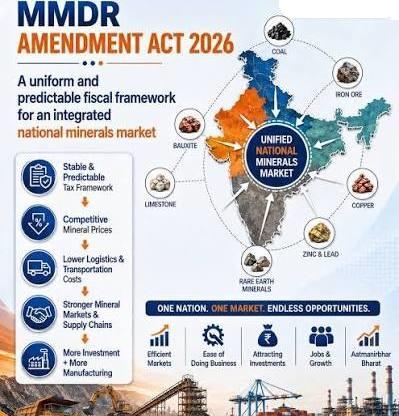
is also where the amendment's proposed uniformity assumes significance. The
policy objective described is “One National, One Mineral Market, One Mineral Tax”,
intended to reduce inter-State mineral trade imbalances and improve the ease of
doing business.
For
Odisha, the test will be whether such uniformity helps unlock investments that
have remained on paper and brings more auctioned blocks into production.
The
next mineral cycle
Odisha's
next mineral cycle may also be broader than the traditional quartet of iron
ore, coal, chromite and bauxite.
The
State has been selected for national critical-mineral processing support and a
Rare Earth Corridor. The Union Budget 2026-27 has also announced a Dedicated
Rare Earth Corridor for Odisha.
That
creates a different opportunity. Critical minerals require processing,
technology, specialised manufacturing and stable long-term investment. A
predictable fiscal regime could strengthen the case for locating those
activities near the resource.
The
economic objective, therefore, is not merely to increase the quantity of
mineral extracted. It is to increase the number of operating mines, deepen
processing capacity, attract manufacturing investment, improve compliance and
strengthen the supply chains around them.
Investment
in deeper pits, beneficiation, conveyor systems, waste recovery, digital
technology, electrification, safety equipment, reserve development,
environmental upgrades and capacity expansion becomes easier to justify when
the long-term fiscal environment is predictable.
Every
auctioned block that remains non-operational represents not only geology
waiting to be mined but also unrealised royalty, premium, DMF, employment and
supply-chain activity.
The
real test of Section 9D
The
political argument surrounding Section 9D is likely to remain sharply divided.
One
side sees the restriction on additional State mineral levies as a loss of
fiscal autonomy and potentially foregone revenue. The counterargument is that
national boundaries on mineral taxation can reduce fiscal unpredictability and
protect the viability of long-term projects.
Similarly,
one view treats the tax rate as the principal revenue lever. The other
emphasises production volume, mineral value and the number of operating mines.
The
disagreement over taxation thus conceals a larger disagreement over the
development model.
Should
Odisha maximise the rent extracted from each tonne of mineral, or maximise the
economic activity generated by that tonne?
For
a State with extensive mineral resources, the second approach could have a
wider multiplier effect.
Every
tonne processed in Odisha can support employment and household incomes within
the State. Every steel, aluminium or mineral-processing unit located close to
the resource can deepen the industrial ecosystem. Every additional operating
mine can contribute not only to royalty but also to auction premium, DMF, local
procurement, transport, power consumption and associated economic activity.
The
ultimate objective is therefore larger than mining revenue.
It
is about ensuring that the ore extracted from Odisha
creates value in Odisha.
The
strongest case for the 2026 amendment, viewed through this lens, is not that
taxation is undesirable. It is that predictable taxation of an expanding mineral economy may be economically
superior to unpredictable taxation of a shrinking one.
For
Odisha, the question before the next mineral cycle is consequently not simply, “How much tax can be collected
from one tonne today?”
It is a more consequential one: How much income, State revenue, employment and industrial value can Odisha create from its mineral endowment over the next 25 years?
The answer may determine whether the State's mineral wealth remains primarily something that is extracted — or becomes the foundation on which a deeper, more diversified manufacturing economy is built.