THEBUSINESSBYTES BUREAU
NEW DELHI, FEBRUARY 22, 2026
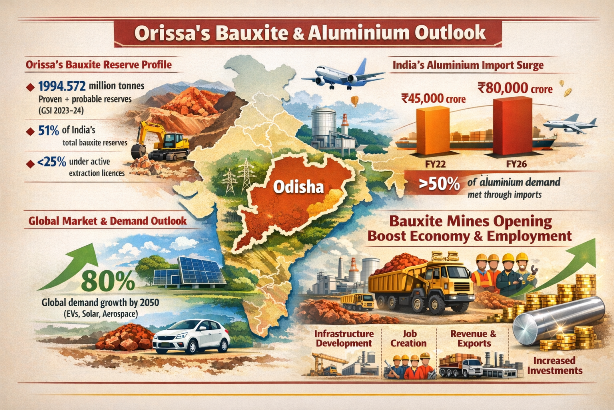
India’s growth trajectory is increasingly intertwined with aluminium — a strategic metal that underpins infrastructure, defence, renewable energy, electric mobility and advanced manufacturing. Yet a persistent contradiction remains: despite possessing abundant bauxite reserves, the country continues to depend on imports to sustain its aluminium value chain.
India’s bauxite resources are estimated at nearly 3.9 billion tonnes, but
imports have shown a steady upward trend. In FY23, bauxite imports were
recorded at 3.6 million tonnes, rising further to 4.5 million tonnes in FY24.
This continued reliance on overseas supplies, despite substantial domestic
reserves, represents a structural vulnerability. It exposes the sector to
global price volatility, shipping disruptions and geopolitical uncertainties —
risks that are becoming more pronounced in an increasingly fragmented global
trade environment.
 Dr. Madhumita Das, Ex Professor, Geology, Utkal University, said, “The
urgency becomes clearer when viewed through the lens of demand. Aluminium
consumption in India is currently around 5.5 million tonnes per annum, and is
projected to exceed 8 million tonnes by 2030. This surge will be driven by the
expansion of renewable energy capacity, electrification of transport, smart
grids, and large-scale infrastructure development. Meanwhile, primary aluminium
production in FY25 is estimated at around 4.2 million tonnes, highlighting the
need to strengthen domestic capacity and raw material linkages. The economic
implications of this gap are already visible. India’s aluminium import bill is
expected to touch nearly ₹30,000 crore by FY26, a substantial outflow that
could otherwise support domestic investment, job creation and industrial
competitiveness.”
Dr. Madhumita Das, Ex Professor, Geology, Utkal University, said, “The
urgency becomes clearer when viewed through the lens of demand. Aluminium
consumption in India is currently around 5.5 million tonnes per annum, and is
projected to exceed 8 million tonnes by 2030. This surge will be driven by the
expansion of renewable energy capacity, electrification of transport, smart
grids, and large-scale infrastructure development. Meanwhile, primary aluminium
production in FY25 is estimated at around 4.2 million tonnes, highlighting the
need to strengthen domestic capacity and raw material linkages. The economic
implications of this gap are already visible. India’s aluminium import bill is
expected to touch nearly ₹30,000 crore by FY26, a substantial outflow that
could otherwise support domestic investment, job creation and industrial
competitiveness.”
The foundation of aluminium self-reliance lies upstream — in bauxite.
Producing one tonne of aluminium requires approximately six tonnes of bauxite,
making secure raw material availability essential for sustaining long-term
growth. Without reliable access to domestic bauxite, ambitions to expand
aluminium capacity and reduce dependence on imported finished metal will remain
constrained.
In this context, Odisha assumes strategic importance. With more than 50
per cent of India’s bauxite reserves — concentrated in districts such as
Kalahandi, Rayagada, Koraput, Sundargarh, Bolangir and Sambalpur — the state
holds the key to reducing import dependence and building resilient supply
chains. Domestic bauxite production has already crossed 23 million tonnes in 2023,
but unlocking the full potential of these reserves could significantly enhance
India’s resource security. Expanding domestic mining is not merely an
industrial necessity; it is also a major economic opportunity, said Dr.
Madhumita Das, Ex Professor, Geology, Utkal University.
Stronger local sourcing supports employment, increases state revenues,
strengthens downstream manufacturing and reduces exposure to external supply
shocks. It also lowers the carbon footprint associated with long-distance
transportation of imported raw materials. Atmanirbhar Bharat cannot be achieved
through downstream production alone. Strategic autonomy in critical sectors
must begin with securing raw materials domestically and building integrated,
resilient supply chains. Reducing import dependence in aluminium is not simply
a trade correction; it is a strategic imperative linked to economic
sovereignty.
If India is serious about building durable industrial strength, aluminium
self-reliance must begin at the source — and domestic bauxite must form the
bedrock of that national ambition.