THEBUSINESSBYTES
BUREAU
NEW
DELHI, APRIL 20, 2026
Warning
that rising global temperatures are emerging as a multi-dimensional crisis,
Union Minister Dr. Jitendra Singh on Monday said global warming now poses a
serious threat not only to the environment but also to public health and the
global economy.
Highlighting
India’s proactive approach, the Minister said the country is strengthening its
commitment to sustainable cooling and climate resilience through the
implementation of the India Cooling Action Plan, which has already been rolled
out across more than 250 cities nationwide.
 Addressing
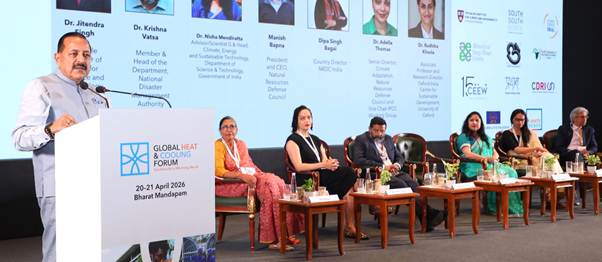
the inaugural plenary of the Global Heat and Cooling Forum, Singh underlined
that rising temperatures are no longer just an environmental concern but a
direct public health challenge. He pointed out that heat stress is increasingly
linked to a surge in both communicable diseases like dengue and
non-communicable conditions such as cardiovascular ailments, calling for
India-specific research to tackle these emerging risks.
Addressing
the inaugural plenary of the Global Heat and Cooling Forum, Singh underlined
that rising temperatures are no longer just an environmental concern but a
direct public health challenge. He pointed out that heat stress is increasingly
linked to a surge in both communicable diseases like dengue and
non-communicable conditions such as cardiovascular ailments, calling for
India-specific research to tackle these emerging risks.
The
Minister noted that climate change-induced heat is a global phenomenon, but
India faces a uniquely complex scenario due to its diverse geography,
experiencing both extreme heat and extreme cold simultaneously. This, he said,
necessitates customised solutions rather than a one-size-fits-all global approach.
Drawing
attention to evolving disease patterns, Singh said India is simultaneously
battling tropical infections and lifestyle-related illnesses, both of which are
being aggravated by rising temperatures. He stressed the urgent need for
integrated research linking climate science with healthcare systems to build
resilience against these dual challenges.
The
high-level forum, organised with participation from the Department of Science
and Technology, National Disaster Management Authority, Coalition for Disaster
Resilient Infrastructure and Natural Resources Defense Council, among others,
brought together leading experts including Dr. Krishna Vatsa, Dr. Nisha
Mendiratta, Manish Bapna, Dipa Singh Bagai, Adelle Thomas and Radhika Khosla.
Singh
also cautioned against the unintended consequences of increasing dependence on
modern cooling systems, noting that excessive use of air conditioning is
raising energy consumption and placing additional stress on both the
environment and the economy. He called for a balanced approach that ensures
access to cooling while maintaining sustainability.
Emphasising
equity, the Minister said access to cooling solutions must be inclusive,
warning that disparities could deepen existing social inequalities. At the same
time, he advocated responsible consumption practices, noting that optimal
temperature settings can significantly reduce energy demand and contribute to
national resource conservation.
With
India’s population exceeding 1.4 billion, Singh said the country holds a critical
position in shaping global climate action. “India’s approach to managing heat
and cooling will have far-reaching implications, not just domestically but
globally,” he said.
Reiterating
the importance of collaboration, the Minister called for stronger partnerships
among governments, research institutions and international organisations to
develop scalable and practical solutions. He concluded by urging stakeholders
to ensure that discussions translate into actionable outcomes, combining
immediate interventions with long-term sustainability goals.