THEBUSINESSBYTES
BUREAU
NEW
DELHI, APRIL 20, 2026
India’s
growing economic stature received a strong endorsement from Lee Jae Myung, who
on Monday described the country as a “key pillar of the global economy,”
underlining its rising influence as the world’s fourth-largest economy with a
population of 1.4 billion.
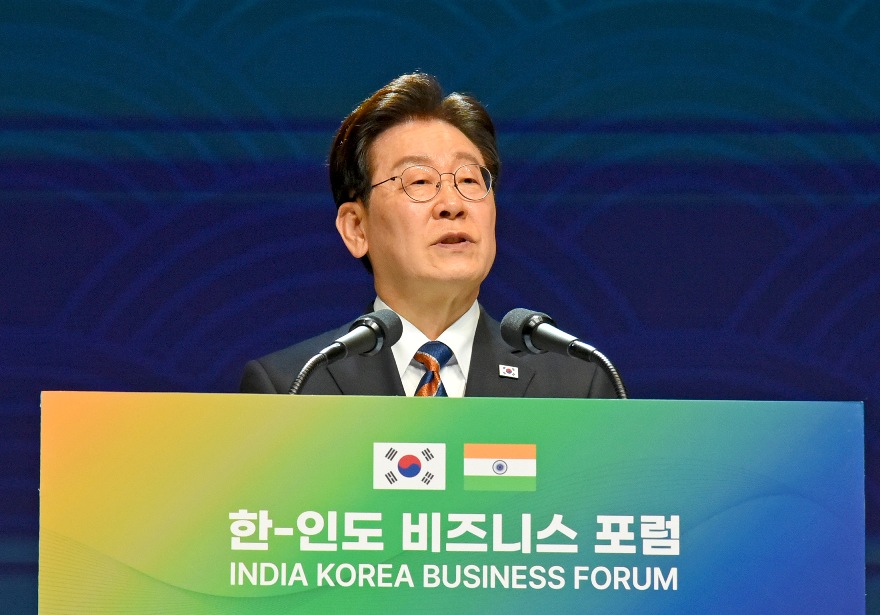
Addressing
the India–Korea Business Forum in New Delhi, the Korean President highlighted
the vast untapped potential in bilateral trade and investment, expressing
optimism that ongoing negotiations to upgrade the Comprehensive Economic
Partnership Agreement (CEPA) could significantly accelerate economic engagement
and potentially double trade volumes.
 Emphasising
future-ready collaboration, Lee called for stronger partnerships in high-tech
industries, particularly leveraging India’s capabilities in artificial
intelligence. He also pointed to enhanced cooperation in the shipping sector
and stressed the importance of building deeper people-to-people trust alongside
economic ties.
Emphasising
future-ready collaboration, Lee called for stronger partnerships in high-tech
industries, particularly leveraging India’s capabilities in artificial
intelligence. He also pointed to enhanced cooperation in the shipping sector
and stressed the importance of building deeper people-to-people trust alongside
economic ties.
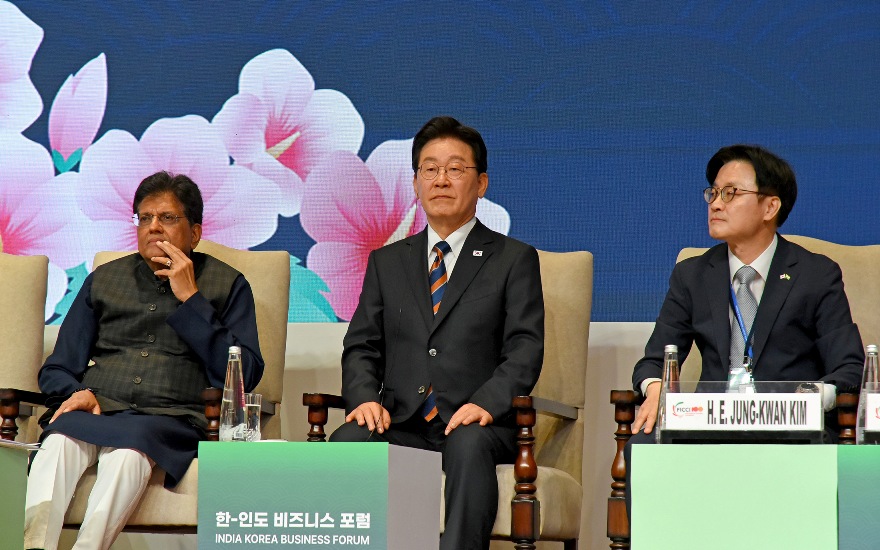
Union
Commerce and Industry Minister Piyush Goyal termed the signing of a Memorandum
of Understanding on the India–Korea Industrial Cooperation Committee as a
landmark development. The MoU establishes four focused working groups spanning
trade, industry, strategic resources, and clean energy. In total, 16 MoUs were
signed at the forum, signalling a major push to bilateral cooperation.
Goyal
revealed that Prime Minister Narendra Modi and President Lee have discussed the
creation of a dedicated Korean industrial township in India. Envisioned as a
plug-and-play enclave, the project aims to attract greater Korean investments
while enabling companies to tap into India’s vast domestic market and its
preferential access to nearly two-thirds of global GDP through multiple free
trade agreements.
Setting
an ambitious target, Goyal said both nations are working to double bilateral
trade from USD 27 billion to USD 54 billion by 2030, requiring an annual growth
rate of around 18%. He noted that this goal represents only a fraction of the
partnership’s true potential and called for accelerated efforts to unlock new
growth avenues.
 The
Minister underscored a fast-track, mission-mode approach to upgrading CEPA,
focusing on reducing non-tariff barriers, easing rules of origin, expanding
market access, and improving ease of doing business to ensure a more balanced
economic relationship.
The
Minister underscored a fast-track, mission-mode approach to upgrading CEPA,
focusing on reducing non-tariff barriers, easing rules of origin, expanding
market access, and improving ease of doing business to ensure a more balanced
economic relationship.
Highlighting
sectoral synergies, Goyal pointed to strong complementarities in
semiconductors, electronics, advanced manufacturing, e-mobility, green energy,
shipbuilding, and digital trade. He stressed that collaboration through
co-production, co-design, and co-innovation can enable both countries to
jointly serve global markets with competitive, high-quality products.
Projecting
India’s economic trajectory, Goyal said the country, currently a USD 4 trillion
economy, is on course to reach USD 30 trillion by 2047. He described this
transformation as a historic opportunity driven by a young workforce, a rapidly
expanding middle class, and sustained policy reforms.
Despite
global economic uncertainties, he said India remains an “oasis of stability,”
backed by strong governance, infrastructure expansion, and business-friendly
reforms.
Reaffirming
the deep-rooted ties between the two nations, Goyal noted that India and Korea
share over two millennia of civilizational links built on trust and shared
democratic values. He also acknowledged the significant contributions of Korean
companies to India’s growth story.
Anant Goenka, President of FICCI, highlighted the strategic alignment between India’s scale and Korea’s innovation strengths. He said both countries are well-positioned to build a resilient and future-ready economic corridor, especially amid shifting global supply chains.
As global trade patterns evolve, Goenka noted that India and Korea have a unique opportunity to develop a diversified, innovation-driven partnership that is less vulnerable to external shocks and geared towards long-term growth.