THEBUSINESSBYTES
BUREAU
MUMBAI,
SEPTEMBER 4, 2026
The
India-European Union Free Trade Agreement (FTA) will open up huge opportunities
for farmers, fishermen, MSMEs, manufacturers, innovators, startups, women
entrepreneurs and service providers across India and Europe, Commerce and
Industry Minister Piyush Goyal said on Friday.
Addressing
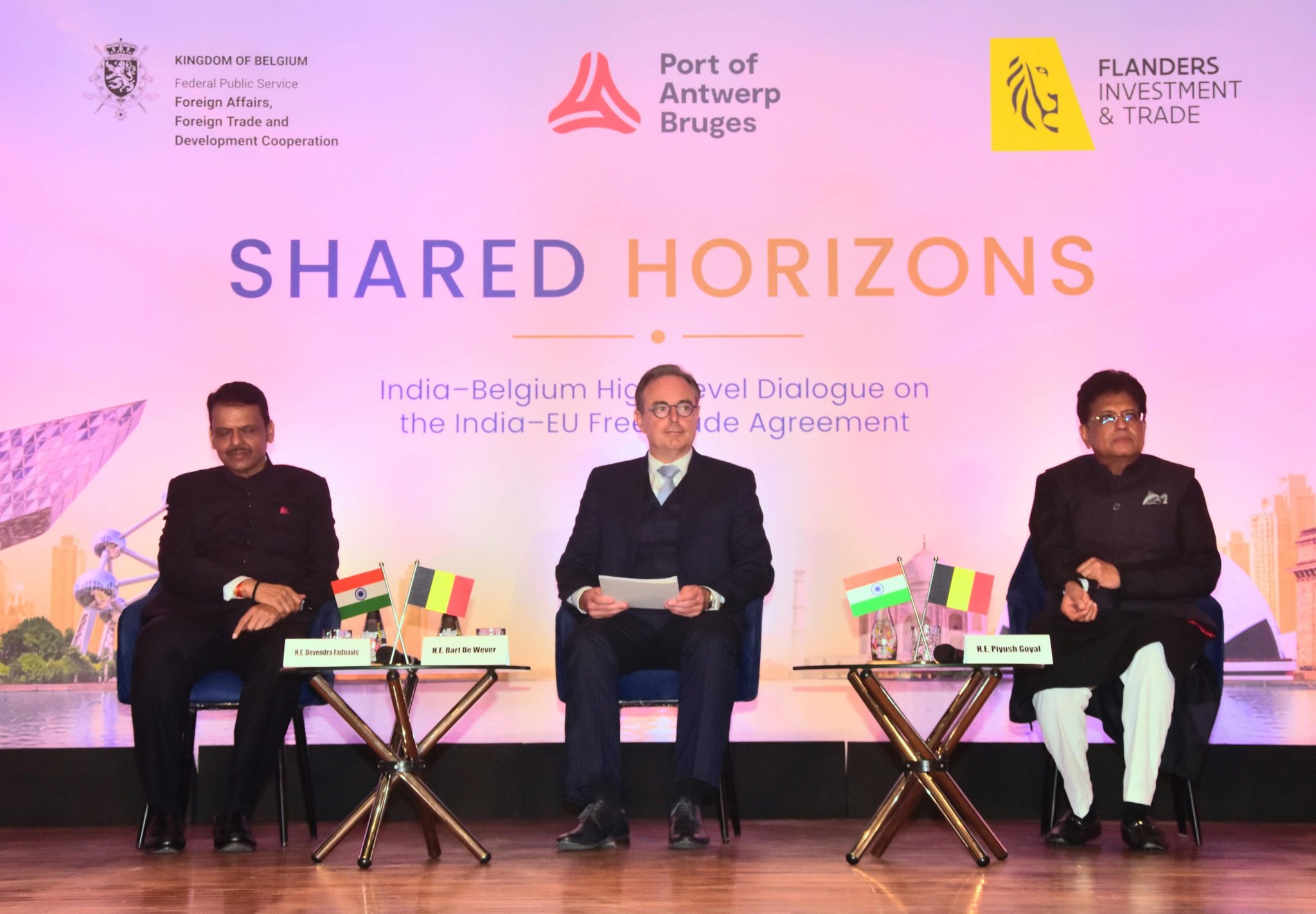
the India-Belgium High-Level Dialogue on the India-EU FTA in Mumbai in the
presence of Belgian Prime Minister Bart De Wever and Maharashtra Chief Minister
Devendra Fadnavis, Goyal said the agreement had been deftly negotiated while
protecting sensitive sectors on both sides.
The
minister said the FTA, which had been in the making for 25 years before
negotiations were concluded under the leadership of Prime Minister Narendra
Modi, would bring together a market of USD 24 trillion, representing nearly two
billion people, a quarter of global GDP and a third of world trade.
“All 27 EU countries are on board, supportive
and desirous of concluding the formalities and bringing the agreement into
force at the earliest,” Goyal said, adding that such unanimous support was rare
in the European context. He said every section in India had also supported the
agreement wholeheartedly.
De
Wever said the India-EU FTA would strengthen trade and open doors for
companies, young talent and investment while making the two economies more
resilient to disruptions.
Highlighting
the Port of Antwerp-Bruges as a critical logistical link between India and
Europe, he said the agreement would create opportunities in sectors including
diamonds, food processing, pharmaceuticals, maritime services, green hydrogen
and infrastructure.
Tariffs
on more than 95 per cent of Indian and European goods exports would be scrapped
or reduced, De Wever said.
Goyal
said India and Belgium had significant scope to deepen economic cooperation,
with their economies complementing each other across several major areas.
He
said the two countries could explore co-creation and design in gems and
jewellery, including lab-grown diamonds, and called for greater cooperation in
technology and certification for mutual recognition, centred around the diamond
hubs of Antwerp, Mumbai and Surat.
Belgium's
world-class micro-electronics research could be combined with India's scale,
skills and talent to create a design-to-fabrication ecosystem in
semiconductors, Goyal said.
He
also proposed deeper cooperation in green hydrogen, saying India's Green
Hydrogen Mission could help power Europe through Antwerp-Bruges' bunkering and
green shipping infrastructure.
Referring
to the exchange of Memoranda of Understanding with John Cockerill, Goyal said
there was significant potential for cooperation in defence and advanced
manufacturing, including counter-drone systems, electronic warfare and
precision munitions.
He
also referred to the potential for Western export corridors for India-designed
BrahMos and Pinaka missiles, saying industrial alignment between India and
Belgium had never run deeper.
Given
increased defence spending in Europe and India's own security environment,
there was “tremendous potential” for the two countries to work together, he
said.
Goyal
also highlighted opportunities in agriculture and food processing, ranging from
potato processing and cold chains to sustainable agri-value chains.
“Technology and sustainable agri-value chains
can serve the entire world through Belgium and India,” he said.
The
minister described Belgium as the gateway to the opportunities created by the
India-EU FTA, noting that the Port of Antwerp-Bruges is Europe's second-largest
seaport.
He
said the port could serve as the doorway through which the FTA's promise would
physically arrive in Europe or be dispatched to India, with its combination of
inland barge, rail and road networks, deepwater facilities, roll-on/roll-off
capabilities and automotive strengths offering Indian exporters an important
route into European industrial and consumer markets.
India's
trade with the EU has already doubled over the last decade to nearly USD 140
billion, Goyal said, adding that India and Belgium faced a choice amid rising
protectionism, disrupted supply chains, problems in food and fuel delivery,
geopolitical conflicts and heightened volatility.
“We choose to build, we choose to connect, we
choose to work together,” Goyal said, quoting Belgian Nobel laureate Ilya
Prigogine's idea of “order emerging out of chaos”.
He
said India's economic and technological transformation had only just begun,
noting that the country's economy was around USD 4 trillion on a purchasing
power parity basis and that India was already the world's third-largest economy
with a GDP of about USD 20 trillion on a PPP basis.
The
collective goal of 1.4 billion Indians was to take the economy to USD 30
trillion by 2047, when India celebrates 100 years of independence, he said.
Goyal
said the roadmap covered social upliftment, infrastructure creation,
manufacturing at scale and creating a destination where global companies could
design, co-design, co-create and co-manufacture.
“India and its partners can collectively work
not only for Europe and India, but for the world as our market,” he said.
Highlighting
India's push to become a global semiconductor hub, Goyal said the first edition
of Semicon India had been fully subscribed by investors from around the world, while
Semicon India 2.0 had recently been launched with an outlay of USD 14 billion.
The
combined programme, he said, could catalyse nearly USD 70 billion of
investments in India's semiconductor sector.
Goyal
said India's Artificial Intelligence Mission was already operational and
supporting startups, while the country was also pursuing initiatives under its
Critical Minerals Mission.
He
said India's nuclear energy programme had been opened to the private sector
after 60 years through the Shanti Act, with a plan to build 100 GW of nuclear
power capacity over the next 20 years as baseload capacity to replace fossil
fuels.
India's
space technology sector, currently valued at about USD 8.5 billion, is expected
to grow to USD 44 billion over the next eight years, driven largely by private
initiatives, startups, innovators and designers, Goyal said.
He
said India had become only the third country in the world where a private
company had launched a rocket into space and the first country where a private
initiative had succeeded on its first attempt.
Goyal
also highlighted India's recently launched USD 12 billion research and
development fund for innovation.
While
the amount may appear modest from a European perspective, India's purchasing
power parity advantage, combined with private-sector investment and academic
capabilities, could deliver innovation equivalent to about USD 150 billion
compared with what could be achieved in Europe, and at a fraction of the cost,
he said.
The
minister invited Belgium and the European Union to partner with India, saying
Belgian technology, innovation and capital could find a “nest” in India,
supported by the country's scale, talent, youthful energy, young population and
decisive leadership.
He
described Maharashtra as an inviting destination for business, calling it
India's financial and commercial capital, industrial capital and
fastest-growing economy.
Goyal
invited De Wever and Belgian companies to engage with India with an open mind
and open heart, backed by the facilities required by modern industry.
People
would remain at the centre of the expanding partnership, he said, calling for
stronger workforce mobility, mutual recognition of qualifications, joint skills
development and dual-degree education programmes, particularly in sectors where
Belgium faces shortages of talent and young workers.
Goyal
said India and Belgium shared a warm and enduring relationship dating back to
1947, when India gained independence, and noted that Belgium was among the
first European countries to establish diplomatic relations with independent
India.
Thanking
De Wever for his leadership and support in strengthening Belgium-India and
EU-India relations, Goyal said the journey that had begun 25 years ago had now
reached a significant milestone.
Recalling
his recent visit to Belgium, Goyal said the real energy he experienced was
among Belgian enterprises.
“Belgium and India, together, can create an
absolutely unbeatable competition” by combining Belgian technology, innovation
and capital with India's scale, talent, youthful energy and decisive
leadership, he said.
Drawing
an analogy with the formation of a diamond, Goyal said diamonds were formed
under tremendous pressure deep beneath the earth, while lab-grown diamonds
emerged through relentless processes involving carbon deposits.
“In a world under pressure and turmoil, India and Belgium can form something equally enduring, beautiful and precious as a diamond,” he said.
“Let India and Belgium form something just as enduring, just as beautiful and precious as a diamond. A diamond not only for Belgium and India, a diamond not only for Europe, a diamond for the world,” Goyal said.