THEBUSINESSBYTES
BUREAU
NEW
DELHI, OCTOBER 27, 2026
Prime Minister
Narendra Modi on Tuesday called upon India’s scientists, researchers, startups
and industry leaders to innovate boldly and take the lead in developing
emerging technologies, asserting that the country must move beyond adopting
foreign innovations to creating solutions that address global challenges.
Inaugurating the
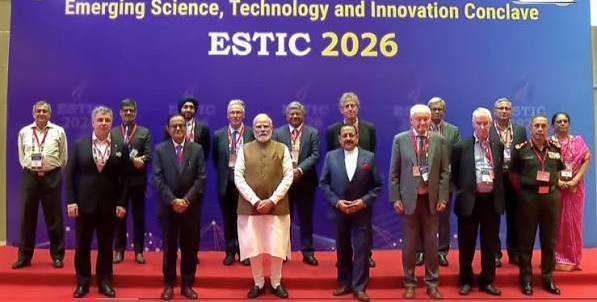
Emerging Science, Technology and Innovation Conclave 2026 at Bharat Mandapam
here, Modi said India’s growing scientific capabilities, expanding research
ecosystem and entrepreneurial spirit among young people offered an opportunity
to shape the technologies of the future.
“The scale at which the youth of India are
thinking and the self-confidence with which they are moving forward is
encouraging,” he said, recalling his interaction with startup founders earlier
in the day.
The prime minister
contrasted India’s earlier approach of catching up with technological
advancements developed elsewhere with the aspirations of a country seeking to
create original technologies, set global benchmarks and solve problems
confronting humanity.
Citing India’s indigenous
COVID-19 vaccines, its maiden Mars mission and the landing near the lunar south
pole, he said the country had demonstrated its ability to undertake complex
scientific missions and deliver technological breakthroughs.
“India must embrace
the technologies of the future, innovate boldly, and lead the world in creating
them,” Modi said.
Highlighting
developments across critical sectors, he referred to progress in nuclear
energy, space exploration, artificial intelligence (AI), semiconductors and
battery storage, describing the breadth of India’s achievements as
unprecedented.
On nuclear energy,
Modi stressed the need to build substantial domestic capacity to support the
goal of a developed India, while reducing vulnerabilities arising from
dependence on imported nuclear fuel.
He highlighted the
achievement of first criticality by the indigenous 500-megawatt Prototype Fast
Breeder Reactor, describing it as an important step towards strengthening
India’s long-term nuclear energy capabilities.
In the space sector,
he cited the achievement of an Indian startup that placed a satellite in orbit
on its maiden attempt using a domestically developed rocket, as well as the
country’s progress in satellite docking technology. He said startups and young
scientists were increasingly contributing to new space-related solutions.
The prime minister
also referred to India hosting the AI Impact Summit, launching its own AI model
and beginning to ship domestically manufactured semiconductor chips to global
markets. He said the country was working to develop battery storage capacity
using raw materials available within India.
Emphasising the
importance of developing technologies that can benefit people on a large scale,
Modi cited the Digital Public Infrastructure ecosystem and indigenous 5G
technology as examples of India's efforts to build secure, population-scale
solutions.
He said scientific
progress should not be confined to laboratories or judged solely by
technological achievements, but should improve everyday life and help address
challenges in healthcare, agriculture, education, employment and disaster
management.
“The real success of Science occurs when it
steps out of the lab and makes the life of the common citizen better,” he said.
Referring to his recent
visit to IIT Madras, Modi highlighted a modern Brain Centre developing
high-resolution, three-dimensional digital imaging of the human brain to
advance research into neurological disorders. He said the principles of
“Science for Society” and “Technology for Transformation” should guide the
country’s scientific endeavours.
Underscoring the role
of research and development in technological self-reliance, the prime minister
referred to the Anusandhan National Research Foundation and the government’s earlier
commitment of Rs 1 lakh crore towards research, development and innovation.
He said the
government had committed Rs 12,000 crore over the past year for technologies
emerging from laboratories and approaching market readiness, with private
investors matching the amount, taking the combined commitment to Rs 24,000
crore.
Modi also highlighted
the growth in patent filings, saying annual filings had increased from fewer
than 50,000 a decade ago to nearly 1.5 lakh last year. He said the rise
reflected a growing culture of research and innovation in the country.
Addressing the
growing role of artificial intelligence in scientific research, he cautioned
that the technology should strengthen, rather than restrict, independent
thinking and scientific judgement.
While AI could
accelerate routine tasks and improve productivity, scientists must devote the
time saved to more complex problems, experiments and validation of new ideas,
he said.
“AI can give us answers quickly, but the
responsibility of testing the veracity of the answer must lie with the
scientist alone,” Modi said.
He called for
sustained efforts through national missions in semiconductors, quantum
technologies, biotechnology, advanced materials, robotics, space, clean energy
and next-generation communications. He also stressed the need to prioritise
safety and security in AI, synthetic biology and autonomous systems, including
developing AI-based and quantum security solutions to counter emerging cyber
threats.
Calling upon
researchers, industry leaders, startup founders and students to set clear
three-year targets, Modi urged them to identify the technologies, prototypes,
pilot projects or products they would help develop.
He said the conclave should move beyond discussions and generate measurable outcomes that contribute to building a developed India and establishing the country as a global hub for technological solutions.
Concluding his address, the prime minister said India, as a young nation with substantial talent and ambition, must prepare a generation that leads emerging science and technology rather than merely participates in it.