Partners’
Handbook released at UMI–NUC 2026; initiative focuses on municipal capacity,
digital transformation, livelihoods and sustainable urban development
THEBUSINESSBYTES
BUREAU
BHUBANESWAR,
OCTOBER 27, 2026
As Odisha looks to
build future-ready cities, the State government is strengthening collaboration
between public institutions, knowledge partners and technical experts to make
urban governance more efficient, inclusive and responsive to citizens’ needs.
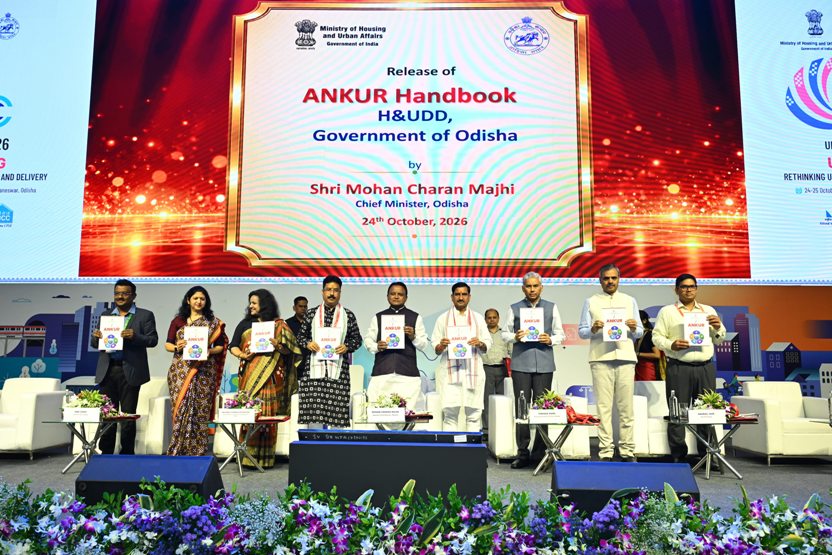
The release of the ANKUR (Atal Network for Knowledge, Urbanisation and Reform)
Partners’ Handbook during the Urban Mobility India Conference and the National
Urban Conclave 2026 in Bhubaneswar marks an important step in showcasing the
State’s collaborative framework for urban transformation. The initiative brings
together 11 strategic partner organisations to strengthen municipal
institutions, promote innovation and develop practical solutions to the
emerging challenges of urbanisation.
ANKUR, conceptualised
by Usha Padhee, Additional Chief Secretary, Housing and Urban Development
Department, Government of Odisha, was formally launched by the State government
on May 28, 2025. Aligned with the visions of Viksit Odisha @2036 and Viksit
Bharat @2047, the initiative seeks to bridge the gap between government
priorities and the specialised knowledge, research, innovation and
implementation support required to translate policy objectives into measurable
outcomes. Inspired by the ideals of former Prime Minister and Bharat Ratna Atal
Bihari Vajpayee, ANKUR rests on four key pillars: capacity building, knowledge
and research, implementation support, and innovation.
The initiative brings
together government institutions, academic organisations, technical experts,
civil society groups and private-sector partners to develop context-specific
responses to the evolving demands of urban development. Its 11 strategic
partners bring expertise in urban governance, municipal finance, digital
services, livelihoods, environmental sustainability and urban planning. They
are Tata Steel Foundation, Janaagraha Centre for Citizenship and Democracy,
Urban Management Centre, eGov Foundation, Lighthouse Communities Foundation,
UN-Habitat, Prosperiti, Air Pollution Action Group, Airawat Research Foundation,
Socratus Foundation and WRI India.
Strengthening municipal
governance and institutional capacity
Through this network,
ANKUR is supporting a range of urban development interventions across Odisha,
covering municipal finance and property tax reforms, digital governance through
the SUJOG platform, youth skilling and livelihood promotion, sanitation worker
welfare, improvements to urban planning regulations, air pollution mitigation
and sustainable construction practices.
The initiative aims
to strengthen the institutional capacity of Urban Local Bodies (ULBs) to plan
effectively, manage financial and human resources, improve public service
delivery and respond to local challenges. By combining technical expertise with
hands-on implementation support, ANKUR seeks to translate policy priorities
into practical interventions while encouraging cities to adopt solutions suited
to their specific requirements.
In the area of urban
planning and regulatory reform, technical support from Prosperiti has
contributed to changes in the Odisha Development Authorities Rules. The changes
include rationalisation of building standards, reduction of industrial land
footprint requirements and the introduction of a more flexible negative-list
zoning framework. These measures are intended to improve the regulatory
environment and provide greater flexibility in urban development planning.
Promoting livelihoods and social
inclusion
Expanding livelihood
opportunities and strengthening social inclusion form an integral part of
ANKUR’s approach to urban transformation. Lighthouse Centres have enrolled
9,703 young people in foundation courses, of whom 4,646 have secured
employment. The interventions seek to improve access to skills, employment
opportunities and economic participation, enabling urban youth to better access
emerging livelihood prospects.
Convergence with the
GARIMA scheme is also opening avenues for skill development and livelihood
support for core sanitation workers and their families. By linking urban
development initiatives with social protection and economic empowerment, ANKUR
seeks to ensure that the benefits of urban growth extend to communities that
often face barriers to accessing opportunities and essential public services.
The emphasis on
inclusion recognises that the success of urban reforms depends not only on
improvements in infrastructure and administration but also on the ability of
cities to create opportunities for vulnerable groups and strengthen the social
foundations of urban development.
Digital transformation for better
public services
Digital
transformation is central to ANKUR’s strategy to improve municipal
administration, strengthen institutional coordination and make citizen services
more accessible. The SUJOG platform is being developed as a unified digital
backbone for urban service delivery, supporting more efficient municipal
processes, streamlined administration and improved coordination across urban
local bodies.
Interventions under
the initiative have helped reduce municipal employees’ reporting time by an
average of 48%, while supporting greater transparency and efficiency in service
delivery, including in faecal sludge and septage management. The next phase
will focus on expanding the platform’s coverage, improving data integrity and
strengthening system reliability to ensure more consistent delivery of
municipal services.
Community outreach
initiatives, SAHAJOG and SAHAJOG Plus, are helping urban households access
government welfare schemes and essential services. Together, the initiatives
have reached 6.60 lakh households, facilitated more than 3.25 lakh applications
for welfare schemes and helped unlock nearly ₹10,000 crore in public welfare benefits.
Beyond facilitating
access to welfare programmes, these initiatives support participatory planning
in informal settlements by enabling residents’ needs and local priorities to
inform urban development decisions. The approach underscores the importance of
citizen engagement in building responsive urban institutions and ensuring that
public services address the needs of the communities they are intended to
serve.
Innovation and circular economy
solutions
ANKUR is fostering an
urban innovation ecosystem in which new ideas and practical solutions can be
tested, demonstrated and scaled to address emerging challenges. Its circular
economy interventions explore the conversion of low-value plastics, industrial
silica and foundry waste into composite bricks and structural panels, offering
potential pathways for waste reduction and resource recovery.
With a targeted
plastic recovery capacity of 50 tonnes a day, these efforts aim to divert waste
from disposal, promote the productive reuse of materials and encourage more
sustainable construction practices. Improved construction and demolition
(C&D) waste management, alongside the reuse of recovered materials, is
another important area of intervention, supporting a more resource-efficient
approach to urban development.
The initiative’s
approach allows potential solutions to be assessed under real-world conditions,
refined in the light of implementation experience and adapted for replication
across ULBs wherever appropriate. By connecting local urban challenges with
technical knowledge and innovative practices, ANKUR seeks to create an enabling
environment for solutions that are practical, scalable and responsive to the
changing needs of cities.
Supporting cleaner and healthier
urban environments
Under the Dispersed
Sources Programme, ANKUR partners are working with urban authorities to
identify and address local sources of air pollution, including open garbage
dumping, unpaved roads and construction debris. The approach enables cities to
identify specific pollution sources, prioritise local interventions and develop
targeted measures to improve urban air quality.
The programme
reflects ANKUR’s emphasis on evidence-based action, locally relevant solutions
and collaboration among institutions with complementary expertise. It also
creates opportunities for urban authorities to draw lessons from interventions
implemented in different locations and adapt effective approaches to their own
local conditions. By focusing on dispersed sources of pollution, the initiative
seeks to complement broader efforts to create cleaner and healthier urban
environments.
2026–27: Scaling up reforms and
strengthening systems
The reform agenda for
2026–27 focuses on expanding successful interventions and embedding them within
the institutional systems of urban governance. Key priorities include
increasing SUJOG’s coverage from 115 to 140 Urban Local Bodies, strengthening
data integrity and system reliability, improving property tax mapping and
municipal revenue intelligence, and promoting greater use of data-driven and
artificial intelligence-enabled administrative processes.
The agenda also
places emphasis on simplifying citizen service journeys, improving coordination
across departments and making public services more transparent, accessible and
responsive. Continued capacity building, knowledge sharing and implementation
support are expected to help ULBs strengthen administrative systems, improve
operational efficiency and sustain the gains from ongoing reforms.
Expanding the reach
of digital platforms while improving the quality of municipal data will be
important to ensuring that reforms translate into better planning, more
effective resource mobilisation and improved service delivery. The focus on
strengthening systems is intended to help urban local bodies move beyond
individual interventions towards more durable and institutionally embedded
improvements in governance.
Building future-ready cities
through collaboration
ANKUR represents an
effort to institutionalise collaboration between government and specialised
partner organisations to address the increasingly complex demands of
urbanisation. It provides a platform through which challenges identified by
cities can be matched with relevant expertise, developed into workable
solutions, tested on the ground and scaled up for wider public benefit.
The release of the
Partners’ Handbook during UMI–NUC 2026 offers an opportunity to showcase the
initiative’s framework, document its areas of intervention and strengthen knowledge
exchange among urban stakeholders. By bringing together government leadership,
institutional expertise and practical innovation, ANKUR aims to build stronger
municipal institutions and improve the quality, accessibility and
responsiveness of urban services.
Its collaborative approach seeks to make specialised knowledge more accessible to urban local bodies, enabling them to draw on the experience of partner organisations while developing solutions that respond to local priorities. The emphasis on implementation, learning and institutional capacity is intended to ensure that promising interventions can move beyond isolated projects and contribute to sustained improvements in urban governance.
Through its focus on knowledge-led reforms, capacity building, social inclusion, digital transformation and sustainable innovation, ANKUR is contributing to Odisha’s broader vision of cleaner, safer, more resilient and citizen-centric cities. By strengthening partnerships and promoting an outcome-oriented approach to urban development, the initiative also provides a framework for sharing lessons, adapting successful interventions and advancing municipal governance reforms in the years ahead.