THEBUSINESSBYTES BUREAU
NEW DELHI, FEBRUARY 13, 2026
India has set an ambitious target of building a $300 billion bioeconomy
by 2030, with the government unveiling a major scale-up push for high-impact
biotechnology under the ₹1 lakh crore Research, Development and Innovation
(RDI) initiative, Union Minister Dr. Jitendra Singh announced on Friday.
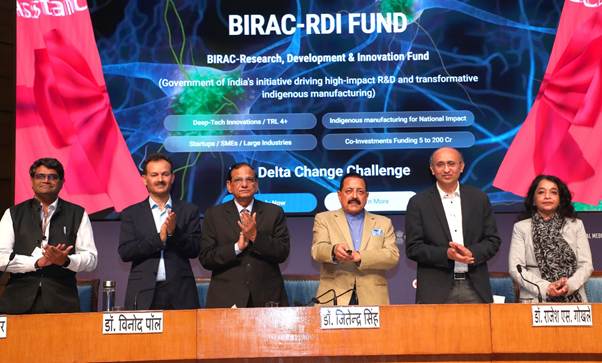
Launching the first national call for the BIRAC–RDI Fund, the Minister
said the move reflects a decisive shift in India’s science-led growth strategy
and positions the country as an early mover in emerging technologies rather
than a late entrant. He described biotechnology as the engine of the next
industrial transformation, comparable to the role information technology played
in reshaping India’s economy over the past three decades.
The launch event was attended by senior policymakers and scientific
leaders including NITI Aayog member Dr. Vinod Paul, Department of Biotechnology
Secretary Dr. Rajesh S. Gokhale, and BIRAC Managing Director Dr. Jitendra
Kumar, along with representatives from industry, venture capital and research
institutions.
 Dr. Jitendra Singh highlighted the rapid expansion of India’s biotech
startup ecosystem, which has grown from around 50 firms in 2014 to more than
11,000 today. He said the bioeconomy has expanded dramatically during this
period, transforming India into one of the leading global players and
demonstrating a shift from policy hesitation to policy acceleration. According
to him, the current initiative strengthens the country’s capacity not only to
generate scientific ideas but also to industrialise them at scale.
Dr. Jitendra Singh highlighted the rapid expansion of India’s biotech
startup ecosystem, which has grown from around 50 firms in 2014 to more than
11,000 today. He said the bioeconomy has expanded dramatically during this
period, transforming India into one of the leading global players and
demonstrating a shift from policy hesitation to policy acceleration. According
to him, the current initiative strengthens the country’s capacity not only to
generate scientific ideas but also to industrialise them at scale.
Pointing to emerging frontiers, the Minister said India has already
entered space biotechnology and is preparing for future domains such as space
medicine. Biotechnology experiments using domestically developed kits are being
conducted in space, covering plant sciences and life sciences research, an
effort he said will enhance India’s scientific stature and geopolitical
relevance.
Dr. Rajesh S. Gokhale said the RDI Fund is designed to support
long-gestation, high-risk research that requires patient capital and advanced
infrastructure. He noted that the initiative complements the BioE3 Policy and
aims to build next-generation products across biopharma, bio-industrial
manufacturing, bioenergy, the blue economy and biocomputation, with a focus on
translating research outputs into scalable industrial outcomes.
Dr. Jitendra Kumar said BIRAC has been designated as a second-level fund
manager under the RDI framework and will deploy ₹2,000 crore over a period of up
to five years, with scope for further expansion. He added that BIRAC has
developed a nationwide innovation ecosystem over the past decade, comprising more than 100 bio-incubation centres, over 10 lakh
square feet of incubation space and engagement with more than 15 lakh startup
entrepreneurs. India’s bioeconomy, he noted, has grown from $28 billion in 2012
to $165.7 billion in 2024 and is projected to reach $1 trillion by 2047.
The BIRAC–RDI Fund forms part of the national RDI initiative approved by
the Union Cabinet in July 2025 and launched in November 2025 under the
Anusandhan National Research Foundation, anchored by the Department of Science
and Technology. The fund is intended to bridge the gap between laboratory
research and industrial-scale manufacturing by supporting technologies from
TRL-4 to TRL-9 through a mix of equity, convertible instruments and long-term
debt.
The national call for applications has opened, with eligible startups,
SMEs and industry partners invited to submit proposals through the official
portal by March 31, 2026. Dr. Jitendra Singh said the initiative sends a clear
signal that India is prepared to lead the global biotechnology revolution by
combining scientific depth, entrepreneurial energy and strong policy support.