
THEBUSINESSBYTES
BUREAU
NEW DELHI, JANUARY 22, 2026
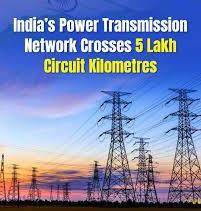
India’s power transmission sector has
reached a landmark moment, with the national transmission network crossing an
unprecedented 5 lakh circuit kilometres, underscoring the country’s rapid
infrastructure expansion and its commitment to a reliable, future-ready energy
ecosystem. Alongside this milestone, transformation capacity at 220 kV and
above has surged to an impressive 1,407 GVA, reinforcing India’s position as
home to the world’s largest synchronous national grid.
The achievement was marked on January
14, 2026, with the commissioning of a 628 circuit kilometre-long 765 kV
transmission line connecting Bhadla II to Sikar II in Rajasthan. This strategic
addition significantly enhances renewable energy evacuation from the Rajasthan
Renewable Energy Zone, enabling the seamless transmission of an additional
1,100 MW of solar power from the Bhadla, Ramgarh and Fatehgarh solar complexes
to the national grid.
Since April 2014, India’s transmission
network has expanded by a remarkable 71.6 per cent, with the addition of over
2.09 lakh circuit kilometres of high-capacity transmission lines and an
increase of 876 GVA in transformation capacity. This rapid scale-up has
strengthened inter-regional power transfer capacity to 1,20,340 MW, making it
possible to move electricity seamlessly across the country and successfully
realize the vision of “One Nation – One Grid – One Frequency.”
The growth momentum is set to
continue, with Inter-State Transmission System projects currently under
implementation expected to add nearly 40,000 circuit kilometres of transmission
lines and 399 GVA of transformation capacity. Complementing these efforts,
Intra-State projects are poised to contribute another 27,500 circuit kilometres
and 134 GVA, further enhancing grid reliability, operational resilience and
power evacuation capability.
This massive capacity build-up is
critical to supporting India’s ambitious clean energy roadmap, particularly the
national target of achieving 500 GW of non-fossil fuel-based power generation
by 2030. The expanding transmission backbone is enabling the efficient
integration of large-scale renewable energy, ensuring that green power
generated in resource-rich regions can reach consumption centres across the
country.